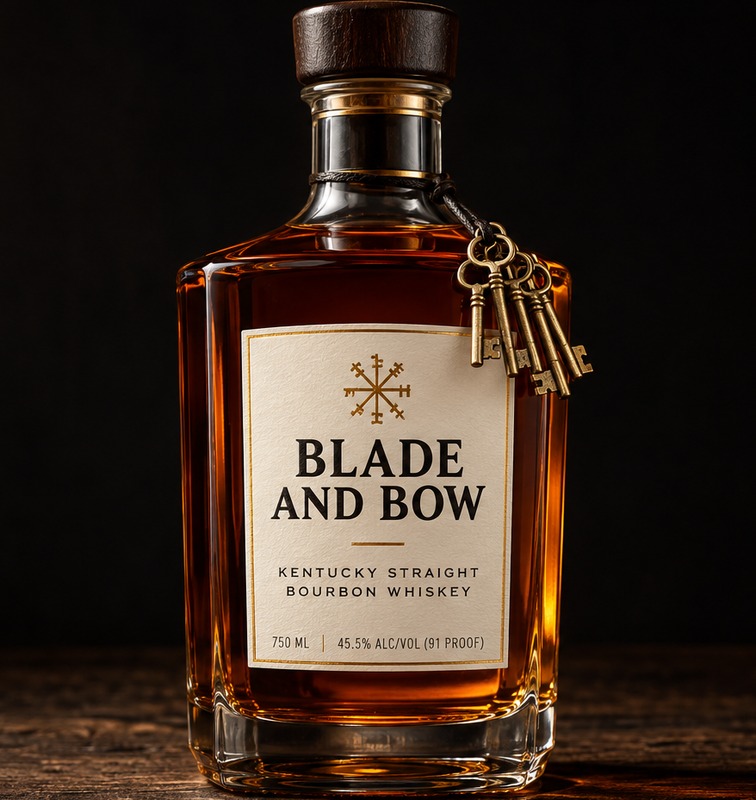
Blade and Bow is the featured bottle in Issue No. 011 — The Ghost in the Bottle, and it is there because it is the hardest case in the issue rather than the best whiskey in it.
Diageo produces and bottles it at the historic Stitzel-Weller site in Louisville, which the company has owned since the distillery passed to its corporate predecessors. The brand’s distinguishing claim is its solera system: a vatting method in which no barrel is ever fully drained, so that — per Diageo — bourbon from the original Stitzel-Weller distillery is incorporated into every bottle.
Take that claim seriously and take it precisely. If it is accurate, some quantity of genuine Stitzel-Weller distillate is in the glass, which no other widely available bourbon can say. But the proportion is not disclosed, it is not independently verifiable, and the arithmetic of a solera is that an original fraction diminishes with every refill without ever quite reaching zero. Stitzel-Weller stopped distilling in 1992; the stock being drawn on has been finite ever since.
The Ledger’s provenance verdict for Blade and Bow is POSSIBLE as to containing some Stitzel-Weller distillate — a far weaker claim than “is Stitzel-Weller whiskey,” and the only one the evidence addresses. See the Prove the Bottle lab for the full reasoning.
None of which tells you whether you’ll enjoy it. At 91 proof with no age statement, this is a soft, approachable, lightly sweet modern bourbon that most drinkers rate as solid rather than remarkable — and it carries a price built partly on a story. That gap between the story and the liquid is the entire subject of Issue No. 011.
On the score: Audience Score Pending. This is the first bottle the Ledger has tried to score by its new Expected Audience Score method, which builds a number from aggregated public drinker reviews rather than one palate. On this bottle, the method did not produce a number we are willing to publish.
Three independent community sources exist, and once normalised to a ten-point scale they disagree by more than a full point — not because drinkers disagree, but because the scales behave differently. A collector database with eighteen ratings, an enthusiast app with a few thousand, and a retailer’s own review widget are not measuring the same thing, and averaging them would manufacture a precision none of them supports. The retailer figure in particular carries obvious selection bias: people who disliked a bottle rarely go back to the shop’s product page to say so.
Rather than publish a number built on that, we are holding it. The underlying research is recorded in docs/issue-011-audience-score-research.md, including each source’s score, scale, sample size and the preliminary figure it produced. It will be published when the evidence supports one.
Full nose, palate and finish notes have not been written up separately.