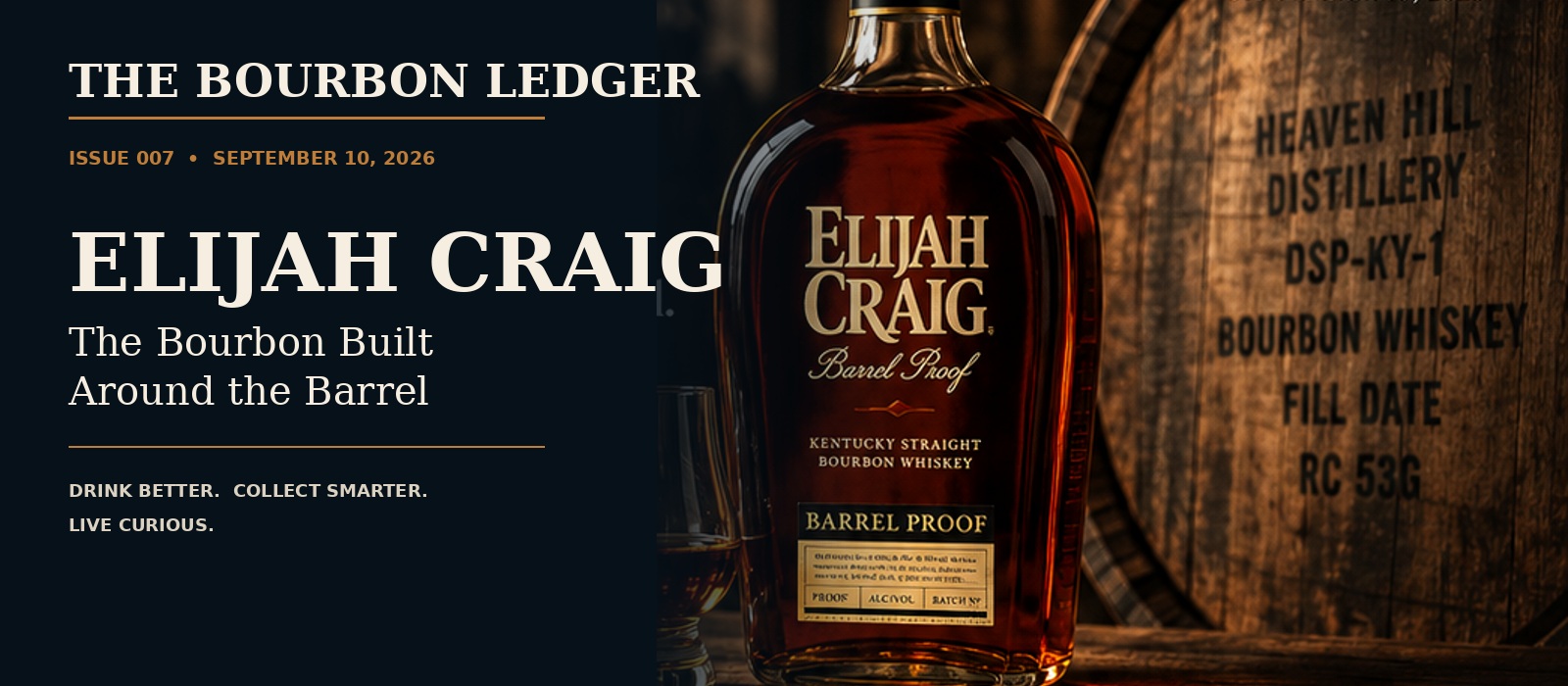
This is why Elijah Craig is the right bottle family to study before Saturday’s Barrel & Char Master Class. Small Batch establishes the baseline. Toasted Barrel changes the wood treatment. Barrel Proof removes dilution. Fifteen, eighteen and twenty-one years show what happens when time becomes the dominant variable.
The barrel is not where whiskey waits. It is where whiskey changes.
The Story
The famous barrel story is great. The evidence is not.
The brand’s version begins in 1789. Reverend Elijah Craig, a Baptist minister and Kentucky distiller, is said to have been the first to age whiskey in new charred oak barrels. One telling blames an accidental fire. Another says Craig reused barrels that had held sugar and discovered that burning the interiors improved the whiskey.
It’s exactly the kind of origin story bourbon loves: one man, one accident, one breakthrough.
But whiskey historians have a problem with it: there is no contemporary documentation proving Craig invented barrel charring or bourbon. The often-cited 1874 History of Kentucky places the first bourbon whiskey at a Georgetown fulling mill in 1789 and separately identifies Craig with a fulling mill there—but does not document him inventing charred-barrel maturation. Historian Michael Veach has noted that Craig never made the claim himself. Whisky Advocate’s history investigation is worth the read →
The Other History That Matters
Elijah Craig the brand is a modern bourbon milestone.
1986 — Elijah Craig Bourbon launches. Heaven Hill introduced the whiskey as an extra-aged premium bourbon named for the Reverend. The company identifies it as the first “Small Batch” bourbon available to consumers.
Parker Beam + Max Shapira era. Heaven Hill credits Parker Beam with overseeing early premium releases including Elijah Craig Small Batch, while Max Shapira spearheaded development of the expression.
2013 — Barrel Proof arrives. The brand turns its mature bourbon into a recurring experiment: uncut, non-chill-filtered, batch-coded whiskey whose proof and age can change from release to release.
2016 — Small Batch loses its 12-year age statement. Rising bourbon demand forced a decision: protect availability or protect the number on the label. Heaven Hill chose the former, and today’s Small Batch remains a 94-proof NAS bourbon.
2020 — Toasted Barrel launches. The brand begins using a second custom-treated barrel to show that “more wood” and “different heat treatment” are distinct variables.
Heaven Hill’s own 90-year timeline →
The Baseline
Small Batch starts with Level 3 char.
Today’s Elijah Craig Small Batch is bottled at 94 proof and matured in new oak barrels with a Level 3 char. Elijah Craig says its barrels are fired for roughly 40 seconds; Heaven Hill’s deeper barrel page describes the house Level 3 treatment as about 45 seconds. The precise seconds matter less than the intensity: this is fast, violent heat creating a blackened surface and a thermally transformed layer beneath it.
- 94 proof — The baseline bottling strength.
- Level 3 char — The common Elijah Craig bourbon barrel treatment.
- New oak — Not simply tradition—part of bourbon’s legal identity.
The char itself is not the only flavor source. Heat changes hemicellulose, lignin and cellulose in the wood, creating and exposing compounds that can become caramel-like, vanilla-like, smoky, spicy and aromatic in mature whiskey. A peer-reviewed study of bourbon barrel staves found continuing loss and extraction of wood sugars during aging as spirit moved into and out of the charred oak. Read the barrel-chemistry study →
The Wood Experiment
Toasted Barrel proves toast and char are not synonyms.
Elijah Craig Toasted Barrel starts as fully matured Small Batch and moves into a second custom barrel. Heaven Hill describes that finishing barrel as toasted and flash-charred. The wood is air-dried for 18 months, then exposed to a lower-intensity heat treatment over a longer period than conventional charring.
Heaven Hill and Independent Stave Company developed the profile through trials. According to Heaven Hill, early versions heated too quickly and produced smoky notes that overwhelmed the fruit and spice of the base bourbon. Their eventual solution used medium-low heat followed by a controlled increase in time and temperature. This is one of the best producer explanations of toasted-barrel development →
Char is fast heat. Toast is controlled heat. Both transform oak—but they don’t transform it the same way.
Bottle of the Week
Elijah Craig Barrel Proof
Uncut • Non-chill-filtered • Batch-specific proof • Batch-specific age
We’re featuring the line, not pretending one batch represents all of it. Barrel Proof is useful precisely because it refuses consistency in two variables that normal shelf bourbon tries to hide: proof and age.
The batch code tells you what you are buying. The first letter marks release order for that year; the first number identifies the release month; the final two digits identify the year. A batch like C925 is the third release of 2025, released in September.
| Recent Bourbon Batch | Proof | Age | What it teaches |
|---|---|---|---|
| A125 | 118.2 | 10 yr 7 mo | Lower proof does not automatically mean less intensity. |
| B525 | 126.2 | 11 yr 6 mo | Age and proof can rise together. |
| C925 | 129.0 | 9 yr 1 mo | Younger whiskey can leave the barrel at a higher proof. |
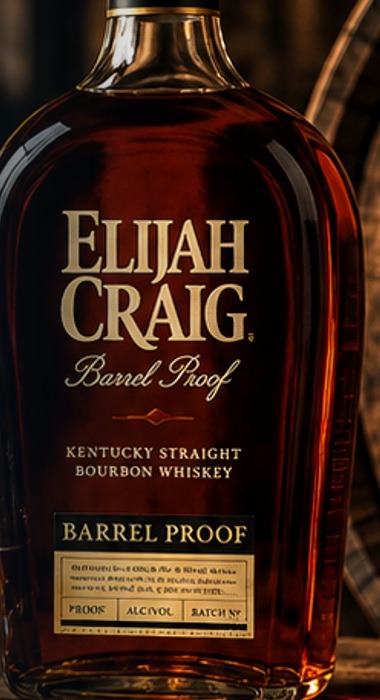
Barrel Proof — uncut, non-chill-filtered, batch-specific proof and age · Cask Strength
Elijah Craig Barrel Proof
Issue No. 007's Bottle of the Week — uncut, non-chill-filtered Elijah Craig with batch-specific proof and age, priced closer to rational than most cask-strength bourbon.
Before mid-2023, Barrel Proof carried a fixed 12-year age statement. Now every batch carries its own age. That’s not merely packaging. It gives drinkers a recurring real-world lab for understanding how age, evaporation, warehouse conditions and selection interact. Explore the official batch archive →
Time as a Barrel Variable
15. 18. 21. Same idea, very different leverage.
Older bourbon does not simply contain “more barrel.” Extended aging changes the balance between extraction, oxidation, concentration and tannin. The interesting Elijah Craig comparison is that Heaven Hill chooses very different bottling proofs for its oldest expressions.
| Expression | Proof | Age | Question to ask |
|---|---|---|---|
| 15-Year Single Barrel | 108 | 15 years | Can higher proof keep mature oak from feeling flat? |
| 18-Year Single Barrel | 90 | 18 years | How does lower proof frame a much older barrel? |
| 21-Year Single Barrel | 94 | 21 years | At what point does barrel selection matter more than the age number? |
The 15-Year debuted nationally in 2026 at a $149.99 SRP and 108 proof. The new 21-Year debuted on National Bourbon Day at 94 proof; Heaven Hill priced the distillery release at $299.99, with 1,789 bottles reserved for select-market distribution later in the year. Explore 15 Year → Explore 21 Year →
The Lineup
One brand. Five useful barrel lessons.
| Expression | Core Variable | The lesson |
|---|---|---|
| Small Batch | Baseline | Level 3 char + 94 proof establishes the house profile. |
| Toasted Barrel | Second barrel / heat treatment | Toast can reshape sweetness, oak and aroma without simply increasing char. |
| Barrel Proof | Dilution removed | See the whiskey before bottling proof standardizes the experience. |
| 15 / 18 / 21 Year | Time + selection | Long maturation requires active barrel selection, not passive patience. |
| 2025 Ryder Cup edition | Wood finishing | Toasted sugar maple and applewood staves show the brand moving beyond a second oak barrel. |
Collector's Map
Where the brand still makes sense.
We’re using national producer SRPs where they’re published and U.S.-wide market references where useful. These are drinking-value ceilings, not resale predictions.
| Bottle | Reference | Buy | Fair | Pass |
|---|---|---|---|---|
| Small Batch | Typical shelf target mid-$30s | ≤ $40 | $41–45 | > $45 |
| Toasted Barrel | $49.99 launch SRP | ≤ $55 | $56–65 | > $65 |
| Barrel Proof | $75 MSRP / ~$82 2026 market avg. | ≤ $80 | $81–95 | > $95* |
| 15 Year | $149.99 2026 SRP | ≤ $175 | $176–220 | > $220 |
| 18 Year | Common 2026 retail around ~$170–180 | ≤ $200 | $201–250 | > $250 |
| 21 Year | $299.99 2026 launch MSRP | ≤ $325 | $326–400 | > $400 |
*A specific legendary Barrel Proof batch or private selection may justify a different ceiling. That’s a bottle-level decision, not permission to overpay for every batch.
Weekend Tasting Exercise
Four glasses. Three barrel variables.
If you can assemble Small Batch, Toasted Barrel and any Barrel Proof batch, this is one of the cleanest home experiments we’ve built.
- Glass A — Small Batch — 94 proof. Your baseline.
- Glass B — Toasted Barrel — 94 proof. Same bottling proof, additional wood treatment.
- Glass C — Barrel Proof — Neat. Proof + batch age + barrel concentration remain intact.
- Glass D — Barrel Proof + measured water — Bring it toward 94 proof. Now ask what survives dilution.
Score vanilla, caramelized sugar, smoke, tannin, spice, fruit, viscosity and finish. Don’t just pick a winner. Identify what changed.
Ledger Lab
The Red Line
Ingredients
- 1¾ oz Elijah Craig Barrel Proof
- ½ oz oloroso sherry
- ¼ oz burnt-honey syrup*
- 2 dashes black walnut bitters
- 2 drops 20% saline
- 3–4 drops lapsang souchong tincture (or a very light tea rinse)
Method
- Stir cold and strain over one large cube.
- Express the orange peel and discard.
*Burnt-honey syrup: gently cook honey until it darkens and smells toasted—not acrid—then carefully dilute 1:1 with hot water once off heat. The goal is not “smoky bourbon.” Oloroso reinforces nut and oxidation notes; darkened honey echoes thermal transformation; walnut bridges oak; saline sharpens structure; the tiny tea dose gives smoke without turning the drink into a campfire. Control rule: if the first thing you taste is smoke, use less tincture.
Go Deeper
- Elijah Craig — The Official Origin Story (opens in a new tab) Read the brand's 1789 charred-barrel story in its own words.
- Whisky Advocate — The True Story of Elijah Craig (opens in a new tab) An independent historical challenge to the “Father of Bourbon” narrative.
- Heaven Hill — How Toasted Barrel Was Engineered (opens in a new tab) Excellent primary-source detail on seasoning, toast, flash char and R&D with Independent Stave.
- Elijah Craig — Barrel Proof Batch Archive (opens in a new tab) Use proof and age changes across releases as your own maturation dataset.
- Scientific Reports — Bourbon Barrel Wood-Sugar Chemistry (opens in a new tab) Peer-reviewed research on what charring and maturation physically do to oak-cell-wall sugars.
- Independent Stave — Barrel Profiling (opens in a new tab) How seasoning time and heat treatment alter aromatic potential before whiskey enters the cask.