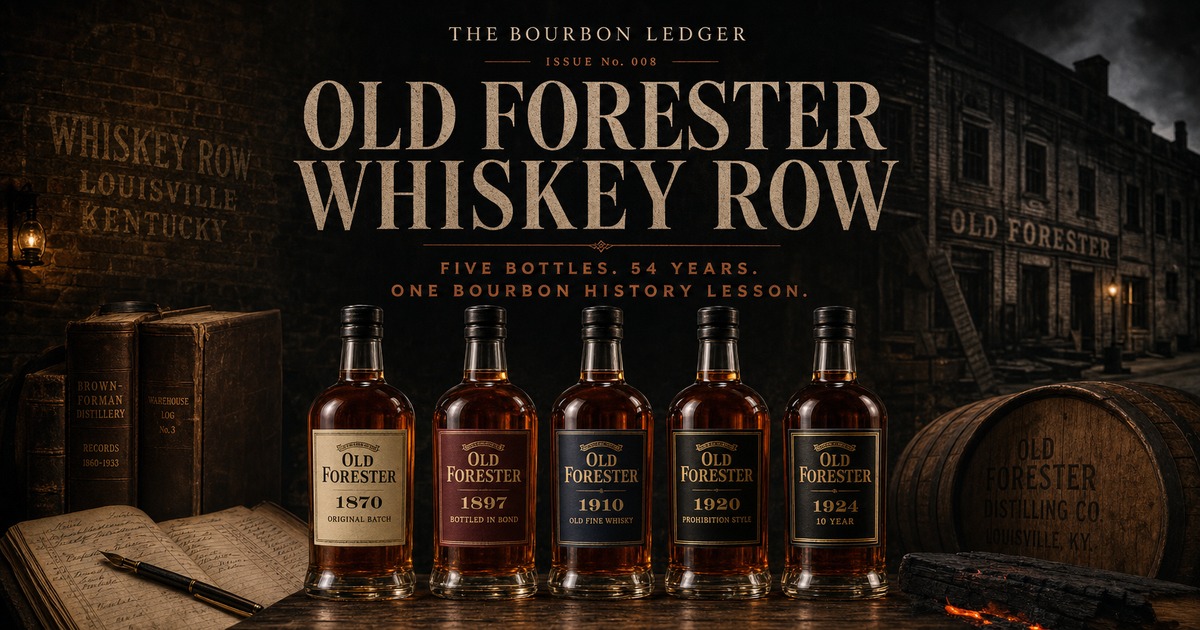
Most Bourbon Ledger issues are built around one bottle. This one is built around five — a single brand’s attempt to turn 54 years of its own history into something you can actually taste, one glass at a time.
The Big Idea
Five years. Five ideas.
Walk down a bourbon aisle and most families make sense the same way. The standard bottle. The higher-proof bottle. The older bottle. Maybe a finished version.
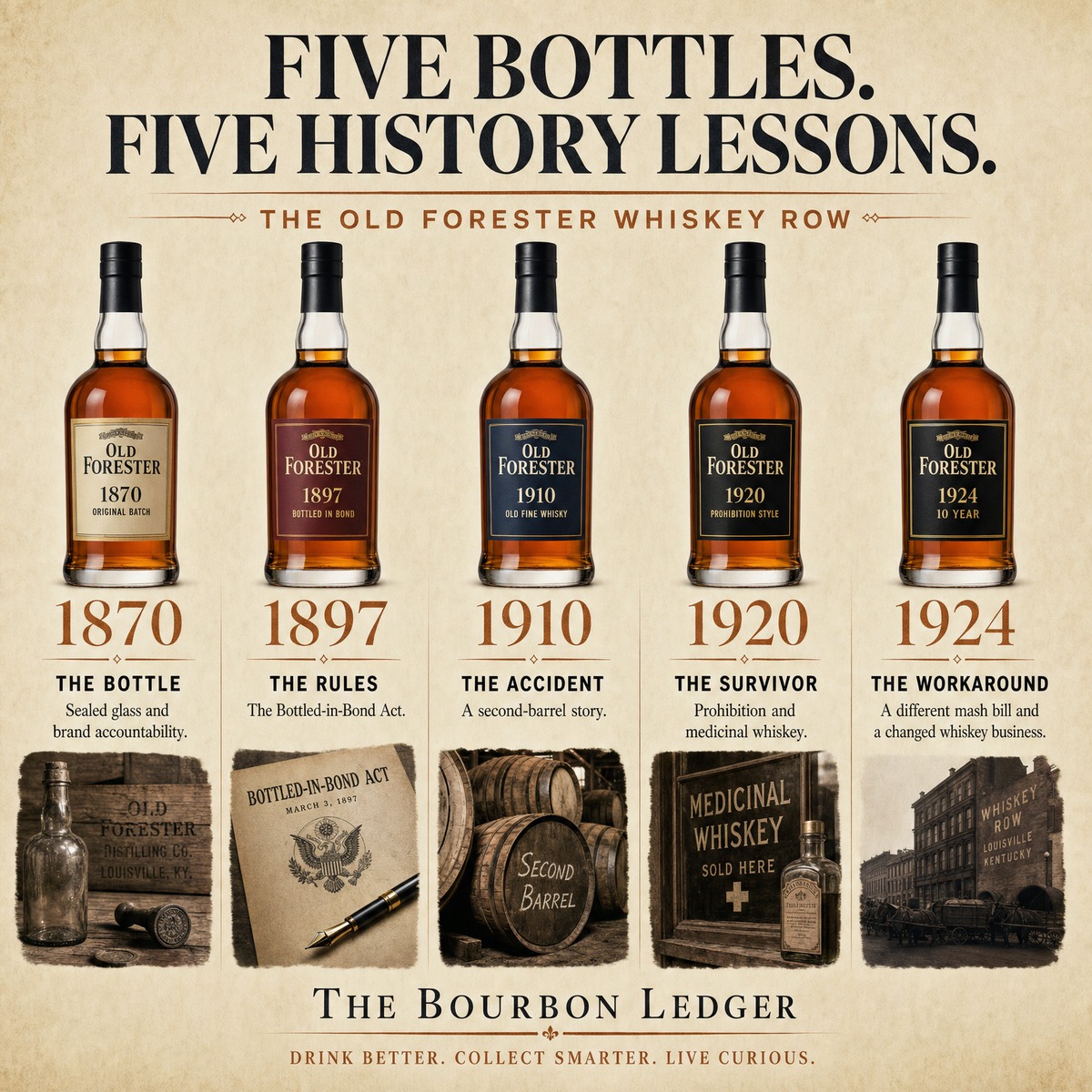
Whiskey Row does something more interesting. Old Forester built it around five specific years — 1870, 1897, 1910, 1920, 1924 — and each one answers a different question about how the brand survived, and how it changed.
| Year | The Idea |
|---|---|
| 1870 | Consistency and the bottle |
| 1897 | Regulation |
| 1910 | The barrel |
| 1920 | Survival |
| 1924 | Adaptation |
Chapter One
1870 — The Bottle
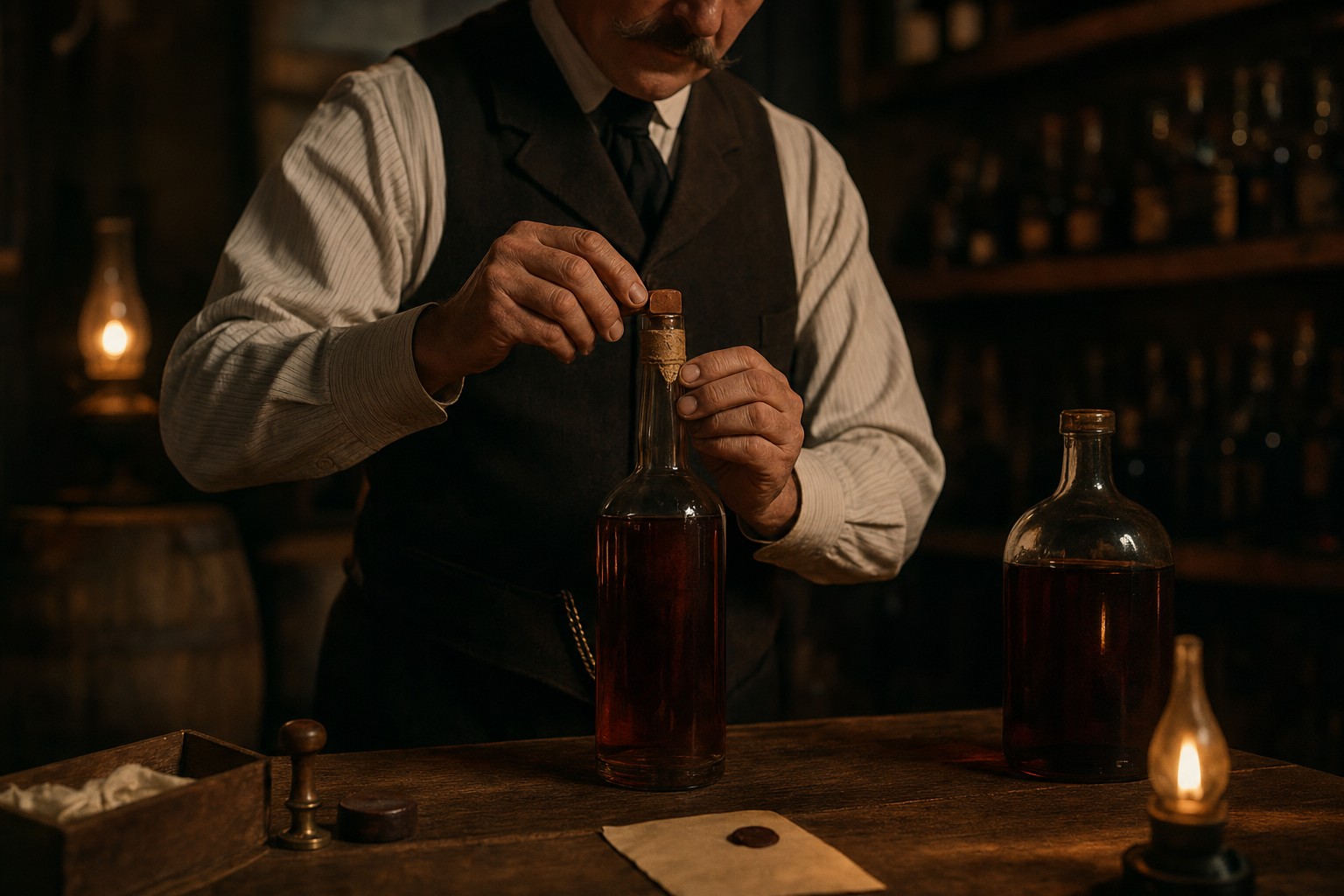
Before Old Forester changed bourbon, George Garvin Brown changed how people bought it.
Brown worked as a pharmaceutical salesman in an era when American whiskey was commonly sold from barrels. He saw an opportunity to make consistency itself part of the product.
The brand says Brown batched whiskey sourced from three nearby distilleries, sold it exclusively in sealed glass bottles, and signed them as a personal guarantee of quality — a real point of distinction in 1870, when most whiskey drinkers had no way to know what was actually in the barrel behind the counter. Read Old Forester’s own account of the 1870 launch →
You weren’t buying whatever whiskey happened to be in the barrel behind the counter. You were buying Old Forester.
| 1870 · Original Batch | Detail |
|---|---|
| Proof | 90 |
| Role in the Flight | Baseline |
| Reference Price | $45.99 |
| Teaches | Batching and consistency |
Chapter Two
1897 — The Rules
Eventually somebody had to define what trustworthy whiskey meant.
Today the phrase can look like decorative label language, but Bottled in Bond encodes real production constraints: one distilling season, one distiller at one distillery, at least four years in a federally bonded warehouse, exactly 100 proof, under U.S. government supervision. See our Bourbon School primer on what Bottled-in-Bond actually guarantees →
| Year | The Answer |
|---|---|
| 1870 | Blending for consistency |
| 1897 | Constraints for accountability |
Two different answers to the same question. How does the buyer know what is in the bottle?
| 1897 · Bottled in Bond | Detail |
|---|---|
| Proof | 100 |
| Role in the Flight | Structure |
| Reference Price | $51.99 |
| Teaches | Standards and provenance |
Chapter Three
1910 — The Accident
Sometimes the mistake becomes the process.
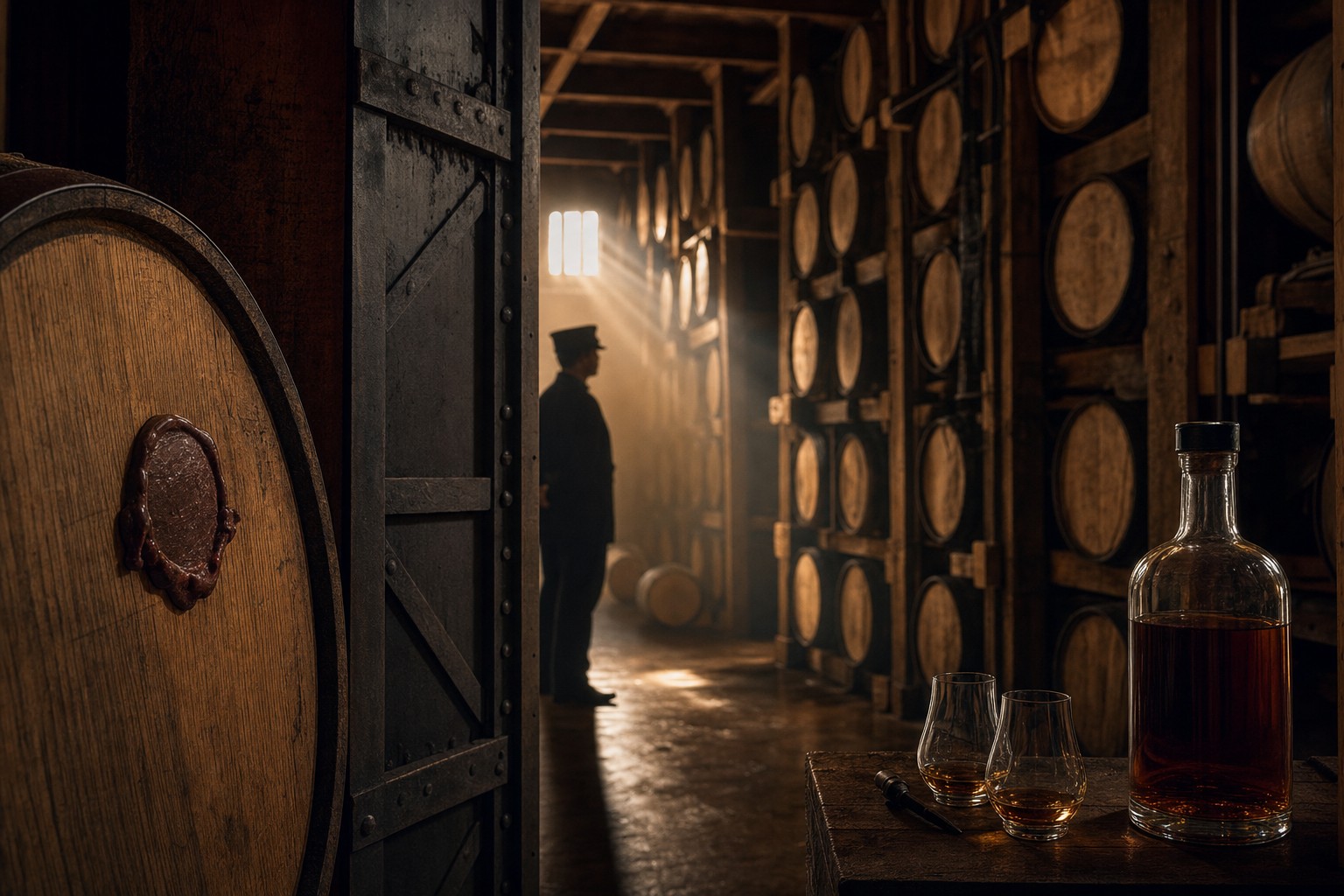
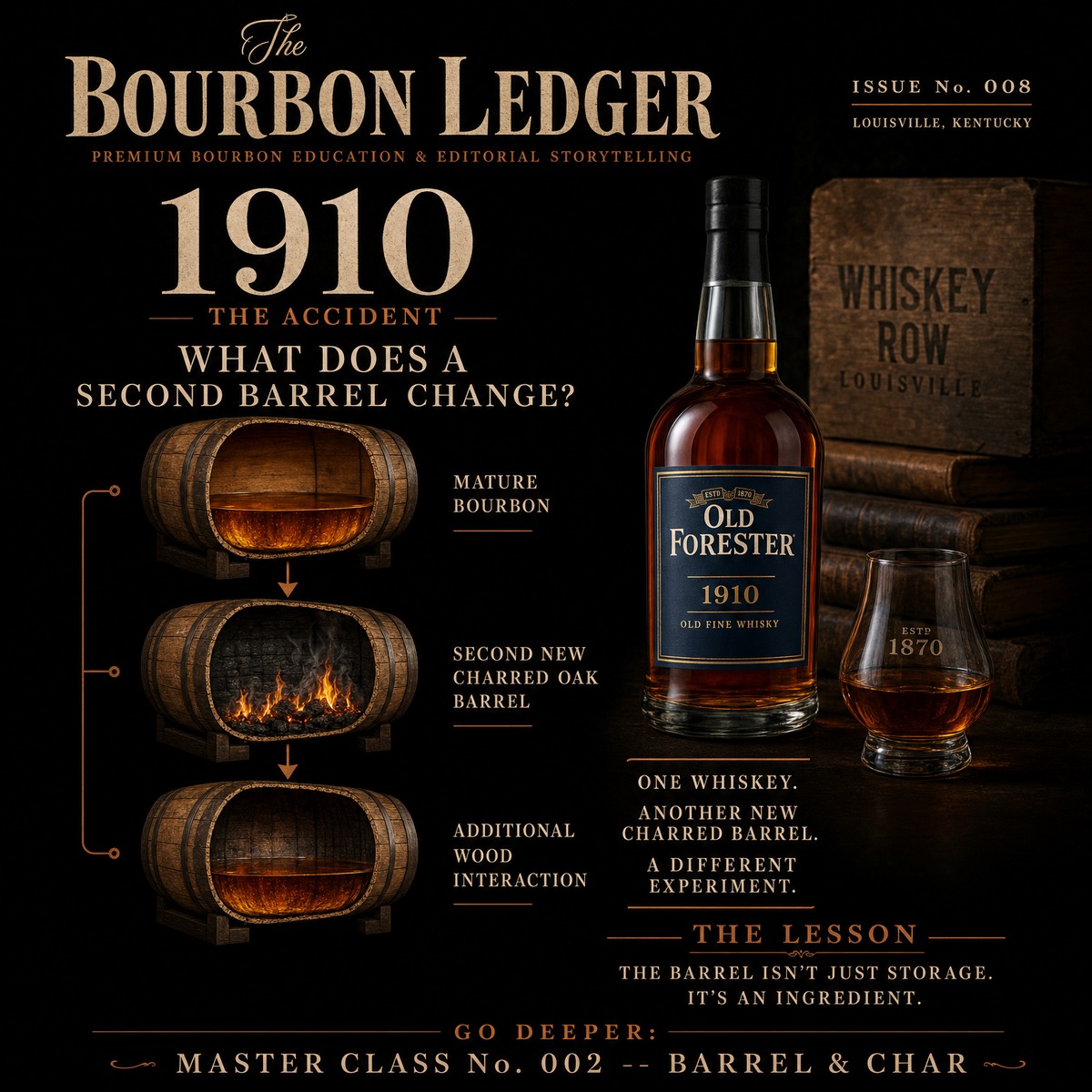
Old Forester’s historical account says an October 1910 fire shut down its bottling line after mature whiskey had already been dumped from barrels. With nowhere to bottle it, the whiskey went back into a second barrel while the line was repaired. That episode inspired today’s 1910 Old Fine Whisky — enters its second barrel at 100 proof, bottled at 93.
| 1910 · Old Fine Whisky | Detail |
|---|---|
| Proof | 93 |
| Role in the Flight | Wood transformation |
| Reference Price | $59.99 |
| Teaches | Second barreling |
Finishing doesn’t have to mean sherry. Another new oak barrel can be the finish. Our own Ledger tasting record on this one: 7/10 neat, roughly 7.25 to 7.5 with ice.
Chapter Four
1920 — The Survivor
Then America tried to kill the whiskey business.
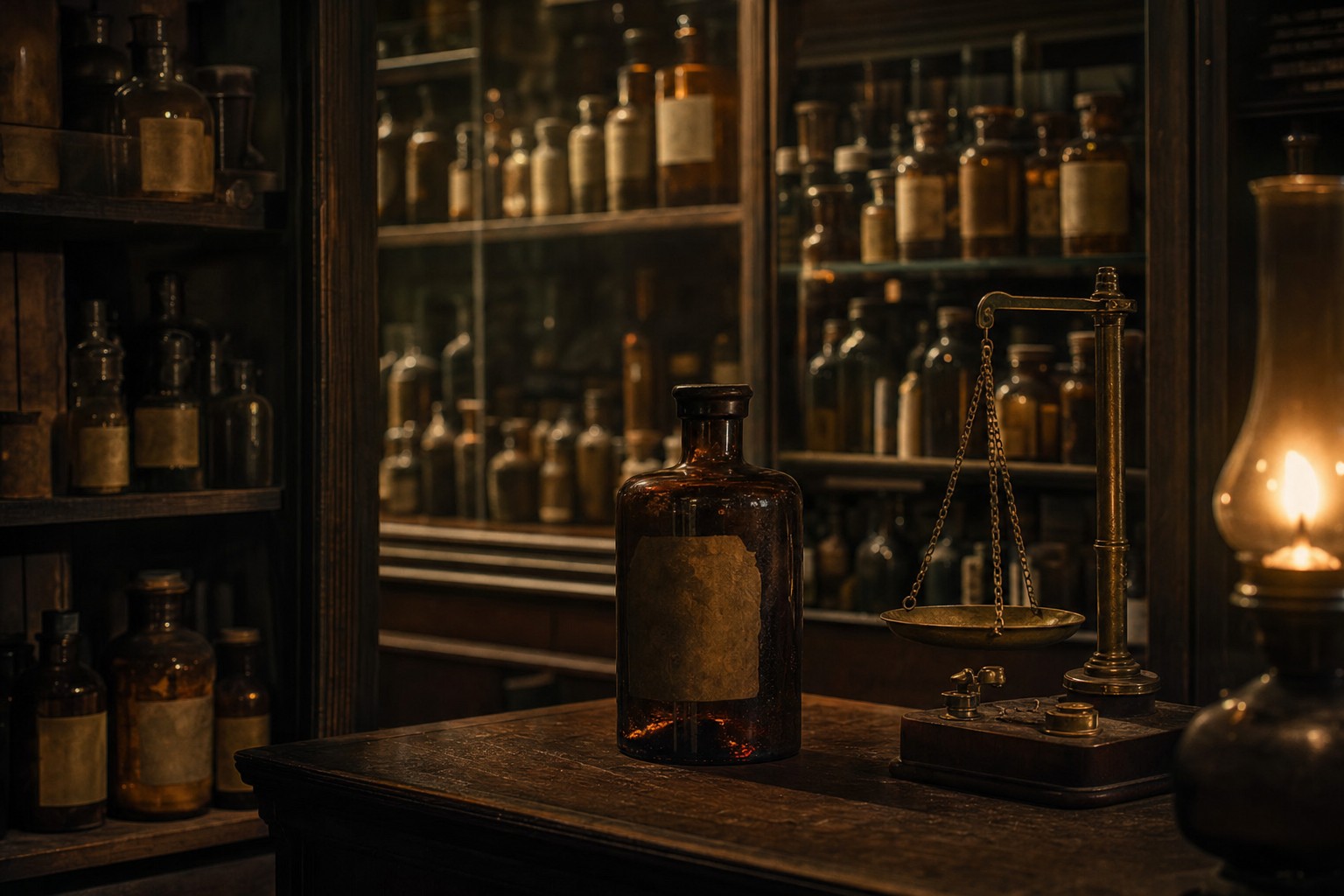
Prohibition closed most legal paths for American distillers. A narrow medicinal-whiskey exception let a small number of distillers keep operating — Brown-Forman received one of only six federal licenses to produce whiskey for medicinal purposes, and Old Forester is the only bourbon that’s been sold continuously by the same company before, during and after Prohibition.
Modern 1920 Prohibition Style uses proof to interpret that history: Old Forester bottles it at 115 proof as an homage to the approximate barrel proof the whiskey could have reached before dilution.
Don’t ask whether this is exactly what someone drank in 1920. Ask what historical idea the bottle is trying to make you taste.
| 1920 · Prohibition Style | Detail |
|---|---|
| Proof | 115 |
| Role in the Flight | Power |
| Reference Price | $62.99 |
| Teaches | Proof and survival |
Chapter Five
1924 — The Workaround
Prohibition didn’t just restrict whiskey. It scrambled the supply chain.
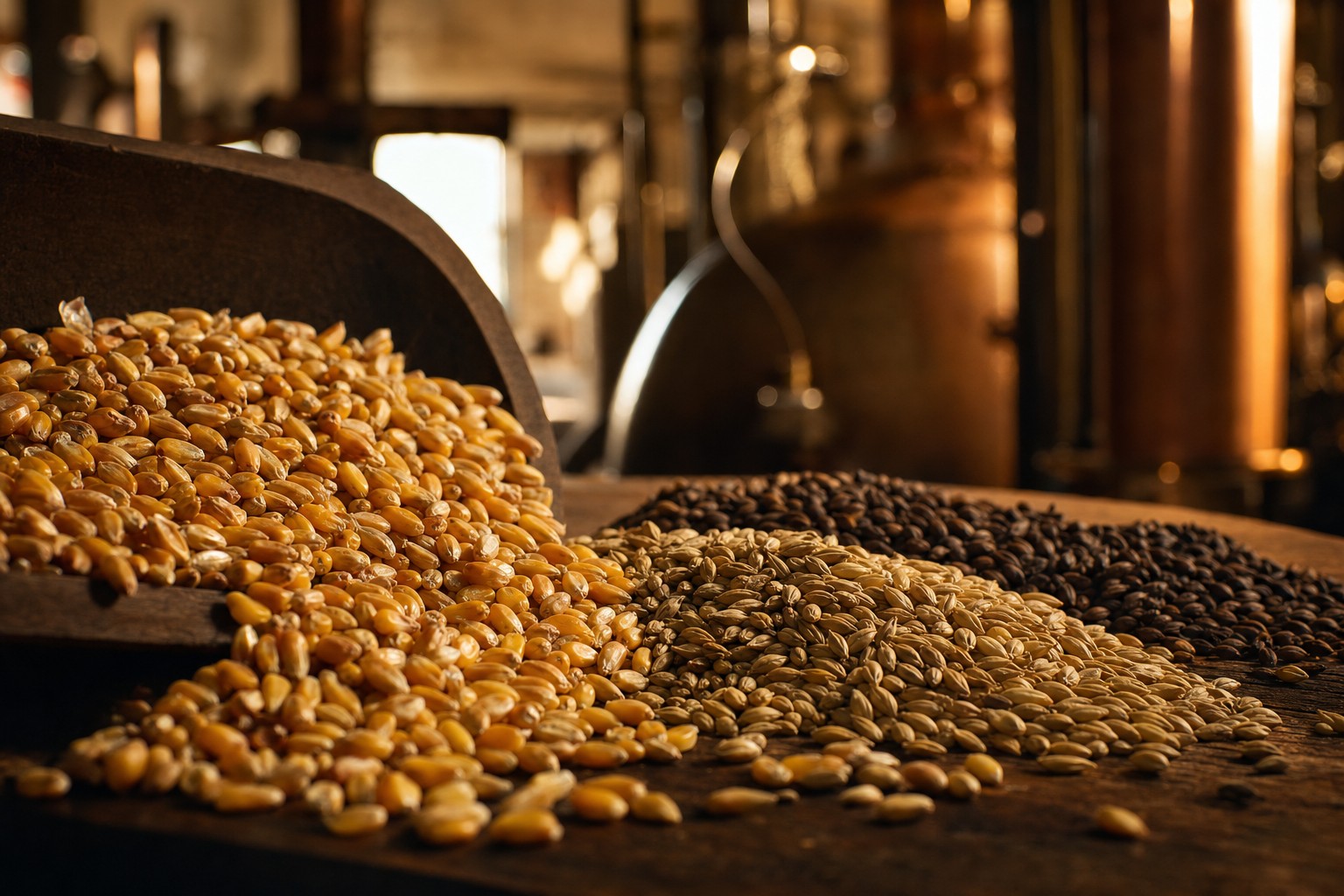
Old Forester says that in 1924 it acquired barrels from shuttered distilleries and bottled whiskey with mash bills different from its own. A century later, the brand created 1924 Ten Year to commemorate that moment. Curious what a mash bill actually changes? Our Understanding Mash Bills Master Class walks through it →
| Mash Bill | Recipe |
|---|---|
| Standard Old Forester | 72% corn / 18% rye / 10% malted barley |
| 1924 Ten Year | 79% corn / 11% rye / 10% malted barley, 10 years, 100 proof |
| 1924 · Ten Year | Detail |
|---|---|
| Proof and Age | 100 proof, 10 years |
| Role in the Flight | Outlier |
| Reference Price | $119.99 |
| Teaches | Mash bill, age and adaptation |
The Whiskey Row Map
Five years. Five ideas. One table.
| Bottle | Proof | Historical Idea | Production Lesson | Price |
|---|---|---|---|---|
| 1870 | 90 | Original batching | Consistency | $45.99 |
| 1897 | 100 | Bottled in Bond | Provenance and standards | $51.99 |
| 1910 | 93 | Bottling-line fire | Second barreling | $59.99 |
| 1920 | 115 | Prohibition | Proof | $62.99 |
| 1924 | 100 | Acquired whiskey during Prohibition | Different mash bill, 10 years | $119.99 |
★ Reference prices from Old Forester’s direct shop (shop.oldforester.com), checked September 2026. These are direct-to-consumer prices, not universal MSRP — local retail pricing and availability vary.
Collector's Map
Don’t buy these five the same way.
| Bottle | Approach | Note |
|---|---|---|
| 1870 | Buy to learn | The baseline. |
| 1897 | Don't overlook | Bonded structure without the headline-grabbing hook. |
| 1910 | Sweet and oak | The distinct double-barrel experience. |
| 1920 | Intensity | The proof-driven member of the family. |
| 1924 | Know why you're buying | Age, limited availability, a different mash bill and the historical concept. Not simply the next rung. |
Do You Need All Five?
If you approach these purely as five bourbons competing for one slot on your shelf, you miss the most interesting thing about the series. They are more fun together.
| Approach | What It Means |
|---|---|
| Core Flight | 1870 + 1897 + 1910 + 1920. The classroom. |
| Expansion | 1924. Add it when you want the older, different-mash-bill, limited chapter. |
If You Only Have One
| What You Want | Pick |
|---|---|
| Historical starting point | 1870 |
| Traditional bonded structure | 1897 |
| Sweet, double-oaked character | 1910 |
| Proof and intensity | 1920 |
| Age-stated limited outlier | 1924 |
The Ledger Flight
Don’t taste them randomly.
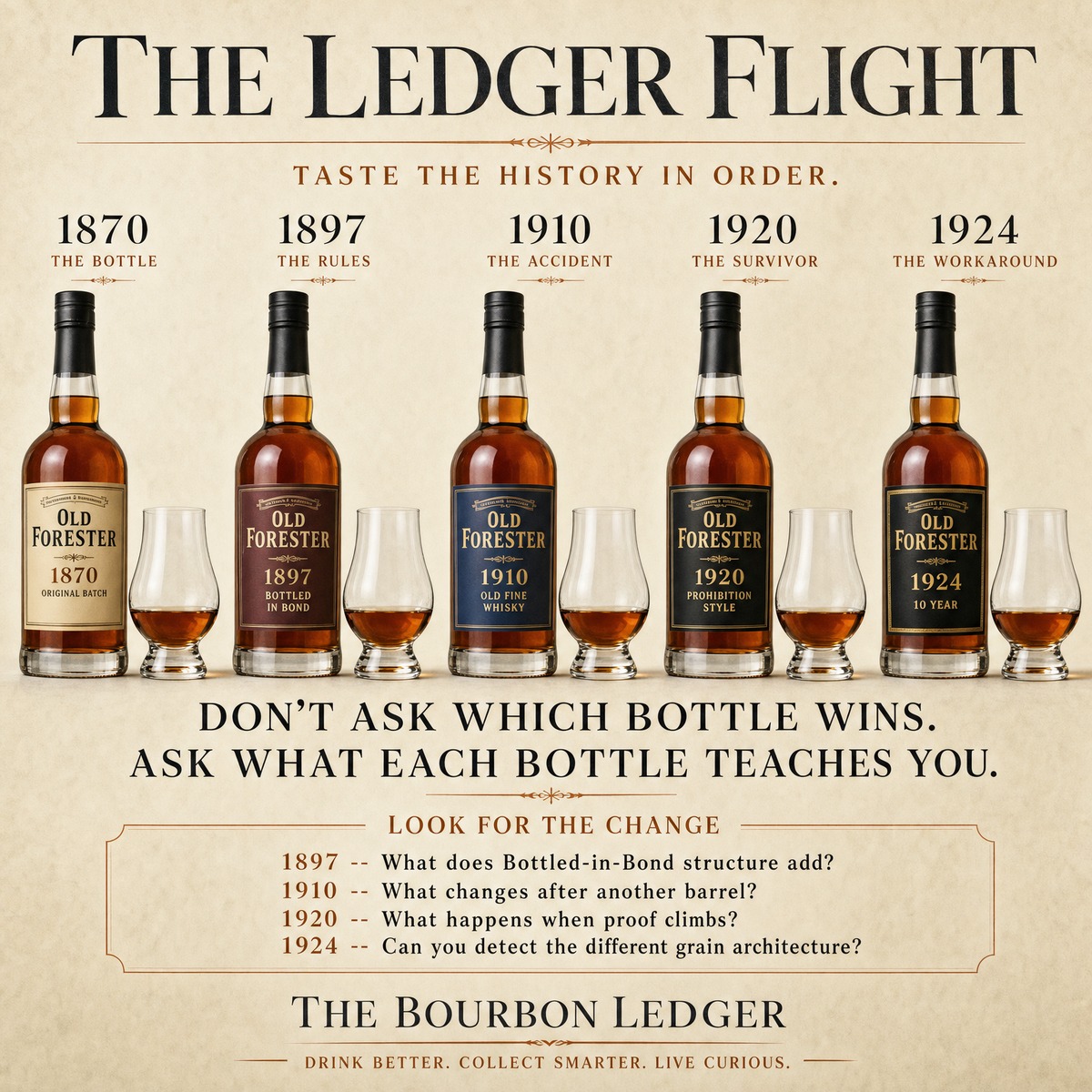
Half an ounce each, in this order: 1870, 1897, 1910, 1920, 1924.
- Neat — One small sip from each. Track only four things: fruit, sweetness, oak and heat. No scores yet.
- Compare — 1870 vs. 1897 for structure. 1897 vs. 1910 for traditional versus second barrel. 1910 vs. 1920 for sweet oak versus proof. 1920 vs. 1924 for proof versus age and mash bill.
- Add water — Add measured drops to 1920, then taste against 1897 and 1924. Once proof is less dominant, how much family resemblance remains?
- Return to 1870 — Go back to the first glass. It may taste completely different than it did ten minutes ago.
Bourbon School
Whiskey Row isn’t really five recipes.
The series is conceptual, not scientific. Multiple variables move across the lineup at once — proof, age, barrel treatment and mash bill all shift together rather than one at a time. So don’t use it to make simplistic claims like “this is exactly what 100 proof does.”
Use it to learn the better question. What changed?
Old Forester’s story stretches from George Garvin Brown’s 1870 launch through Bottled in Bond, the 1910 fire, Prohibition and the modern Whiskey Row distillery. In 2018, Old Forester returned to Louisville’s historic Whiskey Row, opening a distillery and visitor experience at 119 W. Main Street — the same district where the brand was headquartered before Prohibition, and the only company from the original Whiskey Row era still operating there continuously. We ran a similar one-brand, many-variables experiment on Elijah Craig’s barrel treatments in Issue №007 → — different variable, same underlying lesson.
Ledger Lab
The Whiskey Row Manhattan Experiment
Ingredients
- 3 oz Old Forester
- 1 oz Cocchi Vermouth di Torino
- 6 dashes Angostura bitters
- 6 dashes orange bitters
Method
- Stir with ice.
- Strain over a large cube.
- Express the orange oil.
One recipe. Two glasses. Only the bourbon changes. Build it twice — once with 1910 Old Fine Whisky, once with 1920 Prohibition Style. Glass A (1910): watch the double-barrel sweetness collide with the rich vermouth. Glass B (1920): same modifier, same ratio, same bitters, same technique. Don't ask which Manhattan is better. Ask what the whiskey changed.
Go Deeper
- Old Forester — Our Legacy (opens in a new tab) The brand's own account of George Garvin Brown's 1870 launch and the sealed-bottle guarantee.
- Old Forester — 1897 Bottled in Bond (opens in a new tab) Old Forester's own restatement of the Bottled-in-Bond requirements as applied to this expression.
- Distillery Trail — What Is the Bottled-in-Bond Act of 1897? (opens in a new tab) Independent trade-press summary of the 1897 statute's actual requirements.
- Old Forester — 1910 Old Fine Whisky (opens in a new tab) The brand's own account of the October 1910 bottling-line fire and the resulting double-barreled whiskey.
- Old Forester — 1920 Prohibition Style (opens in a new tab) The brand's account of its Prohibition-era medicinal-whiskey license.
- Old Forester Debuts 1924 (opens in a new tab) The brand's own account of the 1924 barrel acquisition and the modern 10-year expression's mash bill.
- Old Forester Shop — Whiskey Row (opens in a new tab) Current direct-to-consumer pricing for the full Whiskey Row lineup.
- Old Forester Distilling Co. Returns to Whiskey Row (opens in a new tab) The brand's account of its 2018 return to 119 W. Main Street.
- Wikipedia — Old Forester (opens in a new tab) Independent corroboration of the Prohibition-era medicinal license and a more precise "sold exclusively in sealed bottles" phrasing of the 1870 claim.