Featured Distillery — Four Roses, Lawrenceburg, Kentucky
For decades, one of America’s great bourbons was easier to buy in Japan than in America.
The brand didn’t disappear because the bourbon-making stopped. It disappeared from its home market while the production system underneath it kept running — an unusually deliberate flavor architecture built from 2 mash bills and 5 proprietary yeast strains, combined into 10 distinct bourbon recipes:
OBSV OBSK OBSO OBSQ OBSF
OESV OESK OESO OESQ OESF
Four Roses isn’t simply a bourbon to drink. It’s a bourbon system you can take apart.
The Big Idea
The mash bill isn’t the recipe.
Ask most bourbon drinkers what determines flavor and they’ll say the mash bill — the grain recipe. It’s a real answer. It’s also an incomplete one.
| Mash Bill | Corn | Rye | Malted Barley |
|---|---|---|---|
| B | 60% | 35% | 5% |
| E | 75% | 20% | 5% |
That’s only half the system. Four Roses ferments each mash bill with any of five proprietary yeast strains, and the brand says each strain contributes its own distinct character:
| Strain | Four Roses' Own Descriptor |
|---|---|
| V | Delicate Fruit |
| K | Slight Spice |
| O | Rich Fruit |
| Q | Floral Essence |
| F | Herbal Notes |
2 mash bills × 5 yeast strains = 10 bourbon recipes
But understanding why it exists requires going backward.
The Bourbon That Disappeared
A major American bourbon, hiding in plain sight.
Four Roses traces its trademark to 1888. By the early 20th century it was one of the best-known bourbon names in the country. In 1943, Seagram acquired Frankfort Distilleries and the Four Roses brand, folding it into one of the largest whiskey operations in America.
Four Roses Kentucky Straight Bourbon was a major seller through the 1930s, ’40s and ’50s — and then, circa the late 1950s, Seagram discontinued it in the U.S. domestic market. The name didn’t vanish. It moved: the bourbon kept selling continuously in Japan and Europe, while in the United States “Four Roses” became a blended-whiskey label instead of a straight bourbon.
Four Roses didn’t need to be rediscovered. The bourbon-making operation had survived.
The System That Survived
Before there were ten recipes, there were five distilleries.
Four Roses’ own account of its history says each of today’s five proprietary yeast strains originated at one of five Kentucky distilleries once part of the Seagram production complex — Calvert, Old Lewis Hunter, Athertonville, Henry McKenna and Old Prentice, the Lawrenceburg site where Four Roses is still distilled today. As Seagram consolidated production over the decades, those five flavor identities were preserved as five distinct yeast strains rather than five separate buildings.
That’s Four Roses’ own simplified version of the story. Independent trade coverage of the yeast program describes a more technical lineage — strains developed and refined in the lab from an original culture rather than five intact cultures simply carried over from five sites. Both things can be true at once: a brand-friendly origin story sitting on top of a more complicated lab history.
Seagram’s broader philosophy helps explain why a system like this existed at all. Seagram was, by design, a component-whiskey company: rather than relying on a single recipe, it operated multiple distilleries and mash bills specifically so its blenders could draw on a range of distinct whiskey characters and combine them into consistent branded products. That is documented industry practice for large distillers of the era, not a guess — component whiskies, blended to a target profile, were standard long before Four Roses became known for showing its math.
What’s interpretation, not documented fact, is drawing a straight line from that general Seagram-era blending logic to the specific ten-recipe system enthusiasts study today. The historical record supports that Four Roses’ recipe framework grew out of a company built to manage multiple whiskey characters at scale. It does not support treating that framework as something designed, in the 1940s or 1950s, for the kind of single-recipe deep-dive tasting this issue is doing. That use came later — the underlying production logic just happened to survive intact enough to make it possible.
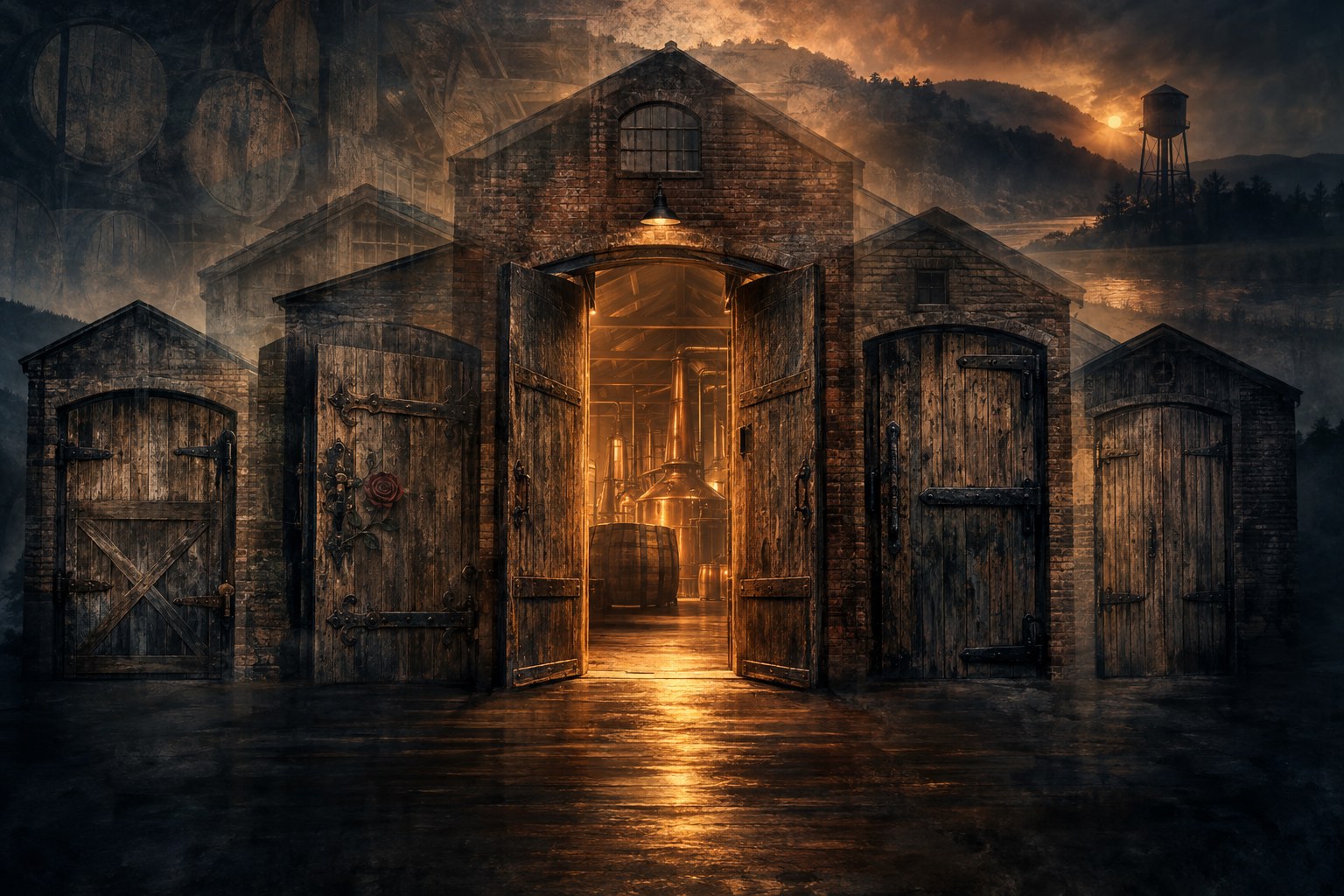
- 5 Seagram Distillery Flavor Sources
- Production Consolidation
- 5 Yeast Strains × 2 Mash Bills
- 10 Four Roses Recipes
One more correction worth making plainly: former Master Distiller Jim Rutledge did not invent this system. Four Roses’ own materials credit him with leading the brand’s return of Kentucky Straight Bourbon to the U.S. market and launching Single Barrel in 2004 and Small Batch in 2006 — reviving and expanding domestic commercial use of a recipe system that had existed inside Seagram’s operation for decades before him.
Bourbon School
Yeast doesn’t just make alcohol.
Yeast’s basic job is converting fermentable sugars into ethanol and carbon dioxide. But fermentation is messy in the best way: yeast also produces a range of flavor-active compounds — esters, higher alcohols, phenols — as byproducts, and different strains produce different mixtures of them. Change the strain, and you change what’s available before the whiskey ever sees a barrel. Four Roses built its entire recipe system around deliberately exploiting that variable.
Bourbon School Yeast & Fermentation What congeners and esters actually are, in plain English — and why yeast is one flavor variable among many.Chemists lump many of these fermentation byproducts under one practical umbrella: Congener Any flavor- or aroma-active compound in a whiskey other than the ethanol and water themselves — esters, higher alcohols, phenols and more. Congeners are what actually give whiskey its character. Open in Dictionary → . A congener is simply any flavor- or aroma-active compound in the whiskey that isn’t the ethanol or water itself — and esters are one of the most important congener families yeast produces. In plain terms, an ester typically forms when an alcohol and an acid combine during fermentation, and different esters read to your nose as different things: some lean fruity, some lean floral, some barely register until later production steps bring them forward. Fermentation doesn’t always hand you the finished flavor directly, either. Sometimes what yeast produces is a precursor — a building-block compound that doesn’t taste like much on its own but reacts further during distillation or barrel aging into something that does.
None of this means yeast alone explains what ends up in your glass. The grain, the still, the barrel’s char, and years of maturation all keep acting on — and sometimes overwriting — whatever the yeast contributed first. Four Roses’ yeast strains are a real, documented variable, not the only one, and not a guarantee that a given descriptor will show up unmistakably in every barrel.
Hold the grain recipe constant and the point becomes obvious. Every one of these five recipes shares the exact same Mash Bill B — 60% corn, 35% rye, 5% malted barley:
| Recipe | Yeast | Four Roses' Own Descriptor |
|---|---|---|
| OBSV | V | Delicate fruit and rye |
| OBSK | K | Rye and baking spice |
| OBSO | O | Rich fruit |
| OBSQ | Q | Rye and light floral character |
| OBSF | F | Delicate rye and mint |
If mash bill were destiny, these five whiskeys shouldn’t be this different.
Grain isn’t destiny. It’s one variable.
Crack the Code
Reading the whiskey.
Four Roses prints its recipe code right on the label. Once you know how to read it, the label stops being trivia and starts being a spec sheet.
- O Distillery Distilled at the Four Roses Distillery, Lawrenceburg, KY.
- B Mash Bill B 60% corn / 35% rye / 5% malted barley.
- S Straight Whiskey Designates Kentucky Straight Bourbon.
- K K Yeast Slight spice / baking-spice character.
Same logic, different recipe:
- O Distillery Four Roses Distillery.
- E Mash Bill E The lower-rye mash bill — 75% corn / 20% rye / 5% malted barley.
- S Straight Whiskey Kentucky Straight Bourbon.
- F F Yeast Herbal, mint-leaning character.
The Four Roses Periodic Table
Ten recipes, one matrix.
B — 35% Rye
OBSV
V · Delicate Fruit
Delicate fruit and rye
OBSK
K · Slight Spice
Rye and baking spice
OBSO
O · Rich Fruit
Rich fruit
OBSQ
Q · Floral Essence
Rye and light floral character
OBSF
F · Herbal Notes
Delicate rye and mint
E — 20% Rye
OESV
V · Delicate Fruit
Delicate fruit and caramel
OESK
K · Slight Spice
Baking spice
OESO
O · Rich Fruit
Rich fruit and vanilla
OESQ
Q · Floral Essence
Delicate grains and floral character
OESF
F · Herbal Notes
Light grain and mint
The Variable Test
Controlled comparison, bourbon-style.
Testing Grain
Question: What changes when rye falls from 35% to 20%?
Taste for
- Same: K yeast
- Change: B vs. E mash bill
- Spice intensity
- Body and sweetness
Testing Yeast
Question: What changes when fermentation changes?
Taste for
- Same: B mash bill
- Change: K vs. O yeast
- Spice vs. fruit
- Aromatic intensity
This isn’t laboratory-controlled science — individual barrels, warehouse location, age and proof can all vary too, even between two bottles of the same recipe. But as a practical tasting framework, changing exactly one labeled variable at a time is about as close as a home taster gets to a controlled bourbon experiment.
Ten Recipes Become Bottles
The blend is the product.
None of the ten recipes are sold as-is by themselves at true full standard-lineup scale — they become bottles through blending and single-barrel selection.
| Bottle | Recipes | Flavor Idea | Proof | Age |
|---|---|---|---|---|
| Small Batch | OBSK, OBSO, OESK, OESO | Spice + rich fruit | 90 | 6–7 years |
| Small Batch Select | OBSV, OBSK, OBSF, OESV, OESK, OESF | Fruit + spice + herbal, non-chill-filtered | 104 | 6–7 years |
| Single Barrel (flagship) | OBSV | One recipe, one barrel | 100 | 7–9 years |
Single Barrel’s flagship has always been OBSV — but the recipe system behind it is bigger than one code. Four Roses’ annual Single Barrel Collection rotates additional recipes into single-barrel release alongside the flagship: the program launched in 2025 with OBSF, OESK and OESO, and its second rotation reached shelves in 2026 with OESQ, OESF and OBSK, according to trade coverage of the release. Each recipe gets nationwide single-barrel distribution roughly once every three years under that rotation — which means the recipe-level exploration that enthusiasts used to have to chase through retailer private-barrel picks is increasingly something Four Roses now does itself, on purpose.
Bourbon School Single Barrel What the designation actually promises — and why barrel-to-barrel variation is the point, not a flaw.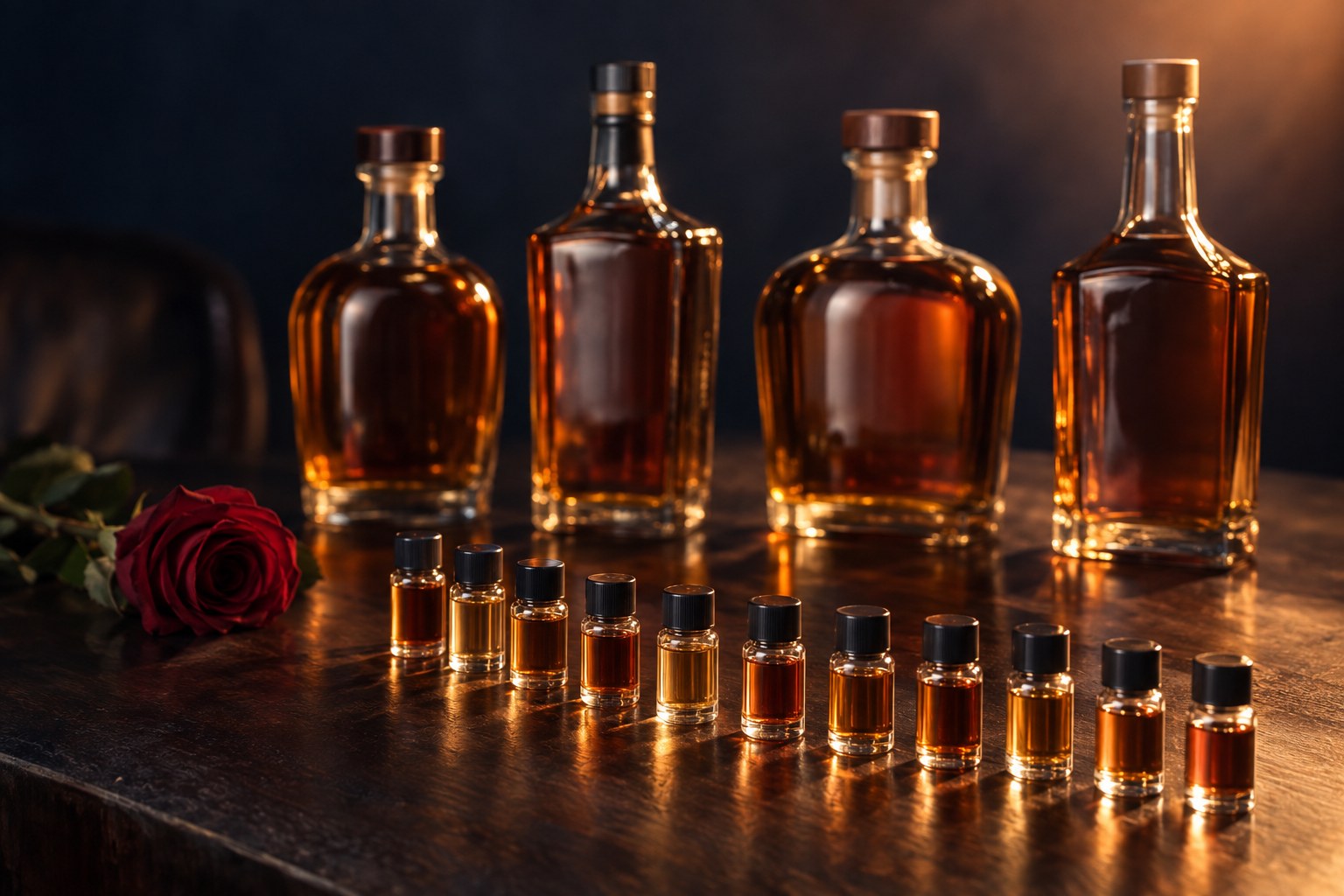
Four Roses Bourbon · Small Batch · Small Batch Select · Single Barrel — the same ten-recipe system, blended (or not) into four very different shelf realities.
The Ledger Lab
Same mash bill. Different yeast.
| Order | Recipe |
|---|---|
| 1 | OBSV |
| 2 | OBSK |
| 3 | OBSO |
| 4 | OBSQ |
| 5 | OBSF |
Constant: Mash Bill B — 60% corn, 35% rye, 5% malted barley. Variable: yeast.
Taste blind if you can arrange it. Score each glass on five things — fruit, spice, floral, herbal, other — and write down your impression before you reveal which code is in the glass.
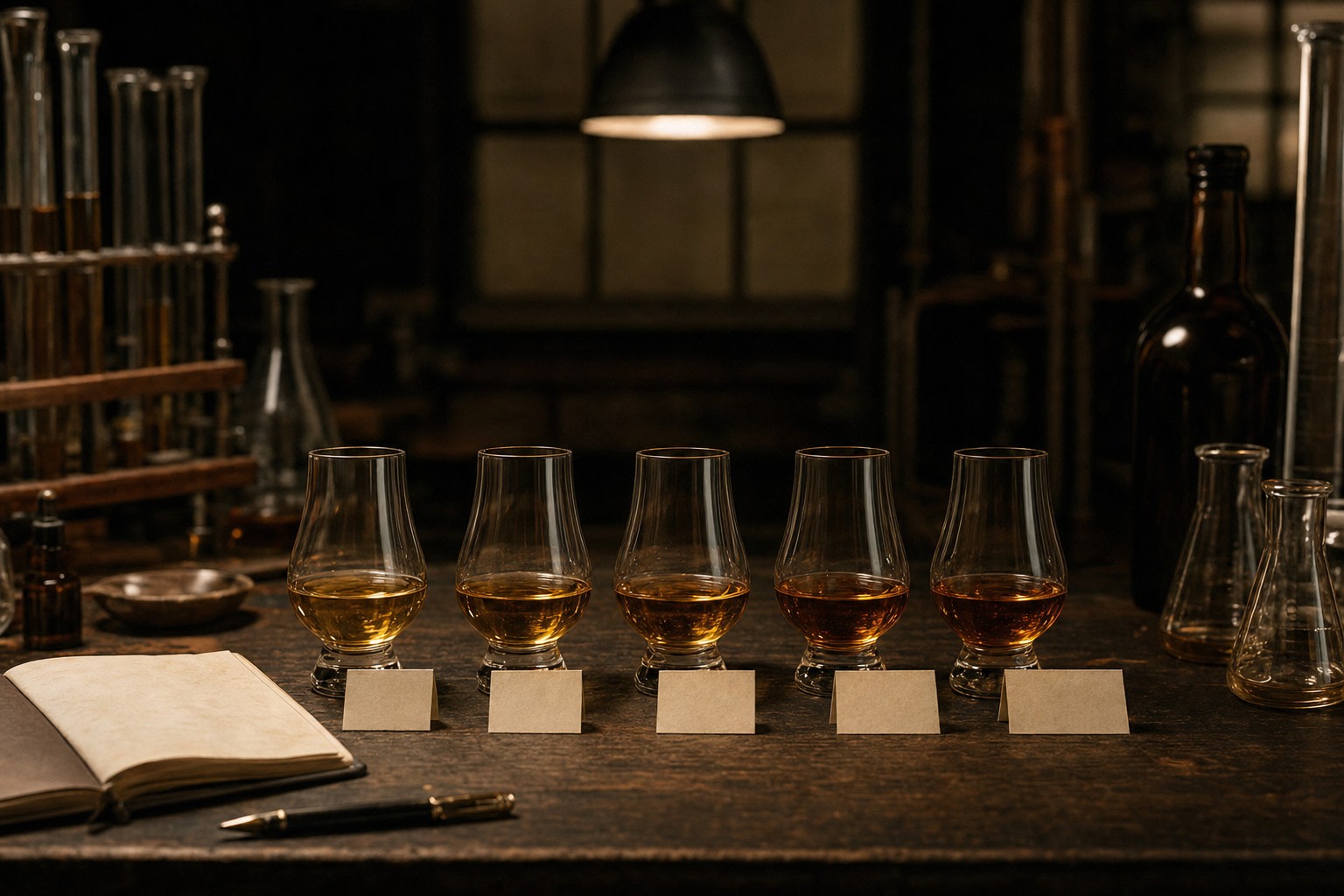
Once you’ve done that once, there’s a second, harder level: the cross-mash test.
| B Recipe | E Recipe |
|---|---|
| OBSV | OESV |
| OBSK | OESK |
| OBSO | OESO |
| OBSQ | OESQ |
| OBSF | OESF |
Constant: yeast. Variable: mash bill.
That’s when Four Roses stops being a brand tasting. It becomes Bourbon School.
The Ledger Cocktail
Don’t add flavor. Reveal it.
This issue publishes in late September. Summer hasn’t fully let go yet, and fall is arriving — the kind of week where a cold, crisp Highball still makes complete sense.
There’s a better reason to reach for one here, though. Four Roses’ own recommended serve for Single Barrel is a Highball — 2 oz Single Barrel to roughly 3–6 oz soda water, finished with lemon. We’re changing that spec on purpose, for a teaching reason rather than a house-style one.
This drink has one job: let the whiskey talk.
Ledger Lab
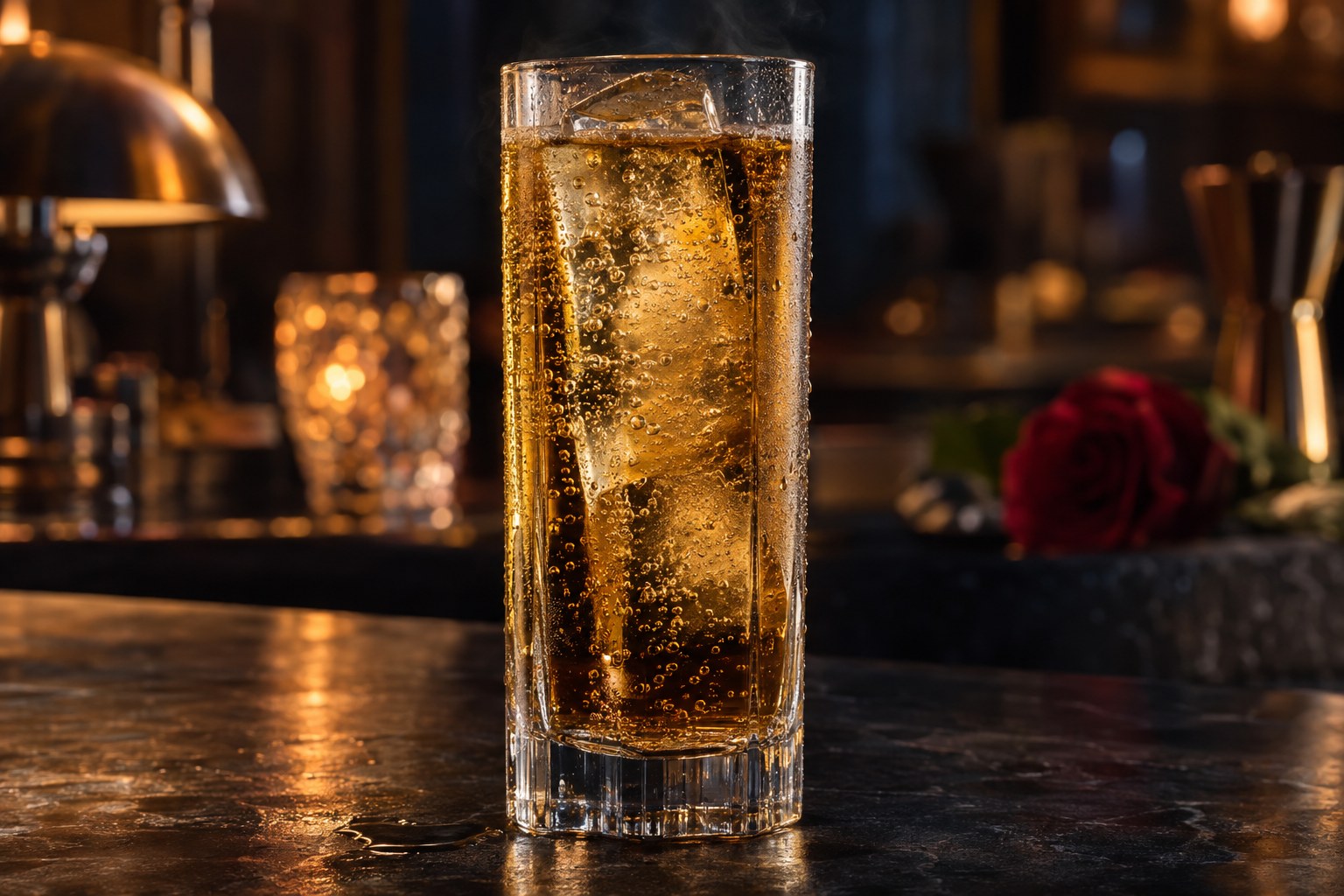
The Ledger Yeast Highball
Ingredients
- 2 oz Four Roses Single Barrel recipe
- 2 oz very cold, highly carbonated plain soda water
- 1 long clear ice spear
Method
- Chill a narrow Highball glass.
- Add the ice spear.
- Add the bourbon.
- Slowly add the soda.
- Give one gentle lift — don't stir hard enough to knock out the carbonation.
Equal parts, not Four Roses' usual wider soda ratio — we want carbonation and dilution doing their job without drowning the signal we're trying to isolate.
- No syrup
- No bitters
- No juice
- No cherry
- No expressed citrus peel
- No aromatic garnish
Here’s why the list above matters more than it looks like it should. A Manhattan adds vermouth and bitters. An Old Fashioned adds sugar, bitters and usually citrus oil. Those are genuinely excellent cocktails — and poor controls for this specific experiment. If OBSK tastes spicy, we want confidence that the spice was already in the whiskey, not manufactured by a garnish. If OBSQ smells floral, we don’t want lemon oil dominating the nose before the yeast gets a vote. If OBSF shows mint or herbal notes, we don’t want vermouth botanicals taking credit for what the F strain already did in the fermenter.
The experiment: make the identical Highball — same glass, same ratio, same ice — with OBSV, OBSK, OBSO, OBSQ and OBSF, one at a time.
Ask which yeast signature survives carbonation. Ask which one gets louder. Ask which one disappears. And ask, separately, which one actually makes the best drink — because those aren’t necessarily the same answer. Carbonation doesn’t objectively amplify every yeast note the same way; treat this as an experiment with a real result you can’t predict from your armchair, not a guaranteed outcome.
Collect Smarter
Don’t collect labels. Collect variables.
- Want to understand yeast? Collect recipes that share the same mash bill.
- Want to understand mash bill? Compare the same yeast across B and E.
- Want to understand blending? Compare Single Barrel with Small Batch and Small Batch Select.
- Want something good to drink tonight? You don't need all ten.
Deep Cut
The blender is an ingredient too.
- Grain
- Yeast
- Distillation
- Barrel
- Time + Place
- Selection
- Blending
- Your Glass
Small Batch and Small Batch Select make the point concretely. Both are blends of multiple recipes from the same list of ten — but different recipes, in different proportions, at different proofs. The blender’s choice of which recipes to combine, and how much of each, is itself a flavor decision layered on top of grain, yeast, distillation and barrel. Change the blend ratio without changing a single recipe, and you’ve still changed the whiskey.
Think of the ten recipes less like ten finished products and more like a painter’s palette. Each recipe brings its own concentration of fruit, spice, floral or herbal character, and blending is the act of deciding how much of each color belongs in the final picture. Combine two recipes that lean the same direction — say, two fruit-forward yeasts — and you emphasize that character. Pair a spice-forward recipe against a mellow, vanilla-leaning one and you can balance them into something neither extreme on its own. Blend recipes with genuinely different personalities and you layer distinct characteristics rather than average them into a blur. Small Batch applies that logic across four recipes; Small Batch Select spreads it across six, at a higher proof, specifically to keep more of each recipe’s individual signature legible in the final blend rather than smoothing it away.
That’s bourbon. Not a mash bill. A system.
Go Deeper
- Four Roses — Our Process (opens in a new tab) The brand's own explanation of the two mash bills, five yeast strains, and what each letter in a recipe code means.
- Four Roses — Heritage (opens in a new tab) The brand's own account of the 1888 trademark and early history.
- Four Roses — Through the Decades: 1940s–1950s (opens in a new tab) Four Roses' own account connecting its five yeast strains to five former Seagram-era Kentucky distilleries.
- Four Roses — Through the Decades: 2000–Present (opens in a new tab) Covers the U.S. bourbon relaunch, and Jim Rutledge's role launching Single Barrel (2004) and Small Batch (2006).
- Whisky Magazine — One Man's Yeast Quest (opens in a new tab) An independent, more technical account of how the five yeast strains were actually developed — useful context alongside Four Roses' own simplified version.
- Four Roses — Small Batch Select (opens in a new tab) Official recipes, proof and age for Small Batch Select.
- Four Roses — Single Barrel (opens in a new tab) Official proof and age for the flagship OBSV Single Barrel.
- Four Roses — Featured Recipe: OESQ (opens in a new tab) Confirms the official "delicate grains and light floral character" descriptor.
- Beverage Information Group — Four Roses 2026 Single Barrel Collection (opens in a new tab) Independent trade coverage of the 2026 OESQ/OESF/OBSK single-barrel rotation.
- Four Roses — Highball (opens in a new tab) The brand's own recommended Single Barrel Highball, which this issue's recipe intentionally modifies for a teaching purpose.