Look at your own shelf.
Jim Beam seems obvious. White Label. Black. Knob Creek. Booker’s. Baker’s. Basil Hayden. Little Book. A family of brands, sitting together, clearly related — one company, one portfolio, one story.
Now look past it. Heaven Hill. Elijah Craig. Evan Williams. Larceny. Henry McKenna. Parker’s Heritage. Yellowstone.
What could these possibly have to do with one another?
Different things. That’s the honest answer, and it’s a more interesting one than “they’re all Beam.” Some of these bottles share ownership. Some share production history. Some share a bloodline. Some share nothing but a lesson passed from one distiller to another. Those relationships are not interchangeable, and this issue’s entire job is to keep them that way in your head instead of letting them blur into one comfortable, mostly-wrong story.
DON’T FOLLOW THE BOTTLES.FOLLOW THE PEOPLE.
You Already Know the Family
You just didn’t know they were related.
Thirteen bottles. Three companies. One family.
- Created by, or named for, a Beam
- Made by Beam-family distillers
- Bought in from outside
- The family returns
Bottles are AI-generated illustrations of the real products, not photographs.
SAME FAMILY ≠ SAME COMPANY ≠ SAME RECIPE
Every bottle outside the Beam territory is a real, respected bourbon owned by a company that isn’t Jim Beam’s. None of them is a Jim Beam brand. And every one of them has a Beam family distiller somewhere in its production history. Both things are true. Neither one erases the other.
To hold both at once, this issue uses five words instead of one:
Family
Who is related to whom, by blood or marriage?
Ownership
Who owns the company or the brand?
Production
Who actually made the whiskey, and where?
Brand
How has this name moved through time and owners?
Knowledge
Who taught whom, and what traveled with them?
Keep that taxonomy handy. It’s the load-bearing idea of everything that follows — and it’s exactly the frame the Ledger’s future Master Class on the wider bourbon family tree will build on.
The Historical Trunk
Where the company’s own story starts.
Be careful with the number 1795. It is not the birth date of bourbon — nobody’s is, bourbon’s true origin is diffuse and undocumented, spread across dozens of anonymous Kentucky and Virginia farm distillers in the late 1700s. What 1795 actually marks, on the company’s own account, is the first documented sale of whiskey by Jacob Beam, a German immigrant (the family name was originally spelled Böhm) whose family had settled in Kentucky roughly a decade earlier. That’s a real, meaningful date. It’s a company’s founding story, not bourbon’s.
From there the documented company line runs through four generations, Jacob, David, David M. and finally James B. “Jim” Beam, before the name “Jim Beam” existed at all: one company, one continuous act of naming and rebranding around whatever the current generation thought would sell. That’s a real trunk. It’s also an incomplete picture, because a single line stops being useful the moment the story leaves the company and starts following the family. The foldout a few sections down picks up exactly there.
Jim Beam — The Rebuild
What survived Prohibition, and what the company says survived it.
Prohibition (1920–1933) shut down federally licensed whiskey production nationwide for fourteen years. When it ended, Jim Beam — in his late 60s — rebuilt the distillery at Clermont, Kentucky essentially from nothing, reportedly in about 120 days. The company’s brand was renamed in his honor in 1943.
The harder claim to pin down is what happened to the yeast. Jim Beam’s own telling of this story isn’t even internally consistent between versions: one account has Jim Beam personally preserving the distillery’s pre-Prohibition yeast strain by carrying a jug of it home every weekend, protecting it through the dry years by hand. A second, different company account says the original culture was lost during Prohibition and that Beam cultivated a new strain afterward, based on the family recipe. Those are not the same story — one is preservation, the other is recreation — and we found no independent, third-party verification of either specific version. Treat “Jim Beam’s yeast has an unbroken lineage back through Prohibition” as a company narrative worth knowing, not a documented fact worth repeating as settled history.
Here’s what doesn’t need a hedge: a distillery is a building. A recipe is paper. Neither one runs a fermenter by itself.
What’s fully defensible, regardless of which yeast story is literally true, is the underlying point both versions of the story are reaching for: Prohibition destroyed physical infrastructure everywhere in Kentucky, but the companies that came back fastest and most intact came back because someone who’d actually done the work before still remembered how.
BUILDINGS DON’T CARRY KNOWLEDGE.PEOPLE DO.
That’s the idea this entire issue is actually about. Everything from here forward is a demonstration of it.
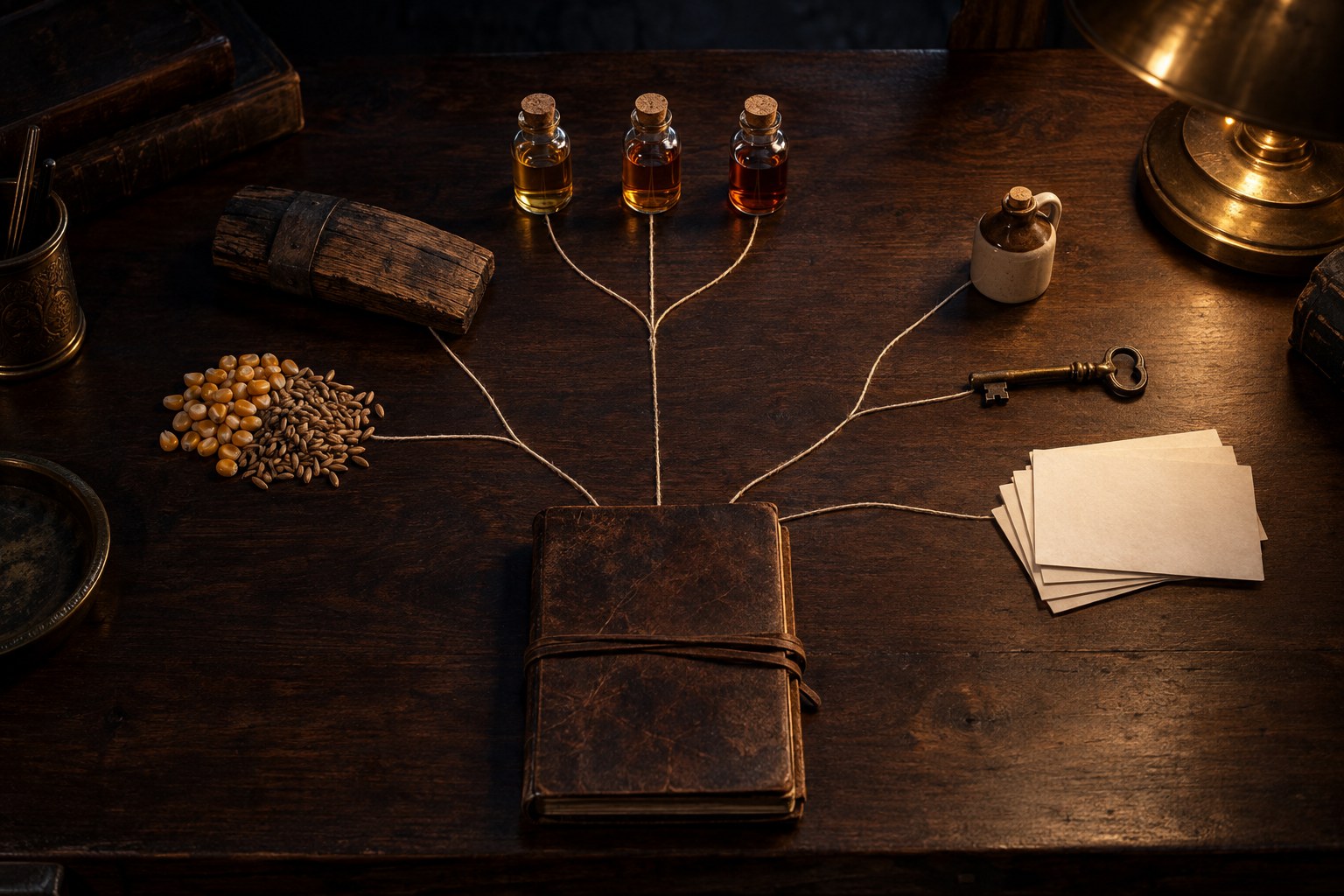
Visual 02 — The Bloodline
The bourbons behind one bloodline.
The company line ends at Jim Beam. It doesn’t end the family. Jim Beam’s own line continues through his son, who left no heir at the company — so the role passed sideways, to a nephew. And one generation further back, the tree forks twice. David Beam had three distilling sons: David M., the father of Jim and Park; Joseph, the father of Minor Case and Joseph L.; and Jack, who founded Early Times. Both pairs of brothers split between companies. Jim’s line stayed with the company that carries his name. Park’s line and Joseph L.’s line both went to work at Heaven Hill. Minor Case’s line leads, three generations later, to Limestone Branch. None of these branches is a straight extension of the company trunk; each is its own story, at its own company, under its own ownership.
Plate IThe Beam family · eight generations
One family. Three companies. None of them owns another.
Copper traces blood. Everything else is business.
- Family
- Master Distiller role
- The job passes on
- Created a whiskey
- Acquired (corporate)
- Company territory
Bottles are AI-generated illustrations of the real products, not photographs.
Read the plate as text
The Beam family drawn as a genealogy atlas. Jacob Beam's first documented sale (1795) and his son David Beam (1802–1852) form the shared trunk. David's sons fork the family: David M. Beam, father of Jim Beam and Park Beam, and Joseph Beam, father of Minor Case Beam and Joseph L. Beam. A third son, Jack Beam, founded Early Times and is not traced here. Each pair of brothers split between companies. Jim Beam's line (Jere Beam, then his nephew Booker Noe, Fred Noe and Freddie Noe) runs James B. Beam Distilling Co., owned by Suntory Global Spirits; its bottles include Booker's, Knob Creek, Baker's and Basil Hayden, created by Booker Noe, Little Book, blended by Freddie Noe, Jim Beam, and Old Grand-Dad, bought in 1987. Joseph L. Beam became Heaven Hill's Master Distiller in 1935, followed by his son Harry; in 1946 the job crossed to Park's line: Earl Beam, then his son Parker Beam, who launched Elijah Craig and Henry McKenna Single Barrel and is the namesake of Parker's Heritage, then Parker's son Craig. Today Conor O'Driscoll, not a Beam, holds the job. Heaven Hill has been owned by the Shapira family since 1935. Minor Case Beam's Gethsemane plant joined the Yellowstone complex around 1910; his son Guy distilled at Yellowstone (date unknown); Guy's son Jimmy was the father of Stephen and Paul Beam, who founded Limestone Branch, owned today by MGP via Luxco, where Stephen distills Yellowstone Family Recipe.
A note on the Joseph branch, in the spirit of this issue’s own rules: bourbon historian Chuck Cowdery’s genealogy of the family places Minor Case Beam and Heaven Hill’s Joseph L. Beam as brothers, sons of David Beam’s son Joseph, which makes both of them Jim Beam’s first cousins. Sources disagree on their father’s middle initial, so the plate leaves it out. The Beam family tree is famously tangled — the same handful of first names (Joseph, David, Jacob, Beam himself) repeat across multiple generations and multiple branches, which is a genuinely common source of confusion in casual bourbon writing. We’re stating the relationships we could verify and declining to invent the ones we couldn’t.
Branch A — Beam / Noe
Booker Noe and the Small Batch Collection.
Booker Noe became Jim Beam’s sixth-generation Master Distiller in 1965 and held the role for nearly thirty years. He had long bottled his own uncut, unfiltered, barrel-proof selections as gifts for friends and family; in 1988 that became a limited commercial release under his own name: Booker’s. In 1992, Beam built Booker’s into a full four-bottle collection by adding Knob Creek, Baker’s and Basil Hayden’s — The Small Batch Bourbon Collection.
| Bottle | Introduced | Concept |
|---|---|---|
| Booker's | 1988 (limited); 1992 (collection) | Barrel proof, uncut, unfiltered |
| Knob Creek | 1992 | Pre-Prohibition-style, 100 proof |
| Baker's | 1992 | Extra-aged, small batch |
| Basil Hayden's | 1992 | Lighter, high-rye, entry point |
Here’s the myth worth correcting carefully, not sloppily: Booker Noe did not invent small-batch bourbon as a category. Heaven Hill’s Elijah Craig — a separate company, made by a separate branch of Booker’s own extended family, as you’re about to read — reached shelves in 1986, two years before Booker’s, arguably as premium bourbon’s real first modern small-batch release. What Booker Noe and his team did do, credibly and by most industry accounts, is put a name on the idea and turn it into a marketable, four-bottle argument that changed what American drinkers expected “premium bourbon” to mean. Both things can be true: Elijah Craig may have gotten there first conceptually; Booker’s coined and popularized the term that the entire category now uses.
Bourbon School Small Batch Not a legal term. Not a fixed number of barrels. What 'small batch' actually promises — and doesn't.The real question isn’t whether Booker Noe invented anything. It’s what he taught drinkers to expect.
Four Bottles, Not Four Ranks
Don’t buy vertically. Taste horizontally.
The Small Batch Collection is routinely misread as a staircase — Basil Hayden at the bottom, Booker’s at the top, a climb toward “better.” That’s backward. It’s four equal, deliberately different ideas about what bourbon can be, built from the same house.
One house · four directions
Not a ladder. A compass.
None of these four bottles is the “good” version of another. Each one lets you investigate a different variable — proof, rye content, age, filtration — using the same underlying house style as the constant. That’s a tasting framework, not a shopping list.
The Man Became a Bottle
Basil Hayden Sr. and Old Grand-Dad.
Basil Hayden’s is the odd one out in that collection, because its story doesn’t start with Booker Noe at all — it starts more than a century and a half earlier, with an actual person.
- Basil Hayden Sr. Kentucky distiller associated with an unusually high-rye recipe; the historical record on his exact dates and biography is thinner than the legend built on top of it
- Old Grand-Dad Founded by his grandson, R.B. Hayden, who put his grandfather's likeness on the label in his honor
- National Distillers → Beam Old Grand-Dad changed owners repeatedly, landing at Beam (via American Brands/Fortune Brands) in 1987
- Basil Hayden's (1992) Beam's new premium expression, built on Old Grand-Dad's own high-rye mash bill (about 63% corn / 27% rye / 10% malted barley), at a lower, more approachable proof
The man became a bottle. The bottle helped inspire another bottle.
That last connector matters: Basil Hayden’s isn’t a fictional throwback name Beam invented in 1992. It’s a real, documented high-rye mash bill Beam already owned — via a brand it had acquired five years earlier — dressed at a friendlier proof and given the original distiller’s own name back. Ownership history (National Distillers → Beam, 1987) and product history (the shared high-rye recipe) did the actual work here. Family history — Basil Hayden Sr. himself — supplied the name and the story on the label, not the liquid in the bottle.
Branch B — Park / Heaven Hill
Same family tree. Different company.
This is the branch most likely to genuinely surprise you, so state the ownership fact first and plainly: Heaven Hill is not, and has never been, a Beam-owned company. It was founded in 1935 by the Shapira family, who have owned it continuously ever since. It is one of the largest independent, family-owned distillers in the country — a direct competitor to Beam, not a subsidiary or sister brand.
James B. Beam Distilling Co.
Owned by Suntory Global Spirits
The company that carries Jim Beam's name
Beam-family distillers here
- Jim Beam's own lineJere Beam · Booker Noe · Fred Noe · Freddie Noe
Brands it owns
Jim Beam · Knob Creek · Booker's · Baker's · Basil Hayden · Little Book · Old Grand-Dad
Heaven Hill
Owned by the Shapira family
Founded 1935 · never owned by Beam, and never owned Beam
Beam-family distillers here
- Jim's cousin's lineJoseph L. Beam → Harry Beam
- Jim's brother Park's lineEarl Beam → Parker Beam → Craig Beam
Brands it owns
Elijah Craig · Evan Williams · Larceny · Henry McKenna · Parker's Heritage
What Heaven Hill needed at its founding, like every new 1935 distillery rebuilding after Prohibition, was someone who already knew how to run a still. The Shapiras hired Joseph L. Beam — Jim Beam’s cousin — as founding Master Distiller A distillery's senior production authority — the person responsible for the recipes, the fermentation and distillation decisions, and ultimately the finished flavor of everything the company makes. An informal industry title, not a licensed credential. Open in Dictionary → . What follows is not a clean single-family relay race; it’s two different lines of the extended Beam family, one after another, holding the same job at a company neither of them owned:
| Master Distiller | Years | Relation |
|---|---|---|
| Joseph L. Beam | 1935– | Jim Beam's cousin |
| Harry Beam | succeeded his father Joseph | Joseph's son |
| Earl Beam | succeeded Harry, 1946 | Jim Beam's nephew, via brother Park Beam — a different line |
| Parker Beam | 1975–2017 (Emeritus) | Earl's son |
| Craig Beam | co-Master Distiller with Parker | Parker's son |
| Conor O'Driscoll | current | First non-Beam Master Distiller in Heaven Hill's history |
Parker Beam joined Heaven Hill in 1960, under his father Earl, and took over as Master Distiller around 1975. He’s credited with launching Elijah Craig as the industry’s first widely recognized small-batch bourbon in 1986, and later with introducing Heaven Hill’s single-barrel bourbons in the 1990s — Henry McKenna’s acclaimed single-barrel expression among them. In 2010 he was diagnosed with ALS; he continued working and fundraising for ALS research until his death in January 2017. Parker’s Heritage Collection, Heaven Hill’s annual limited-edition series, launched in 2007 — before his diagnosis, in recognition of his standing body of work, not as a memorial. Since 2013, a portion of every bottle’s proceeds has gone to ALS research in his name.
(For a closer look at what Heaven Hill actually does inside the barrel with this branch’s own brand — Small Batch, Toasted Barrel, Barrel Proof — see Issue No. 007, Elijah Craig.)
Evan Williams — Heaven Hill’s flagship since 1957 and today one of the best-selling bourbons in the world — predates Parker Beam’s tenure entirely and isn’t “his” brand in any ownership or creation sense; it’s simply a Heaven Hill brand his family’s distilling work helped shape and mature over decades on the job. That distinction matters more than it sounds like it should: being the distiller behind a brand and being the reason a brand exists are two different claims, and this issue tries hard not to collapse them.
Same family tree. Different company. That’s not a contradiction — it’s the whole point.
Bourbon School
Can you inherit yeast?
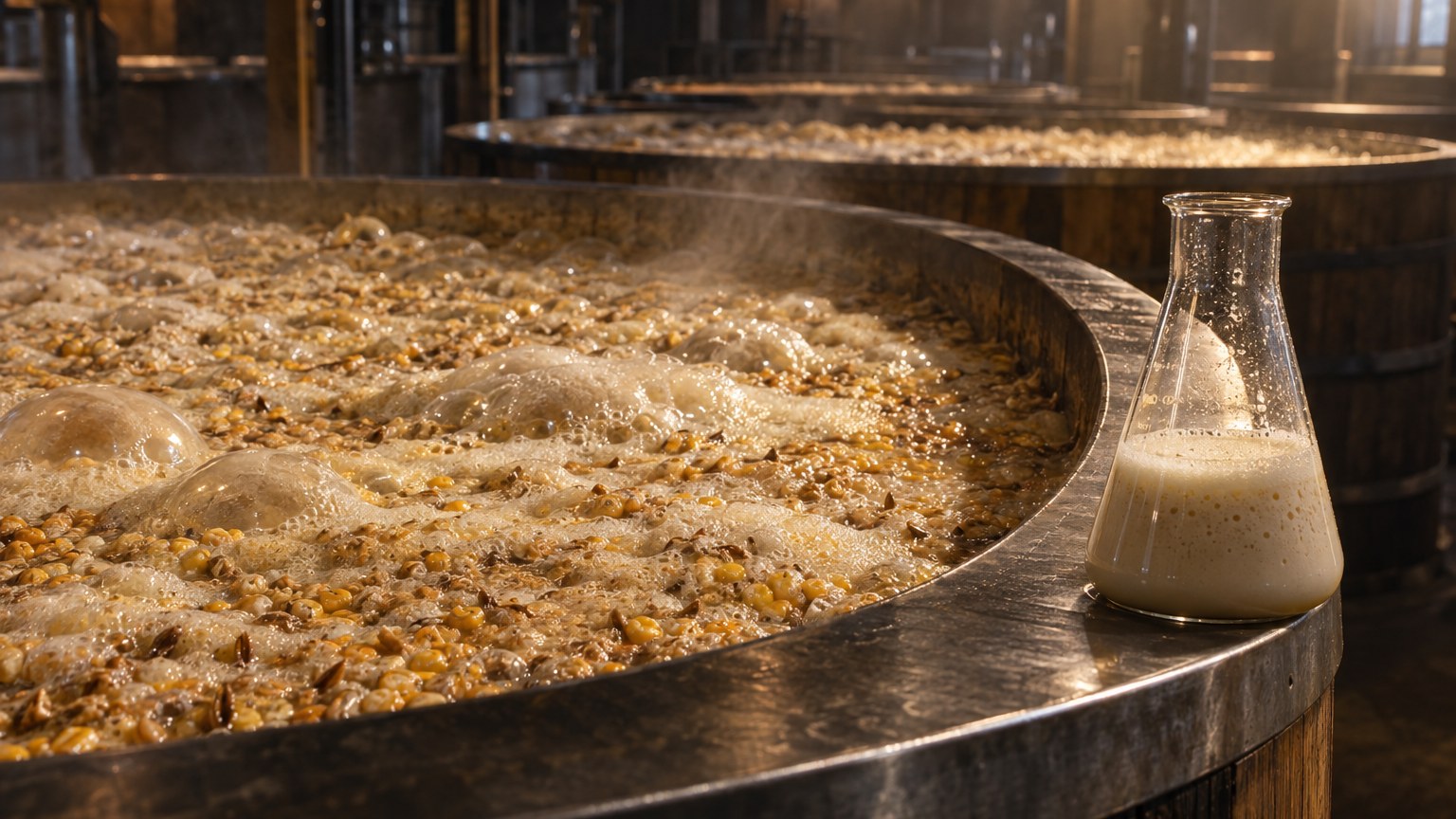
Same how?
Yellowstone Family Recipe A recipe or production method a distilling family says it has passed down across generations — a claim about lineage and knowledge, not a guarantee that the liquid is chemically identical to what an ancestor once made. Open in Dictionary → , the 2022 Limestone Branch release made by Minor Case Beam’s great-grandson Stephen Beam, is built on a genuinely striking claim: that the whiskey uses yeast cloned from an antique ceramic jug that belonged to Minor Case Beam himself, alongside recipe notes handed down from his son, Guy Beam. It’s a wonderful story. It also deserves the same careful vocabulary this whole issue has been insisting on.
- Yeast strain — a specific, genetically distinct population of yeast cells
- Yeast culture — a living, propagated batch descended from a strain
- Propagation — growing more yeast from an existing culture, generation after generation
- Genetic continuity — whether a modern culture's DNA still matches its claimed ancestor
Here’s what’s genuinely possible: dormant, dried yeast cells can survive for decades under the right conditions, protected inside a hard protective shell they form when starved of food and moisture — and a lab can revive even a small surviving population and grow it back into a usable culture. That’s real, documented microbiology, not science fiction. Here’s what’s a much bigger claim: that a culture propagated for years afterward — divided, refed, regrown batch after batch — remains genetically and functionally identical to whatever was dormant in that jug a century ago. Every generation of propagation is an opportunity for mutation and drift. “The same yeast” gets fuzzier, not clearer, the longer a culture has been kept alive and growing.
Bourbon School Yeast Strain vs. Yeast Culture What 'the same yeast' actually claims — and how much of that claim a lab can and can't verify.None of that makes Yellowstone Family Recipe’s story false. It makes it a claim worth holding with an open hand rather than repeating as settled fact — exactly the same posture this issue has taken toward Jim Beam’s own yeast story a few sections back. Both companies are telling a version of the same tale: something survived, something was carried forward, something connects the modern bottle to a real ancestor. Whether the yeast itself is the mechanism, or whether the mechanism is really the recipe notes and the family member who chose to revive them, is a question no bottle label can settle for you.
Branch C — Minor Case / Yellowstone
A recipe, a jug, and a family tie that keeps changing shape.
One more ownership fact, stated as carefully as Heaven Hill’s: no Beam has ever owned the Yellowstone brand, but for four decades it was run by the Dants, the other half of Stephen Beam’s family.
Yellowstone was created around 1872 by Taylor & Williams, a Louisville wholesale house, and named for the new national park. In the 1880s the firm contracted J.B. Dant to make it at his Cold Spring distillery at Gethsemane, in Nelson County. By 1900 Dant was running Taylor & Williams, and around 1910 the company bought the neighboring Gethsemane distillery of Minor Case Beam. Until Prohibition, the Yellowstone complex was run by members of the Dant and Beam families. (The brand’s own telling credits the Dant family with the 1872 whiskey; independent historians credit Taylor & Williams with creating the brand and date Dant’s production to the 1880s.) Limestone Branch’s history adds that Guy Beam, Minor Case’s son, distilled at Yellowstone among several distilleries; no source we found gives the dates.
During Prohibition, Yellowstone was sold as medicinal whiskey under another company’s permit; sources disagree about whose. After repeal, the Dants built a new Yellowstone distillery in Shively, outside Louisville, and in 1944 sold the brand to Glenmore. Guinness bought Glenmore in 1991 and folded it into United Distillers, which sold Yellowstone in 1993 to the David Sherman Company, renamed Luxco in 2006. From 1944 until 2015, the sources we found show no family hand in it at all.
Then, in 2010–11, Minor Case’s great-grandsons Stephen and Paul Beam, Dant descendants on their mother’s side, founded Limestone Branch. At the start of 2015, Luxco bought half of the distillery and began making Yellowstone there, from what the brothers describe as the original recipe, while keeping the brand itself. MGP bought Luxco, and Limestone Branch with it, in 2021.
Yellowstone, 1865–2025 · drawn to true time
Contractor. Owner-operator. Distiller. Gone for generations. Distiller again.
The family connection kept changing shape.
Stephen Beam didn’t inherit the Yellowstone brand. He inherited a family’s whiskey-making knowledge, and Yellowstone hired it.
That’s not a lesser story than “the family brand came home.” It’s arguably a more honest and more interesting one: a company (Luxco, then MGP) chose to partner with a specific family specifically because of what that family’s name and knowledge represented in Kentucky whiskey history — production and knowledge lineage doing real commercial work, with brand ownership sitting somewhere else.
Booker Noe — Premium Bourbon
What did Booker teach drinkers to value?
Set the invention question aside — it’s already been answered above, carefully — and ask a better one. Before Booker’s, “good bourbon” in most American drinkers’ minds meant an easy, consistent, blended-to-a-house-style pour. Booker’s asked drinkers to accept the opposite: unfiltered, uncut, whatever proof the barrel actually produced (commonly in the 121–130-plus range), batch to batch variation as a feature rather than a flaw to be engineered away. That’s a real shift in what “premium” was allowed to mean, and it predates — and arguably helped set the stage for — the modern single-barrel and barrel-proof category that now fills an entire section of any serious bourbon shelf.
Freddie Noe
Inheritance becomes invention.
Freddie Noe, eighth-generation Beam distiller, runs Little Book — an annual, deliberately experimental blending series that treats “inheritance” as raw material rather than a finished answer. Two releases make the point concretely.
Little Book Chapter 3: “The Road Home” (2019) blended four whiskeys, one from each bottle in his grandfather Booker’s original Small Batch Collection: a nine-year-old Knob Creek, a nine-year-old Basil Hayden’s, an eleven-year-old Booker’s and a twelve-year-old Baker’s, bottled uncut at 122.6 proof. Booker Noe spent a career keeping those four ideas distinct from one another. His grandson’s entire creative act was putting them back together.
Little Book Chapter 3 · The Road Home · 2019
Grandfather creates four whiskey ideas. Grandson blends them back into one.
Little Book The Infinite takes the same instinct further. Its most recent release, Edition II, blends whiskeys distilled by three different generations of the same family at once — a seven-year-old, a ten-year-old and a twenty-two-year-old, credited respectively to Freddie, Fred and Booker Noe’s own distilling work, bottled at cask strength (120.8 proof) with a portion of the prior year’s edition carried forward into the blend (Beam hasn’t published the exact ratio). It’s explicitly designed as a perpetual, evolving series rather than a one-off — meaning every future edition will, by design, keep carrying a little of the last one forward.
Collect Smarter
Build the family reunion.
Six bottles. Six different meanings of “related.” Availability and pricing checked as of this issue’s research — bourbon lineups shift often, so treat proof/price as a snapshot, not a permanent spec.
01
Jim Beam Black
Baseline
The modern house baseline — currently a 7-year, 90-proof bourbon
TeachesWhat the everyday Beam house style tastes like with no special selection applied.
Taste ForYour control glass for everything else on this list.
02
Knob Creek 9 Year, 100 Proof
Family
Booker Noe's small-batch vision, matured and made permanent
TeachesWhat Booker's original small-batch idea looks like as a full-proof, age-stated core release.
Taste ForStructure, at real proof, with real age behind it.
03
Booker's
Family
Booker Noe's own name, uncut and unfiltered
TeachesWhat bourbon tastes like with nothing softened — batch-to-batch proof and all.
Taste ForIntensity as a deliberate choice, not an accident.
04
Old Grand-Dad Bottled-in-Bond
Brand
Basil Hayden Sr.'s high-rye recipe, under federal bond
TeachesThe actual high-rye mash bill Basil Hayden's is a lower-proof expression of.
Taste ForCompare directly against Basil Hayden's to taste what proof alone changes.
05
Elijah Craig Small Batch
Production
Heaven Hill — not Beam-owned, built by the Park/Earl/Parker Beam line
TeachesThat a genuinely competing company can share a distilling family without sharing a drop of liquid.
Taste ForA completely different house style, made by a Beam.
06
Yellowstone Family Recipe
Knowledge
Stephen Beam's reconstructed family history, at Limestone Branch
TeachesWhat it looks like when a family's knowledge outlives every company that ever owned the brand around it.
Taste ForThe newest, most self-consciously 'inherited' bottle on this list — judge the claim for yourself.
The Ledger Flight
Two experiments, one honest limitation.
Flight A — The House
Question: Can you find a house resemblance as proof, age and selection change, all inside one actual company?
Taste for
- Same production system
- Rising proof
- Rising selection intensity
- A throughline, if there is one
This one is about as controlled as home tasting gets: three bourbons from one real production system, at three different proof points and selection philosophies. If there’s a “house style” to Beam’s bourbon at all, this is where you’d expect to actually taste it.
Flight B — The Bloodline
Question: Can you taste family lineage across three completely different companies?
Taste for
- Different mash bills
- Different yeast
- Different stills, warehouses, and blending decisions
- Whatever's actually left over
Flight B is the harder, more honest experiment — and it’s designed to test a premise, not confirm one. Mash bill, yeast, still design, barrel char, warehouse position, barrel selection, blending and proof can all differ completely between these three bottles, because they’re made at three unrelated companies. If you taste a genuine family resemblance across all three, that’s a real, interesting result worth sitting with. If you don’t, that’s also a real result — and arguably the more scientifically honest outcome, because genealogy is a documented historical fact and flavor is a production outcome, and nothing guarantees the first one survives into the second.
The Ledger Cocktail
The Inheritance.
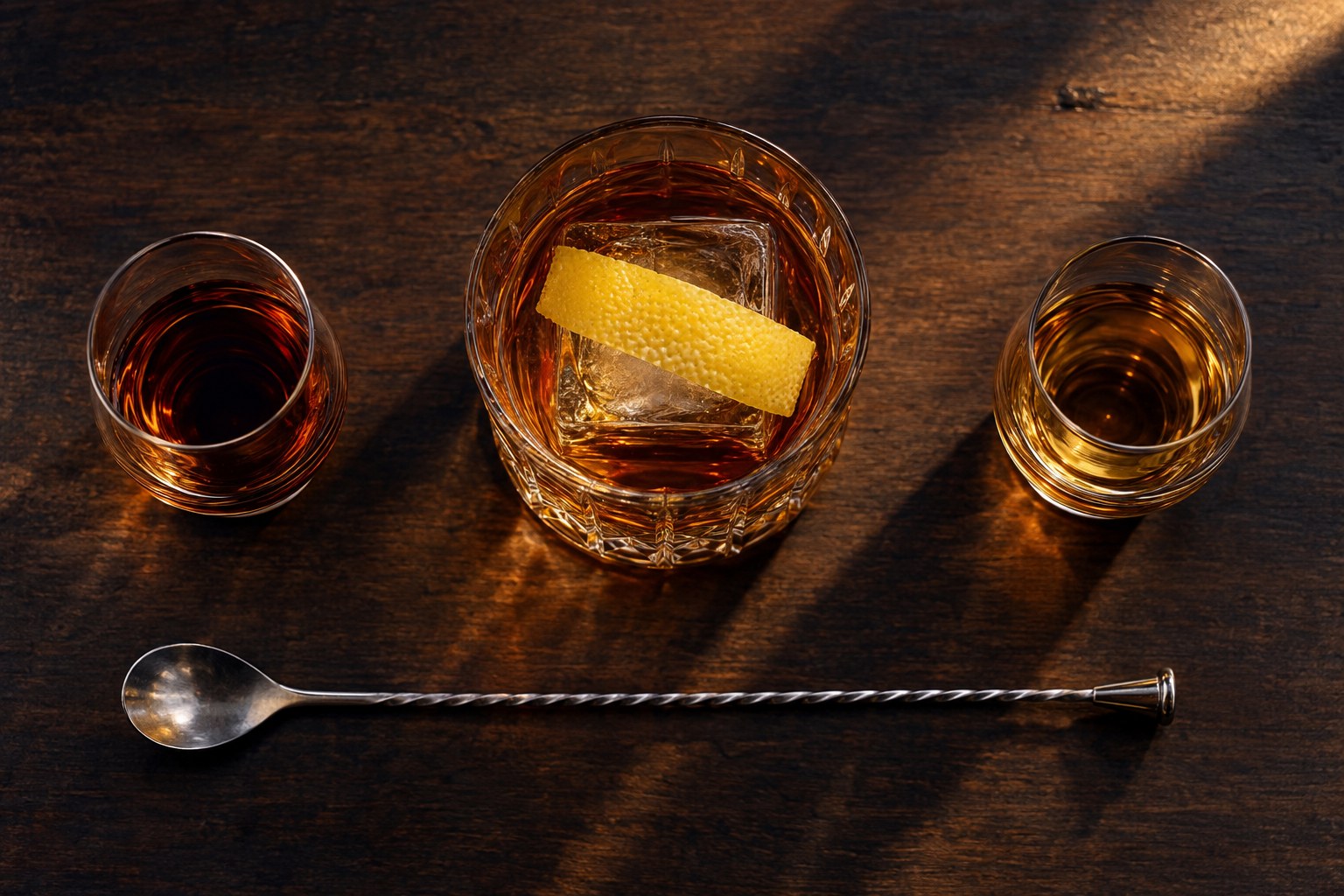
The family’s distilling knowledge split in 1935, when Heaven Hill hired Jim Beam’s cousin Joseph as its first Master Distiller. Jim Beam’s own line stayed with the company that carries his name, and two generations later produced Booker Noe and Knob Creek. Jim’s brother Park’s line went to Heaven Hill too, where Park’s grandson Parker Beam launched Elijah Craig in 1986. Two bourbons from two competing companies, with one family’s knowledge behind both.
The Inheritance puts one bourbon from each branch back in the same glass.
The structure underneath is older than both branches. The earliest known printed definition of a “cocktail,” in a Hudson, New York newspaper, The Balance and Columbian Repository, on May 13, 1806, calls it “a stimulating liquor composed of spirits of any kind, sugar, water and bitters.” That’s the Old Fashioned’s skeleton, and it’s what this drink is built on. The real work is getting two different bourbons to sit together inside it.
An even split only works if the rest of the build accounts for how the two bourbons differ. Here’s what we weighed, from each bourbon’s published proof and tasting notes:
| Factor | Knob Creek 9 Yr · Elijah Craig Small Batch | What the recipe does |
|---|---|---|
| Proof | 100 proof vs. 94 proof | Equal parts land near 97 proof before stirring: enough backbone to take dilution without going thin. |
| Oak | Robust, charred oak vs. toasty, 'pleasantly woody' | Two oak voices already, so no wood-forward modifier: no amaro, no vermouth. |
| Sweetness | Caramel that finishes dry vs. vanilla bean and caramel, the rounder of the two | Just 1 tsp of rich demerara syrup, because Elijah Craig and the sherry bring sweetness of their own. |
| Nuttiness | Roasted nuts (tasters often say peanut) vs. only light nut | ¼ oz oloroso sherry. Its walnut note picks up Knob Creek's nuttiness and gives both bourbons a shared middle. |
| Spice | Peppery spice that builds vs. nutmeg, baking spice and a hint of mint | Two dashes of Angostura, whose clove and cinnamon sit between the two spice profiles. |
| Texture | Full, with drying tannin vs. softer and smoother | Equal parts: Elijah Craig rounds Knob Creek's grip without hiding it. |
| Acidity and aroma | Neither needs juice | No citrus juice. An expressed lemon peel lifts the nose and trims sweetness without making it sour. |
| Dilution | Both are strong enough to open up with water | Stir 25–30 seconds and serve over one large cube: about 3 oz in the glass at roughly a third alcohol, opening slowly as the cube melts. |
| Carbonation | None | Bubbles would thin the texture the two bourbons build together. |
We considered weighting the pour. More Knob Creek pushes the drink toward one branch’s dry oak. More Elijah Craig softens it toward dessert. At equal parts, each bourbon covers the other’s weak spot, so the editorial idea and the balance point land in the same place.
A live tasting bore that out. Knob Creek brought the firmer oak, leather and nut, an oily structure and a rye-driven finish. Elijah Craig brought creamier vanilla and caramel, some fruit and softer baking spice. Neither disappeared, and the oloroso bridged the two without taking over. The drink is best in its first few minutes, when the dilution helps it; left too long, the melting cube thins it out. That’s one tasting, not a universal verdict, but the equal split worked in the glass as well as on the page.
Ledger Lab — Tested Recipe
The Inheritance
Ingredients
- 1 oz Knob Creek 9 Year, 100 proof
- 1 oz Elijah Craig Small Batch, 94 proof
- ¼ oz oloroso sherry
- 1 tsp rich (2:1) demerara syrup
- 2 dashes Angostura bitters
- Wide lemon peel
Method
- Add both bourbons, the oloroso, the demerara syrup and the bitters to a mixing glass with cold ice.
- Stir for 25–30 seconds, until properly chilled and diluted.
- Strain into a chilled rocks glass over one large clear cube.
- Express a wide lemon peel over the drink and lay it across the cube. No cherry.
Drink it early. Stirring and the first minutes on the cube improve it; as the cube keeps melting, the drink eventually thins.
Cocktail Ledger Lab
Can you taste both branches?
| Glass | Whiskey | Listen for |
|---|---|---|
| 1 — Beam / Noe | 2 oz Knob Creek 9 Year | Roasted nut, dry oak, a peppery finish |
| 2 — Park / Heaven Hill | 2 oz Elijah Craig Small Batch | Vanilla, nutmeg, a rounder, sweeter middle |
| 3 — The Inheritance | 1 oz of each | Do you find both, or does one branch take over? |
Build the first two exactly like The Inheritance, with one bourbon doubled, then taste all three in order. If glass 3 tastes like glass 1, shift ¼ oz toward Elijah Craig. If it tastes like glass 2, shift it back toward Knob Creek. That adjustment is the whole issue in miniature: the two branches share a family, not a flavor, and whether they get along in one glass is something you find out by tasting, not by reading the family tree.
Deep Cut
The shelf answers one question. History answers another.
The family didn’t just pass down a recipe. Across three companies and eight generations, what actually crossed every gap — Prohibition, a change of employer, a change of brand owner, a change of company entirely — wasn’t a piece of paper or a jug. It was fermentation knowledge. Distillation judgment. An eye for which barrels to pull and which to leave. Institutional memory that had to be re-taught, in person, by someone who already knew it, every single time a new generation or a new company needed it.
The most important thing the Beam family passed down may not be a recipe. It may be knowledge.
The shelf organizes whiskey by brand. History organizes whiskey by people. Both answer real questions. They’re not the same question.
Fully illuminated. Everything else below is real — and not yet drawn.
ONE FAMILY DOWN.
Every name above is real, and every one of them belongs somewhere in American bourbon’s larger human story. Two of them already appear in this issue’s company history: the Shapiras, who own Heaven Hill, and J.B. Dant, who founded Yellowstone. We haven’t mapped any of these families’ own trees here, or drawn family lines between them and the Beams — not because those connections don’t exist, but because we haven’t verified them yet, and this issue’s entire standard has been to say so plainly instead of guessing.
Go Deeper
- Jim Beam — Beam History (opens in a new tab) The brand's own account of Jacob, David, David M. and Jim Beam, and the Prohibition rebuild.
- Distillery Trail — The Complete James B. Beam Distilling Co. Timeline (opens in a new tab) A detailed year-by-year company timeline, including the 1992 Small Batch Collection launch.
- Wikipedia — Jim Beam (opens in a new tab) General company history and generational succession, cross-checked against other sources.
- Wikipedia — Booker's (opens in a new tab) Booker's 1988 limited release and 1992 formal Small Batch Collection launch.
- Wikipedia — Knob Creek (bourbon) (opens in a new tab) Knob Creek's 1992 launch and 2016/2020 age-statement history.
- Wikipedia — Basil Hayden's (opens in a new tab) The 1992 launch and the brand's naming history.
- Wikipedia — Old Grand-Dad (opens in a new tab) R.B. Hayden's founding of the brand and its ownership history through National Distillers to Beam.
- Chuck Cowdery Blog — Are Basil Hayden and Old Grand-Dad the Same? (opens in a new tab) An independent, skeptical look at the shared mash-bill claim between the two brands.
- Wikipedia — Heaven Hill (opens in a new tab) The Shapira family's 1935 founding and continuous ownership.
- Whiskey University — Heaven Hill's Founders (opens in a new tab) Joseph L. Beam, Harry Beam, Earl Beam, Parker Beam and Craig Beam's succession as Heaven Hill Master Distillers.
- Taste Select Repeat — Who Was Parker Beam? (opens in a new tab) Parker Beam's career, Elijah Craig's 1986 small-batch launch, and his 1960 start date at Heaven Hill.
- Heaven Hill — Celebrating 15 Years of Parker's Heritage Collection (opens in a new tab) The Collection's 2007 launch, Parker Beam's 2010 ALS diagnosis, and the ALS Association fundraising tie-in since 2013.
- Whisky Advocate — Heaven Hill Master Distillers Unity (opens in a new tab) Confirms Conor O'Driscoll as Heaven Hill's current Master Distiller alongside Parker Beam and Denny Potter's legacy.
- Wikipedia — Evan Williams (bourbon) (opens in a new tab) Evan Williams' 1957 launch as Heaven Hill's flagship, predating Parker Beam's tenure.
- Wikipedia — Yellowstone Bourbon (opens in a new tab) The brand's ownership chain through Glenmore, United Distillers, David Sherman/Luxco and MGP.
- MGP — Limestone Branch Distillery Launches Yellowstone Family Recipe (opens in a new tab) The official announcement, including the Minor Case Beam yeast-jug and Guy Beam recipe-notes claims.
- Fred Minnick — Limestone Branch to Launch Family Recipe Bourbon (opens in a new tab) Independent trade coverage of the 2022 launch, proof and pricing.
- Suntory Global Spirits — Freddie Noe Releases Little Book Chapter 3 (opens in a new tab) Official confirmation of Chapter 3's four-whiskey blend from the original Small Batch Collection.
- Whisky Advocate — Little Book The Infinite: Edition II (opens in a new tab) The multi-generational Booker/Fred/Freddie blend, its ages, proof and carryover design.
- Suntory Global Spirits — Freddie Noe Announced as 8th-Generation Master Distiller (opens in a new tab) Confirms the 6th/7th/8th generation numbering used throughout this issue.
- Wordhistories — 1806: Earliest Definition of 'Cocktail' (opens in a new tab) The Balance and Columbian Repository's May 13, 1806 definition, with original wording.
- Chuck Cowdery — History of Yellowstone, Parts One and Two (opens in a new tab) Taylor & Williams' creation of the brand, J.B. Dant's contract production, the c. 1910 purchase of M.C. Beam's distillery, Shively and Glenmore.
- Chuck Cowdery — The Genealogy of Beam Yeast (opens in a new tab) David Beam's three distilling sons; Minor Case and Joseph L. Beam as brothers; Earl replacing Harry at Heaven Hill in 1946.
- Jack Sullivan — The Dants Permeated Kentucky Distilling (opens in a new tab) J.W. and J. Bernard Dant, the Cold Spring distillery, and Dant's leadership of Taylor & Williams from 1900.
- Luxco — Luxco Acquires an Interest in Limestone Branch Distillery (opens in a new tab) The 2015 50% equity position and joint operation, with Yellowstone production moving to Limestone Branch.
- Shanken News Daily — Luxco Acquires 50% Stake in Limestone Branch (opens in a new tab) Luxco keeps its Yellowstone brand while moving production to Limestone Branch.
- Limestone Branch — About (opens in a new tab) The distillery's own family history: Minor Case Beam, Guy Beam's work at Yellowstone and other distilleries, and Stephen Beam's lineage.
- Heaven Hill — Launch of Larceny Kentucky Straight Bourbon (opens in a new tab) Larceny's 2012 launch as Heaven Hill's wheated bourbon, heir to the Old Fitzgerald line.
- Beam Distilling — Little Book Chapter 3: The Road Home (opens in a new tab) The four components (9-year Knob Creek and Basil Hayden's, 11-year Booker's, 12-year Baker's) and 122.6 proof.
- The Whiskey Wash — Little Book The Infinite: Edition II (opens in a new tab) Edition II's 120.8 proof and its carried-forward portion of Edition I.
- Knob Creek — 9 Year Bourbon (opens in a new tab) The brand's own proof and tasting notes, used to design The Inheritance.
- Heaven Hill Distillery — Elijah Craig Small Batch (opens in a new tab) 94 proof and the distillery's own tasting notes, used to design The Inheritance.