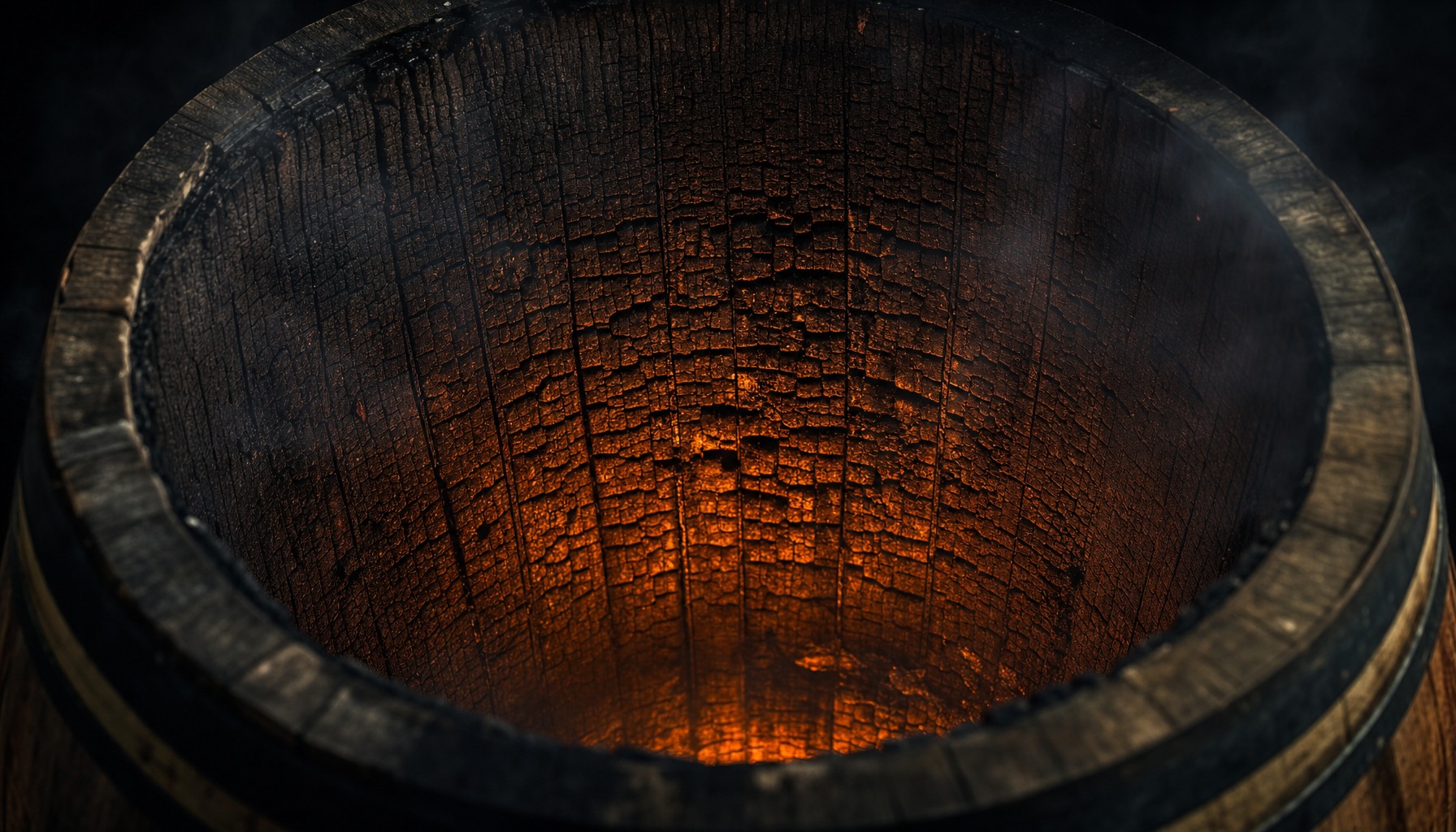
Most bourbon drinkers learn the mash bill first. Corn brings sweetness. Rye brings spice. Wheat softens the profile. Malted barley helps make fermentation possible in the first place.
That’s useful. It’s also incomplete. The clear spirit leaving the still doesn’t yet look, smell or taste like the bourbon in your glass. Something enormous happens next.
We put it inside a tree.
The barrel is not where whiskey waits. It is where whiskey changes.
This Master Class is built around one idea: the barrel isn’t a single spec you can read off a label. It’s a system — a chain of decisions made by a forest, a cooper, a fire, a distiller and a warehouse, stacked on top of each other, long before the whiskey inside is ready to drink.
Before There's a Barrel
There’s a Tree
American whiskey cooperage runs overwhelmingly on one species: American white oak, Quercus alba. It’s not the only oak in the world, and it isn’t oak’s only use — French and European oaks such as Quercus petraea and Quercus robur are the traditional workhorses of wine cooperage and increasingly show up in whiskey finishing, with their own distinct tannin, phenolic and structural profiles. But the classic bourbon barrel is new charred American white oak, and that’s a specific, deliberate choice, not a default.
Independent Stave notes that American white oak carries relatively high levels of tyloses — structures that plug the wood’s internal vessels — along with oak lactones and aromatic components including vanillin. Tyloses are part of what makes white oak liquid-tight in the first place; a species without them wouldn’t hold whiskey without a liner. Cooperage-grade oak is heavily sourced from regions including the Ozarks and Appalachians, where growing conditions have historically favored the tight, usable grain a cooper needs.
None of that is uniform. A tree isn’t a raw material the way a sheet of steel is — forest origin, climate, soil, growth rate and grain all vary from one stand of oak to the next, and all of it eventually shows up in the barrel. Cooperage-quality oak can be many decades old before it’s ever selected for cutting.
Seasoning
Wood That Has Already Started Changing
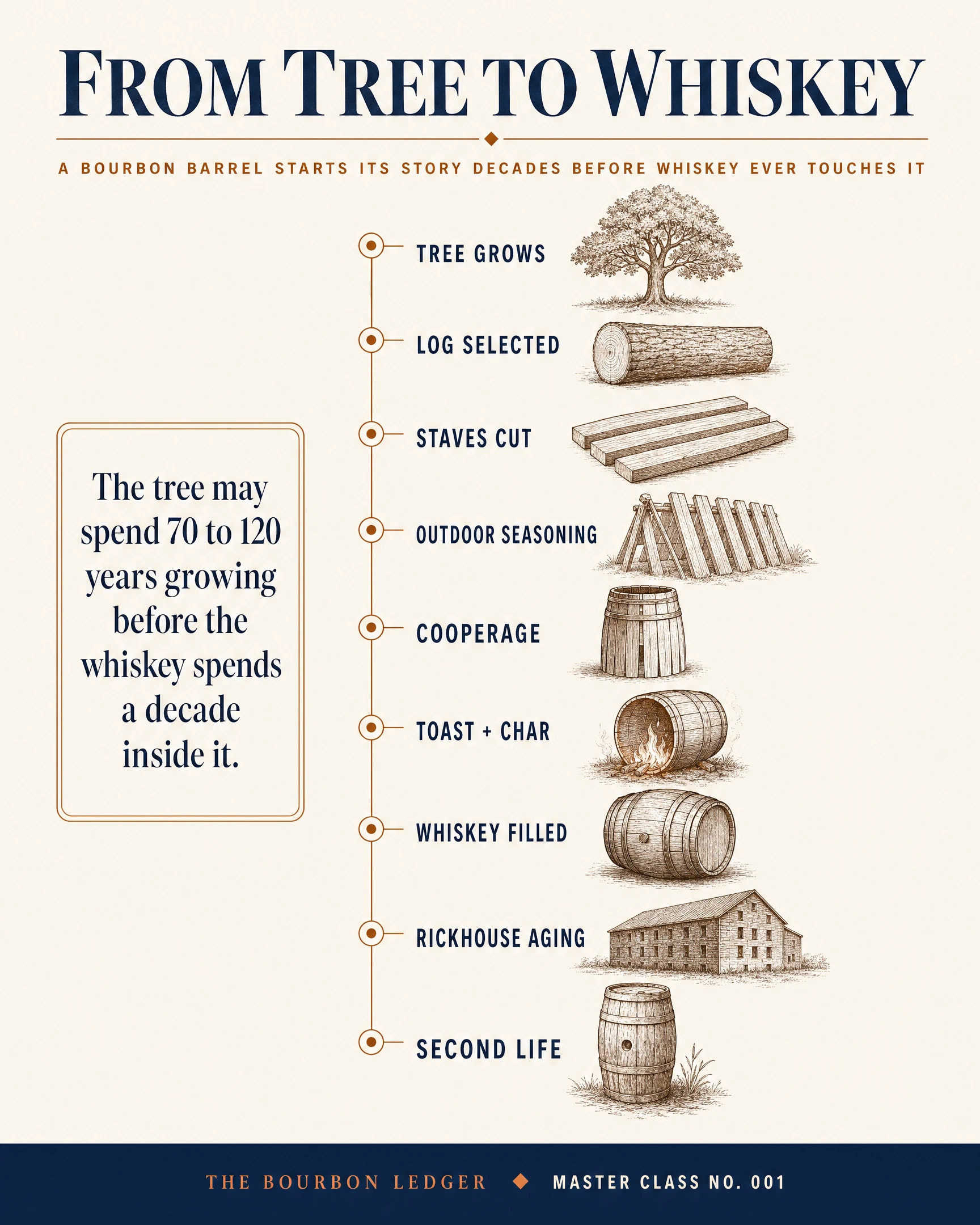
Once a log is milled into staves and other cooperage components, the wood is commonly seasoned outdoors before it ever meets fire. Rain, air, sun, cold and time act on it. Independent Stave’s own barrel-profiling work describes this seasoning period as more than drying: longer outdoor seasoning gives lignin and hemicellulose more time to break down before heat treatment, while tannins soften — which changes the aromatic compounds available once the cooper finally toasts or chars the wood.
That means the barrel has already begun becoming an ingredient before it is a barrel.
Stave dimensions matter here too, but carefully: stave dimensions can affect the physical relationship between spirit, wood and environment, but stave thickness works together with wood structure, seasoning, construction and heat treatment — it isn’t a lever you can pull on its own and expect a predictable result. Treat any claim that thicker or thinner staves single-handedly “age whiskey faster” or “age it longer” with real skepticism; the honest version of that story always has more than one variable in it.
Barrel Anatomy
How a Barrel Becomes Liquid-Tight
A cooper raises fitted staves into a rough barrel shape, applies temporary hoops, then uses heat and moisture to make the oak pliable enough to bend into its final form. The heads — the circular top and bottom — fit into a groove cut near each end of the staves called the croze. Permanent hoops lock the whole structure under compression.
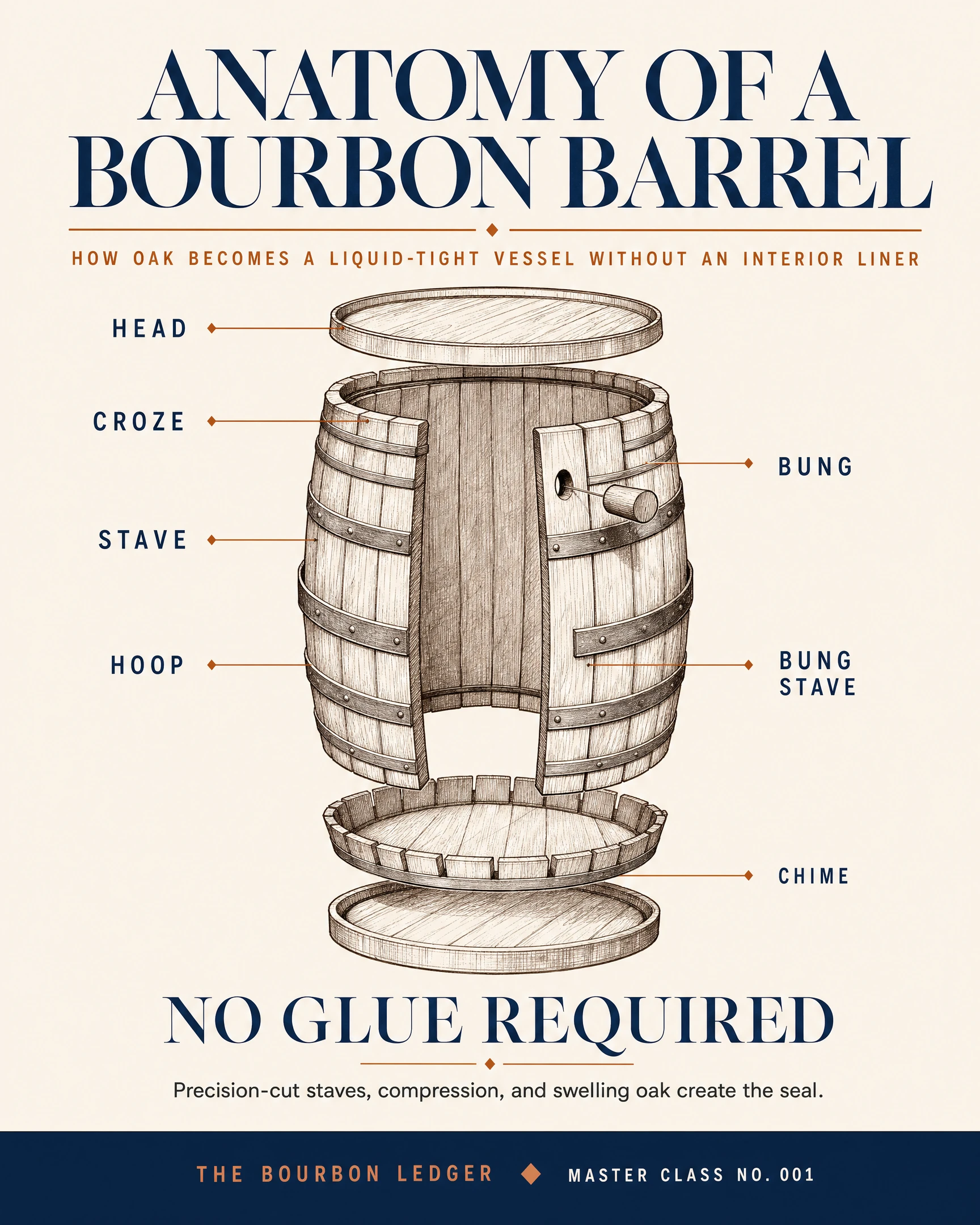
There’s a small glossary worth having on hand for the rest of this Master Class:
- Cooper — a craftsperson who makes barrels
- Cooperage — a barrel-making facility, or barrels collectively
- Stave — one curved wooden piece forming the barrel wall
- Head — the circular wooden top or bottom
- Croze — the groove near each end that the head fits into
- Hoop — a metal band holding the staves under compression
- Bung — the stopper sealing the fill hole
- Bung stave — the stave containing the bung hole
- Chime — the beveled edge at each end of the barrel
Toast vs. Char
Two Different Fires
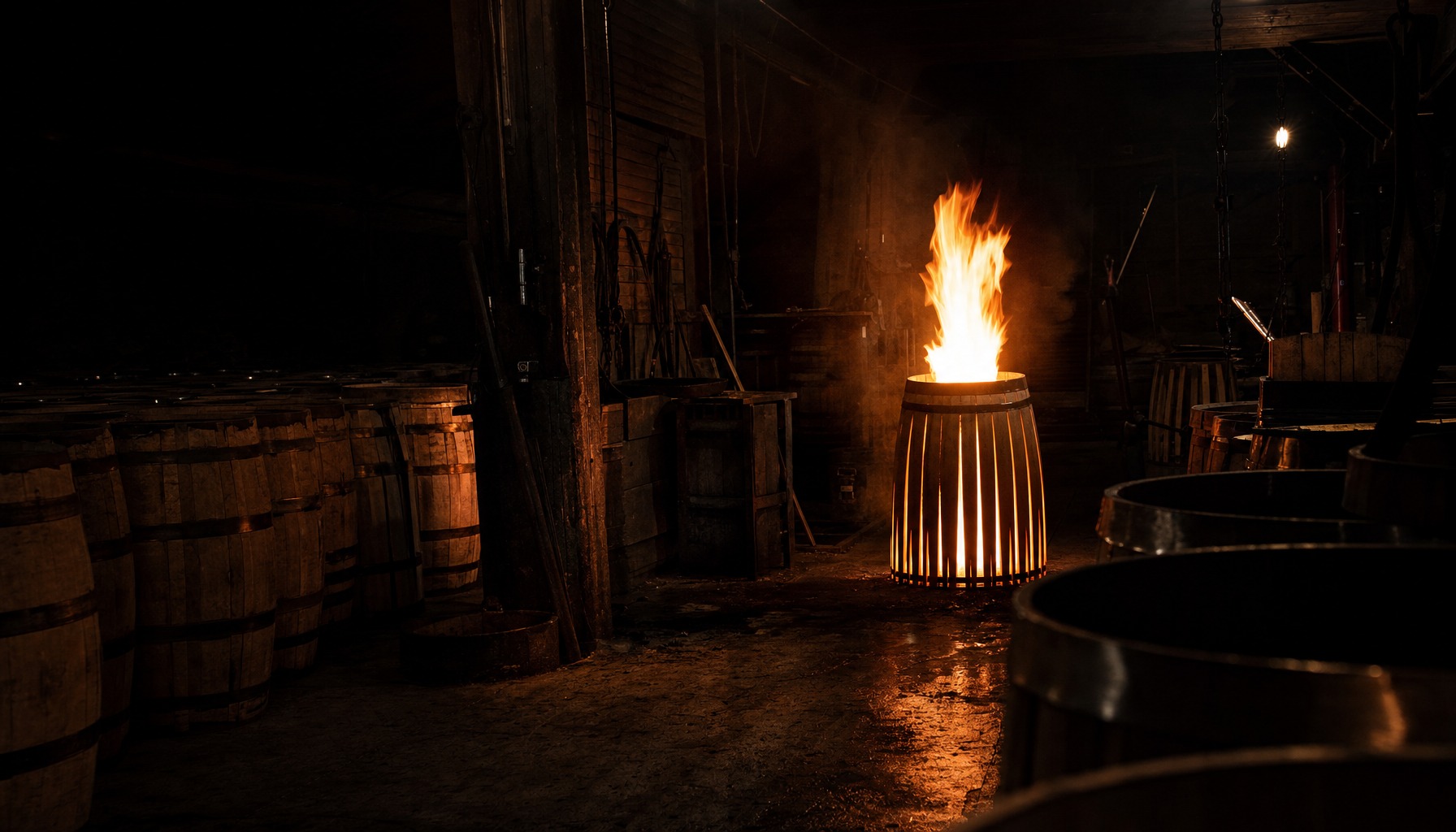
Toasting is a gentler, longer heat treatment. Charring is a much more intense exposure that blackens and burns the interior surface. A barrel can receive both, and cooperages can manipulate the sequence and profile of each to chase different flavor outcomes.
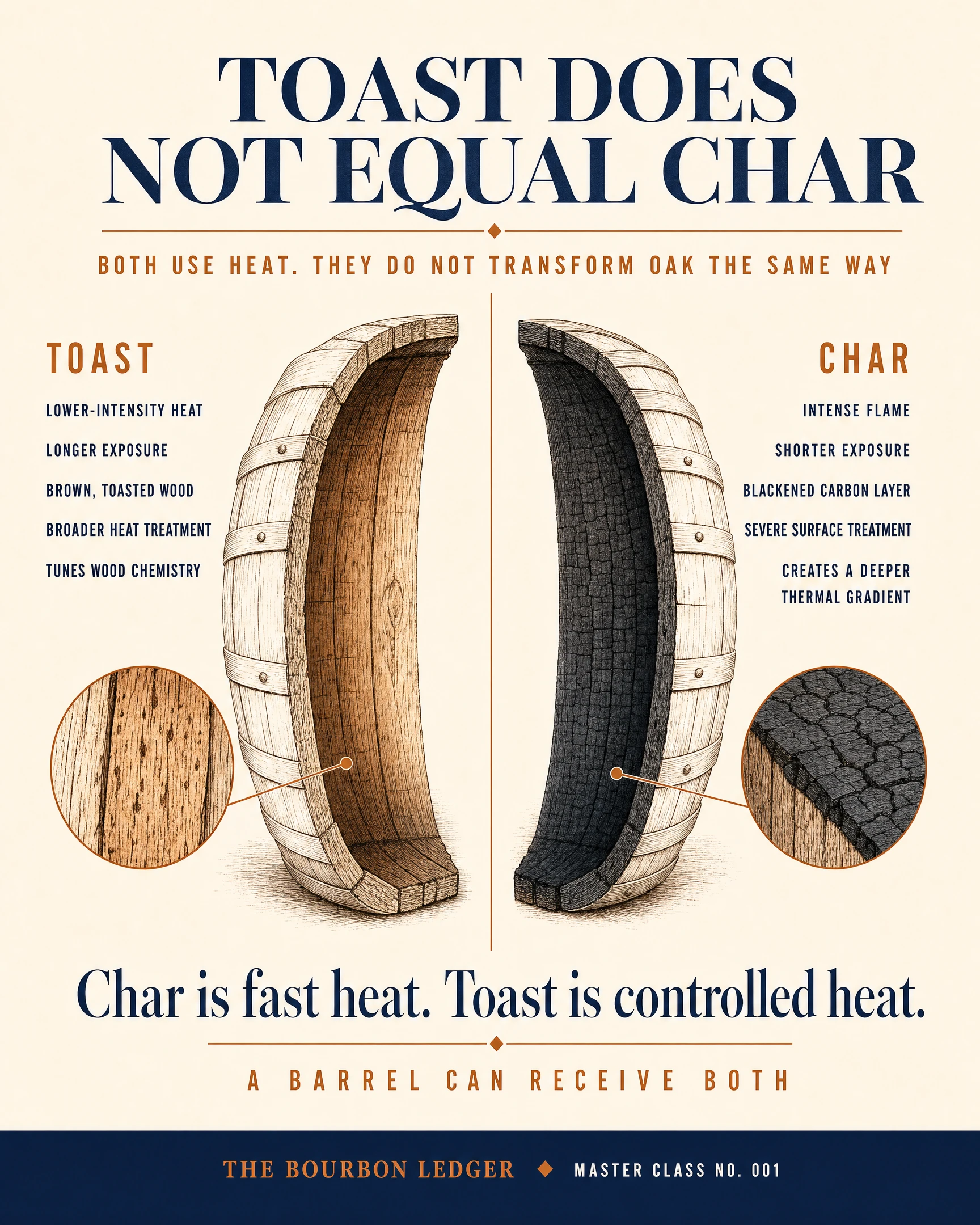
| Toast | Char | |
|---|---|---|
| Heat | Lower, longer | Intense flame, shorter |
| Surface | Brown, toasted wood | Blackened carbonized layer |
| Flavor direction | Caramelized, toasted, spice-driven possibilities | Deeper thermal gradient beneath the char layer |
| Role | Tunes wood chemistry before aging | Required element of bourbon's new-oak storage standard |
Char is fast heat. Toast is controlled heat.
You don’t have to take this on faith — one Elijah Craig bottle exists specifically to prove it. Elijah Craig Small Batch is charred; Elijah Craig Toasted Barrel takes that same matured bourbon into a second, custom-toasted barrel. Heaven Hill has said its early toasted-barrel trials ran too hot and produced smoky notes that overwhelmed the base bourbon’s fruit and spice, before settling on a medium-low heat followed by a controlled increase in time and temperature — a real, documented example of toast and char being tuned as genuinely separate variables, not two names for the same fire.
See it in practice → Elijah Craig: The Bourbon Built Around the Barrel
Wood Chemistry
What Fire Actually Does
Oak is built largely from cellulose, hemicellulose and lignin, along with tannins and other extractives. Heat doesn’t simply “add smoke” — it breaks and rearranges that chemistry.
Hemicellulose contains wood sugars; heating it can produce compounds associated with caramel, toast and sweet aromas. Lignin, a structural polymer, can generate aromatic compounds including vanillin and other aldehydes and phenolics. Academic wood-science literature describes furfural and related compounds emerging from heat-treated hemicellulose, and vanillin-related compounds from lignin transformation. Tannins and other extractives contribute structure, dryness and the astringent edge some older whiskeys carry. Oak lactones — naturally present in the wood, not purely a product of heat — are often associated with coconut and woody sweetness.
Treat these compound families as broad sensory directions, not one-to-one flavor switches. “Lignin makes vanilla” is a useful shorthand, not a guarantee — the same compound families interact with fermentation character, proof, and years of aging before any of it reaches your glass.
Fire doesn’t season the whiskey. Fire prepares the wood to season the whiskey.
Inside the Stave
A Layer Cake, Not a Surface
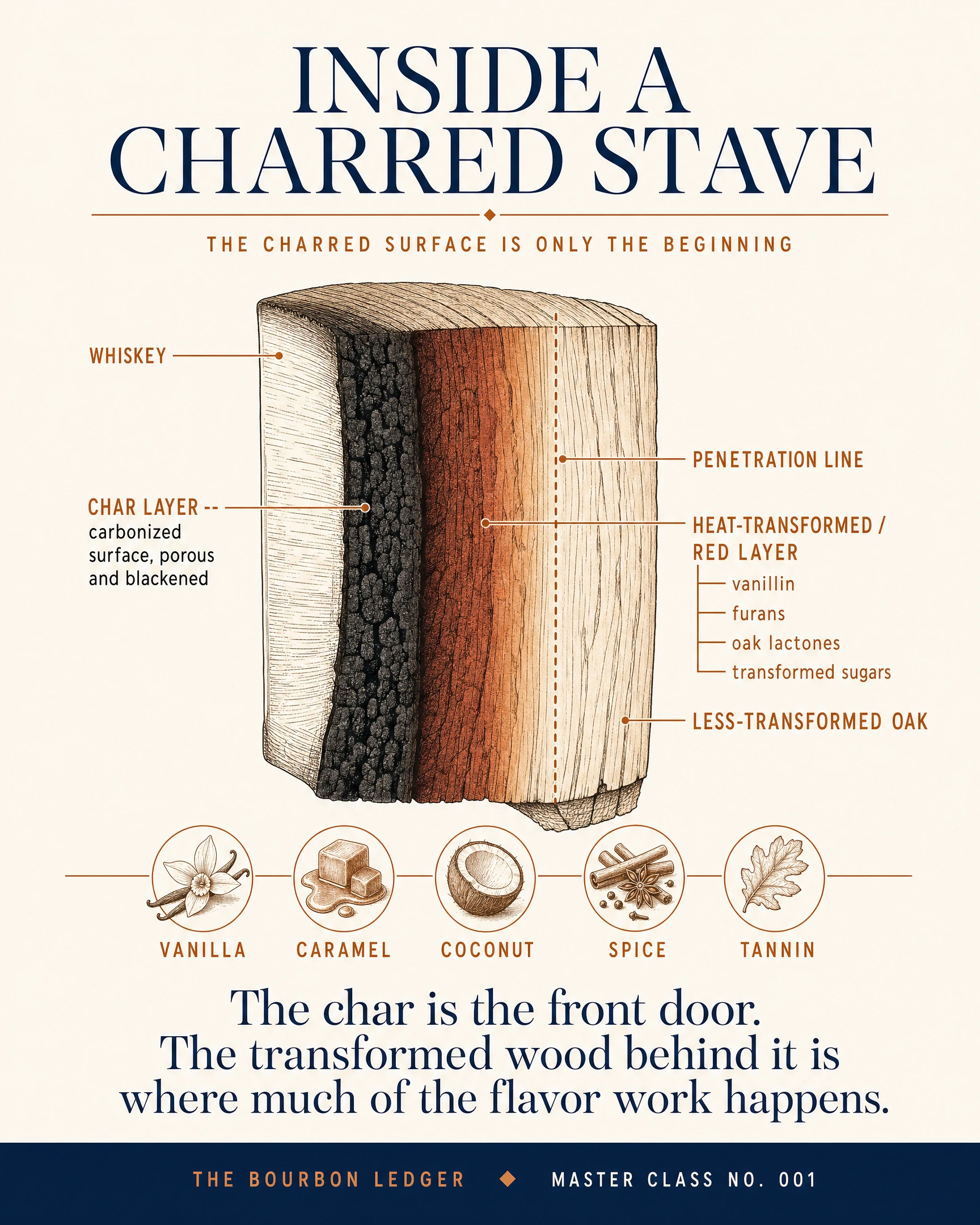
Whiskey doesn’t interact with one homogeneous surface. Think of the stave from the inside outward: a carbonized char layer, a heavily heat-altered layer often called the “red layer,” a more lightly toasted zone beneath that, and progressively less-transformed oak further out. Whiskey moves into this gradient as warehouse temperatures rise and out of it as they fall, extracting different compounds at different depths across years of that cycle.
Char Levels
Why the Number on the Spec Sheet Isn’t the Whole Answer
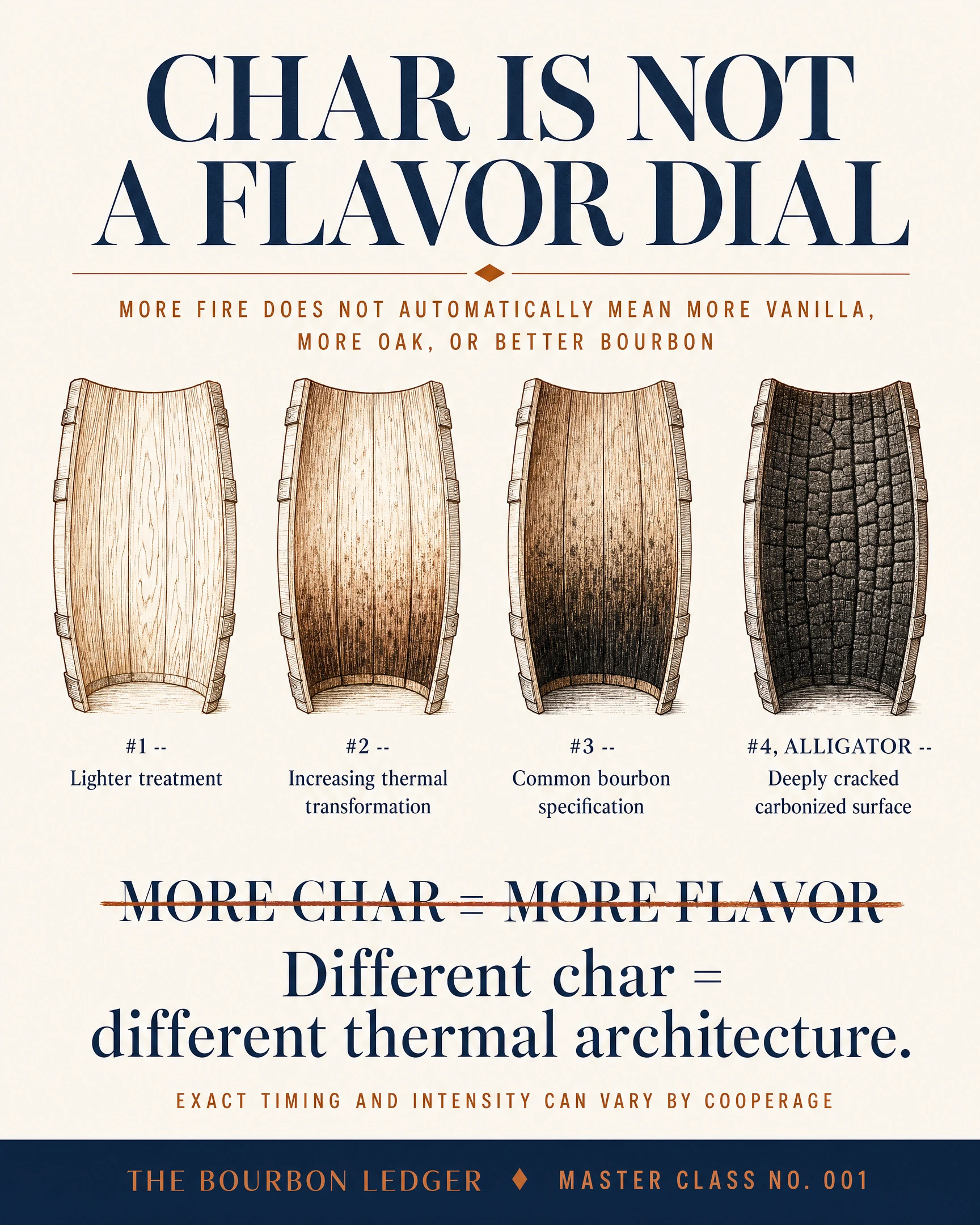
Char numbers are shorthand for a cooperage’s intensity-and-time specification. You’ll commonly hear #1 through #4, with #4 nicknamed alligator char because the cracked black surface can resemble alligator skin. Exact seconds and procedures vary by cooperage, so treat any universal internet chart as a rough guide, not a fixed standard.
Entry Proof
The Proof Decision Nobody Asks About
Bourbon may enter the barrel at no more than 125 proof — a legal ceiling, not a requirement to hit it. Some producers choose to enter wood at a lower proof than the maximum allows. Water and ethanol extract differently from wood, so entry proof is part of the barrel recipe from day one, not an afterthought that only matters at bottling.
The interesting question isn’t only “what proof did they bottle it at?” It’s also: what proof did they put it into wood at?
Rickhouse
Where the Barrel Lives
Temperature, humidity, airflow and a barrel’s specific floor or location inside a rickhouse all shape how whiskey and wood interact over time. Warehouse conditions drive the expansion and contraction that pushes spirit into and out of the wood, and they drive evaporation — the angel’s share — that concentrates what’s left behind. Two barrels filled the same day from the same batch can age into meaningfully different whiskey depending on where in the warehouse each one sits.
A 10-year age statement tells you how long the whiskey lived. It doesn’t tell you what kind of life it lived.
Age + Time
More Time Is Not Automatically Better
Extended aging changes the balance between extraction, oxidation, concentration and tannin — it doesn’t move in a straight line toward “better.” Given enough time, oak can dominate a whiskey entirely: tannin, dryness and astringency can overtake the grain and fermentation character that made the spirit distinctive in the first place.
Old bourbon isn’t impressive because the barrel did more. It’s impressive when the barrel knew when to stop.
The Barrel Lab
Taste the System, Not Just the Spec
Reading about barrel variables only gets you so far. These two labs use widely available bottles to make specific variables tangible — no allocated or hard-to-find whiskey required.
Lab A — Elijah Craig
Question: What did the second heat-treated barrel change?
Taste for
- Caramelized sugar
- Vanilla
- Chocolate
- Baking spice
- Toast
- Oak structure
- Finish
Lab B — Woodford Reserve
Question: Does the second barrel push both whiskeys in the same direction, or does the base whiskey still dominate?
Taste for
- Caramel
- Toasted oak
- Dried fruit
- Baking spice
- Mouthfeel
- Finish length
Straight Bourbon
Woodford Reserve Kentucky Straight Bourbon
The Bottle of the Week in Issue No. 006: a bourbon built from pot-still and column-still whiskey, blended for a consistent, repeatable profile.
Barrel Char vs. Smoked Cocktail
Two Different Uses of Fire
Barrel char is a maturation process: it happens once, years before the whiskey reaches a glass, and it reshapes the wood the spirit will spend years extracting from. Smoking a cocktail is an aromatic finishing technique: it happens in seconds or minutes, at the moment of serving, and it adds a layer on top of an already-finished drink rather than changing the spirit itself. Independent Stave’s own purpose-built smoked barrels — a separate, proprietary cold-smoking process using woods like maple, apple, hickory and peat — are explicitly distinguished by the company from conventional toasting and charring. Smoke character and char character are not interchangeable, whether it’s happening inside a barrel or over a finished drink.
Done lightly, a smoked garnish can reinforce the same oak and caramel notes barrel char already built in. Done heavily, everything just tastes like a campfire.
Ledger Lab
The Charred Orange Old Fashioned
Ingredients
- 2 oz 100–115 proof bourbon
- ¼ oz demerara syrup
- 2 dashes Angostura bitters
- 1 dash orange bitters
Method
- Stir with ice and strain over a large cube.
- Express an orange peel over the drink; briefly flame or char the peel only if you're comfortable doing so safely, keeping flame well away from the drink and any bottles.
Caramel, orange oil and oak naturally reinforce the same barrel-derived flavor family this Master Class has been building all along.
Collector Checklist
What “Custom Barrel” Should Actually Tell You
When a bottle advertises custom or special barrels, the barrel spec worth asking about is longer than a single number:
- Oak species
- Forest / source
- Growth rate / grain
- Stave cut
- Stave thickness
- Seasoning duration
- Moisture at construction
- Toast profile
- Char level
- Barrel size
- Entry proof
- Warehouse location
- Age
- Finishing vessel (if any)
- Finishing duration
The Barrel Variable Map
The Whole System, in One Place
This is the synthesis of everything above: tree, stave, fire, spirit, place and time, each with its own sub-variables, all feeding into what ends up in your glass.
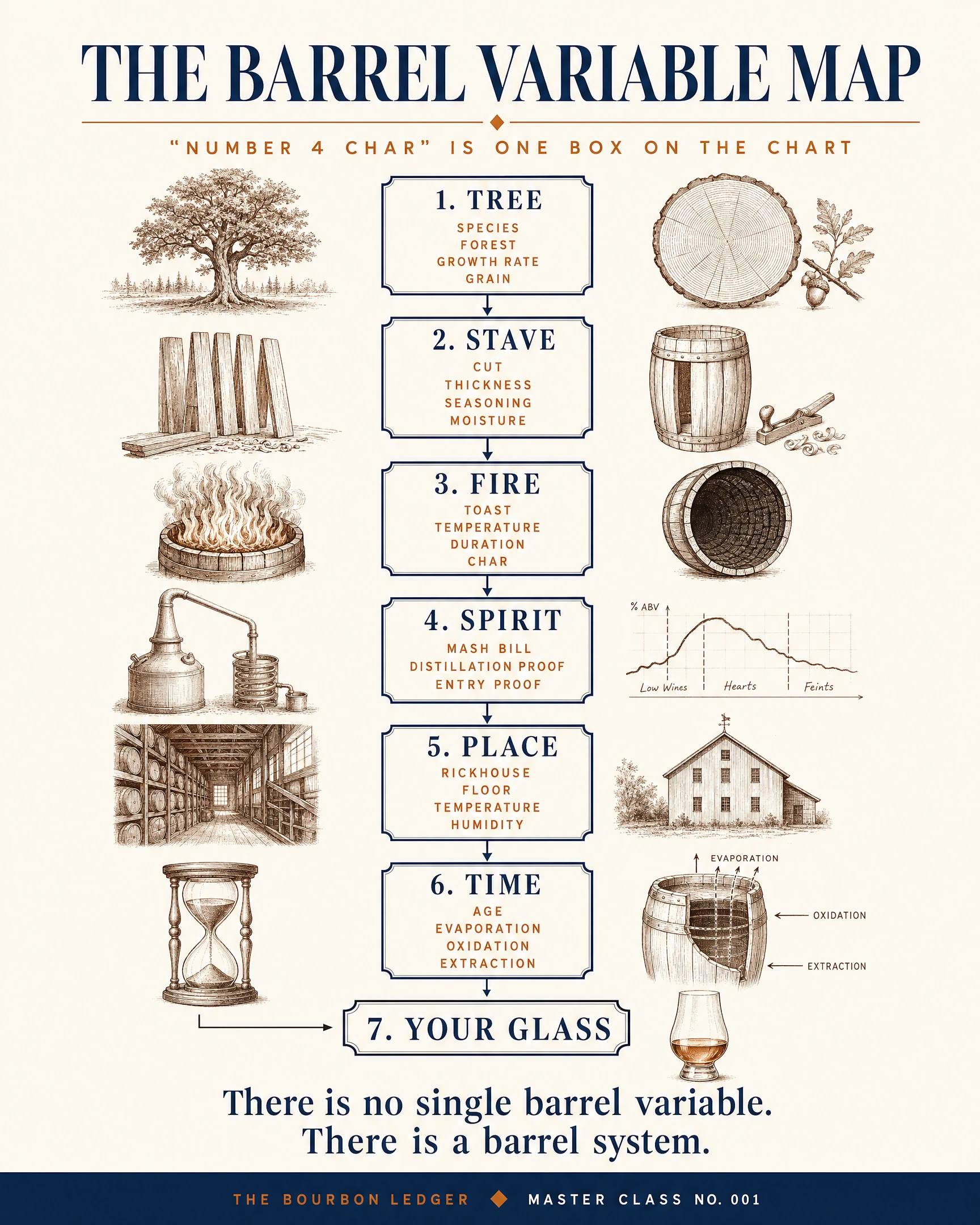
There is no single barrel variable. There is a barrel system.
Legal Framework
The Short Version
Bourbon must be distilled from a mash of at least 51% corn, distilled at no more than 160 proof, and stored in charred new oak containers at no more than 125 proof. Bourbon also cannot contain coloring, flavoring or blending materials — which means a whiskey’s brown color and much of its vanilla, caramel and oak character has to come from production and maturation, not an additive. (If two bourbons look dramatically different in color, the barrel, warehouse and age are the first places to look — not caramel coloring, which the standard doesn’t permit.) Straight bourbon adds a minimum two years in that same charred new oak, and the TTB defines a bourbon’s age as the time it actually spends inside those containers. This is context for everything above, not a separate lesson — the barrel rules are what make the rest of this Master Class necessary in the first place.
Second Life
What Happens to the Barrel Next
Bourbon’s new-charred-oak requirement means every barrel is used exactly once for bourbon — which creates a large secondary barrel economy. Once emptied, those barrels commonly move on to age Scotch, Irish whiskey, rum, tequila, beer and more. It’s one of bourbon’s quieter global influences: the category effectively supplies a steady stream of seasoned oak vessels that other spirits categories rely on. Finishing bourbon itself in a second vessel — a used sherry barrel, for instance — changes the legal and sensory story too; that whiskey no longer fits simply within the bourbon standard of identity and gets described as a specialty product finished in that second barrel.
The Last Drop
What You’re Actually Drinking
Before whiskey enters a barrel, decades of biology and months or years of wood preparation have already happened. A tree grew. Someone selected it. A mill cut it. Weather seasoned it. A cooper shaped it. Fire transformed it. Then the distiller filled it.
And for years afterward, whiskey moved through oak that was itself still changing — extracting compounds, undergoing reactions, losing alcohol and water, gaining color, aroma, structure and flavor.
So the next time somebody tells you “it’s American white oak with a #4 char,” you’ll know the right follow-up question: what else can you tell me about the barrel?
Go Deeper
- TTB — Distilled Spirits FAQs (opens in a new tab) Official federal guidance on bourbon's standard of identity, aging definition, and prohibited coloring/flavoring materials.
- Independent Stave Company — Oak Species for Cooperage (opens in a new tab) Producer background on American white oak versus French and European oak species, tyloses, oak lactones and vanillin.
- Virginia Tech — Barrels, Barrel Adjuncts and Alternatives (opens in a new tab) Dr. Bruce W. Zoecklein's technical discussion of oak's cellulose, hemicellulose and lignin content, and the heat-derived compounds (including furfural and vanillin) each yields under toasting.
- Independent Stave Company — ISC Barrels Introduces Smoked Barrels (opens in a new tab) The distinction between conventional toast/char and purpose-built cold-smoked barrels.
- Heaven Hill — How Toasted Barrel Was Engineered (opens in a new tab) Producer explanation of seasoning, toast, flash char and R&D behind Elijah Craig Toasted Barrel.
- Woodford Reserve — Double Oaked (opens in a new tab) Producer explanation of the second-barrel treatment behind Woodford Reserve Double Oaked.