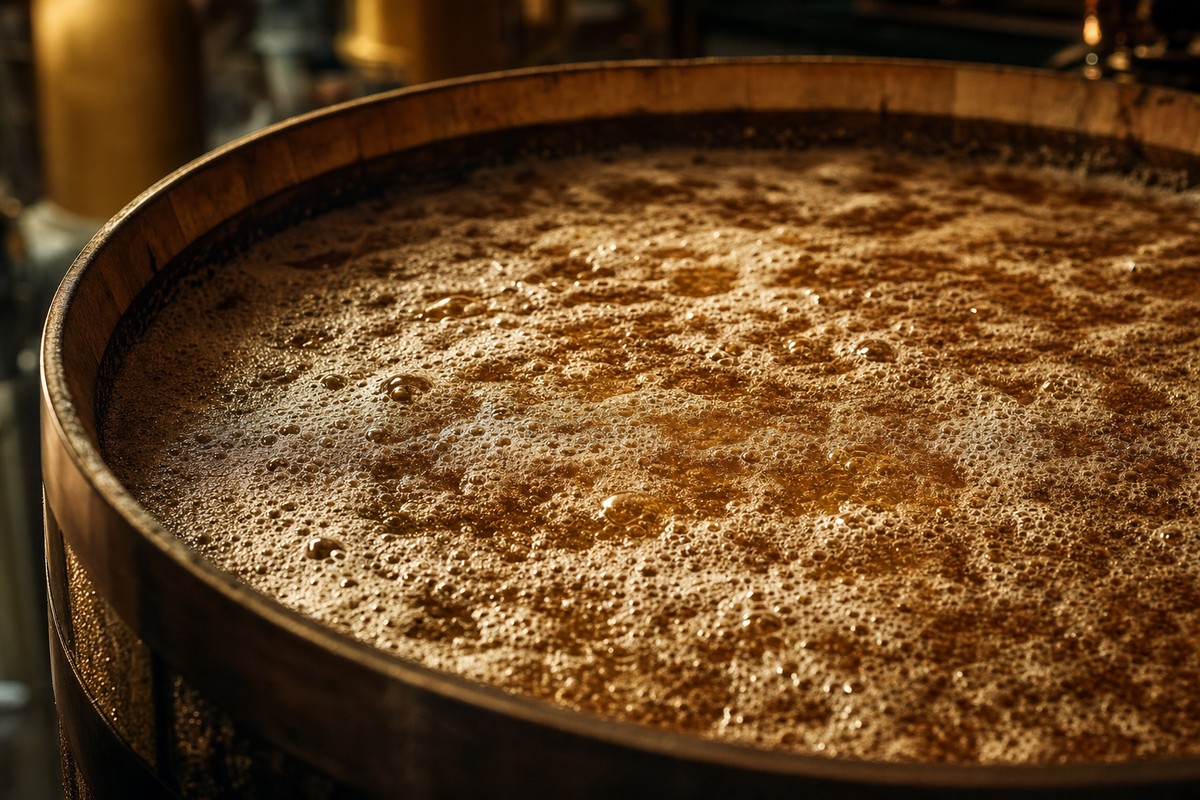
Fermentation is the step between mashing and distilling: a distiller adds yeast to the cooked, cooled grain mash, and over several days the yeast converts fermentable sugars into ethanol and carbon dioxide. That’s yeast’s basic job. It’s also not its only job.
The Deeper Lesson
Fermentation is messy, in the best way.
Along with alcohol, fermenting yeast produces a range of flavor-active byproducts — compounds chemists group under one practical umbrella term: Congener Any flavor- or aroma-active compound in a whiskey other than the ethanol and water themselves — esters, higher alcohols, phenols and more. Congeners are what actually give whiskey its character. Open in Dictionary → . A congener is simply any flavor- or aroma-active compound in the whiskey that isn’t the ethanol or water itself. Esters — which typically form when an alcohol and an acid combine during fermentation — are one of the most important congener families yeast produces, and different esters read to your nose as different things: some lean fruity, some lean floral, some barely register until later production steps bring them forward.
Fermentation doesn’t always hand you the finished flavor directly, either. Sometimes what yeast produces is a precursor — a building-block compound that doesn’t taste like much on its own but reacts further during distillation or barrel aging into something that does. Different yeast strains produce different mixtures of these congeners and precursors, which is why changing the strain changes what’s available before the whiskey ever sees a barrel.
Most bourbon fermentation today is also sour mash: each new batch is inoculated with a portion of stillage (the acidic spent liquid) from a previous fermentation, which stabilizes pH and keeps house flavor consistent from batch to batch. Sweet mash, which uses no backset, is rarer today but still used by a handful of distillers for a different, less acidic profile.
Case Study
Four Roses: two mash bills, five yeasts, ten recipes.
2 mash bills × 5 yeast strains = 10 bourbon recipes
No other widely available bourbon makes this variable easier to see. Four Roses ferments each of its two mash bills with any of five proprietary yeast strains — and describes each strain as contributing its own distinct character:
| Strain | Four Roses' Own Descriptor |
|---|---|
| V | Delicate Fruit |
| K | Slight Spice |
| O | Rich Fruit |
| Q | Floral Essence |
| F | Herbal Notes |
Hold the grain recipe constant and ferment it five different ways, and the resulting whiskeys are genuinely different from each other — the clearest real-world, on-shelf demonstration that fermentation is doing real flavor work, independent of the grain bill.
Go Deeper
- Four Roses — Our Process (opens in a new tab) The brand's own explanation of its two mash bills, five yeast strains, and recipe-code system.