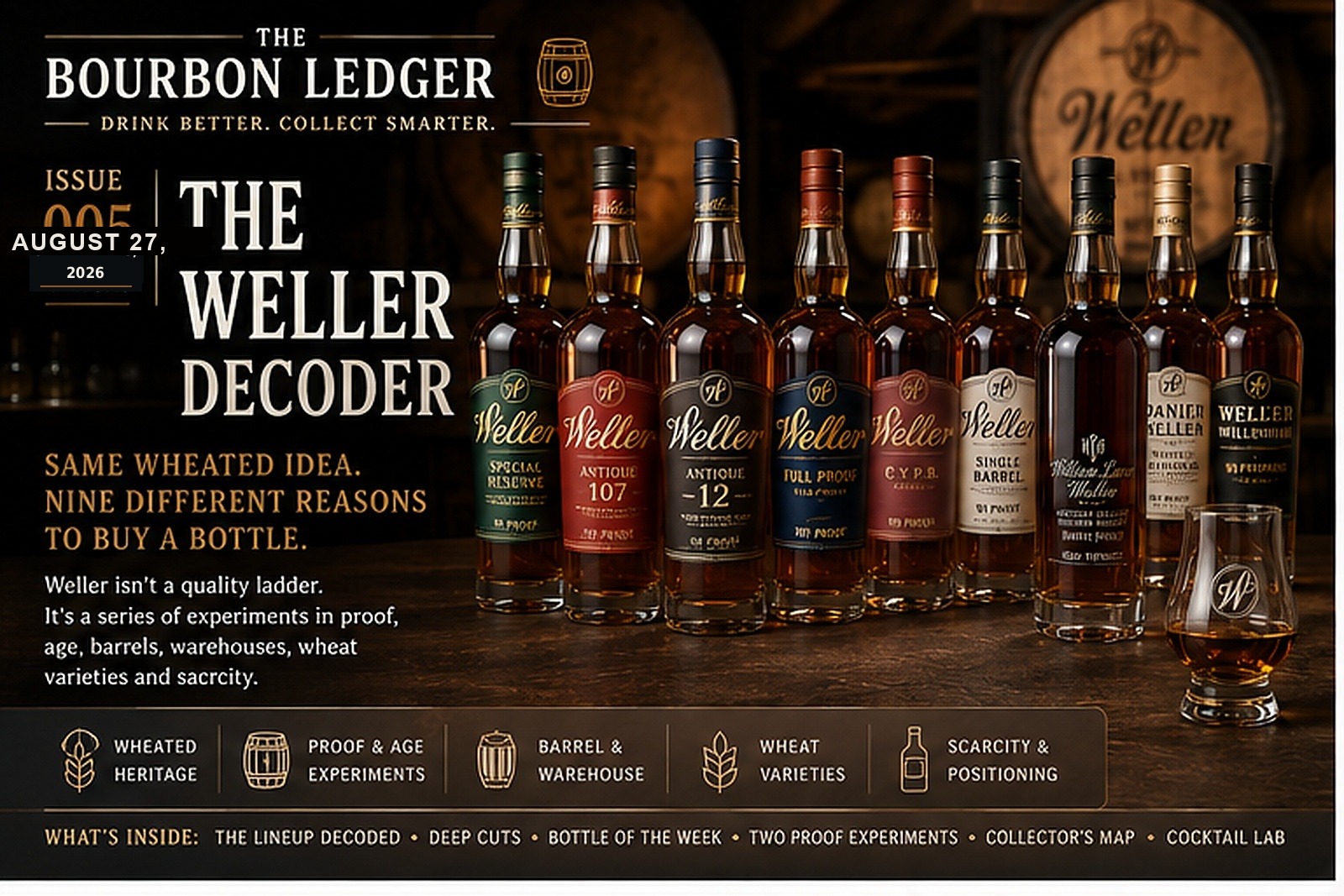
It isn’t. The Weller family is better understood as a series of experiments built around a wheated-whiskey identity: change the proof, hold proof steady and add age, isolate a single barrel, return whiskey to entry proof, alter the wheat itself, blend old stocks, or move beyond bourbon into wheat whiskey.
Don’t ask, “Which Weller is best?” Ask, “Which variable am I paying for?”
The History
Before the hype, Weller was a whiskey business.
William Larue Weller was born in 1825 into a Kentucky family with generations of distilling connections. Buffalo Trace’s history traces his commercial whiskey career to 1849, when he started W.L. Weller & Brothers with his younger brother Charles before the business became W.L. Weller & Sons.
1849 — Weller goes into business. He builds a whiskey wholesaling and distilling enterprise around a style that used wheat in place of rye as the secondary grain. Buffalo Trace now describes him as the first person to commercialize wheated bourbon mash bills. Read Buffalo Trace’s Weller biography →
1893 — A young Julian “Pappy” Van Winkle joins the company. He is hired as a salesman at W.L. Weller & Sons. That employment relationship—not internet mythology—is the beginning of the real Weller/Van Winkle connection.
1908 — Van Winkle and Alex Farnsley buy the company. After William Larue Weller’s death in 1899, the business eventually passes to two men who had worked inside it.
1935 — Stitzel-Weller opens. Van Winkle and Farnsley combine their Weller business with Arthur Stitzel’s operation, creating the Stitzel-Weller Distillery that opens on Derby Day. The wheated style becomes central to the distillery’s identity.
Today — Weller lives at Buffalo Trace. The modern brand is produced in Frankfort as part of Buffalo Trace’s portfolio, with the actual wheated mash-bill percentages remaining undisclosed.
Wheated Bourbon 201
Wheat replaces rye. It doesn’t replace corn.
Calling Weller “wheated bourbon” does not mean wheat is the dominant grain. Bourbon still requires at least 51% corn. In a wheated bourbon, wheat takes the secondary-grain role normally occupied by rye.
That often shifts the sensory profile away from rye’s sharper spice and herbal notes, but don’t turn that into a law of nature. Wheat does not leave finished bourbon full of extra sugar; fermentation consumes the grain’s fermentable sugars. What we perceive as “sweeter” is a sensory outcome produced by the entire system—grain, fermentation, distillation, oak, age and proof.
”Wheat = sweet” is a useful beginner shortcut. It is not a complete explanation.
Bottle of the Week
W.L. Weller Antique 107
107 proof • Wheated Kentucky straight bourbon • NAS
Antique 107 remains the best teaching bottle in the family because it changes an obvious variable without becoming an exercise in museum-grade scarcity: proof. Compared with Special Reserve, it brings more concentration, structure and heat while remaining below barrel-proof territory.
| Metric | Ledger Rating |
|---|---|
| Quality | 8.5/10 |
| Drinkability | 8.7/10 |
| Value near controlled-state retail | 9/10 |
| Value after hype markup | Falls quickly |
| Teaching Value | 10/10 |
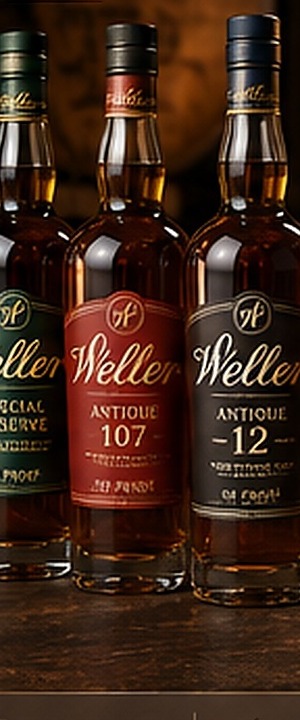
Wheated Bourbon
W.L. Weller Antique 107
Issue No. 005's Bottle of the Week — more concentration than Special Reserve, still below barrel-proof territory, and the clearest lesson in the whole Weller lineup.
There is no single meaningful nationwide shelf price for Weller. State alcohol laws, allocation, retailer markup and local demand can move the same bottle dramatically. For a national reality check, compare producer-published SRP with a current U.S. market benchmark. Antique 107’s last widely published MSRP was $50, while BRBNFNDR’s August 26, 2026 U.S. snapshot showed an average observed market value of about $97, with listings ranging from roughly $82 to $111. That gap is the Weller story in one number: suggested price and acquisition price are not the same thing. See the current U.S. Antique 107 benchmark →
The Lineup Decoded
Stop ranking. Start identifying the experiment.
| Expression | Proof | What changed? |
|---|---|---|
| Special Reserve | 90 | Baseline modern Weller profile |
| Weller 12 | 90 | Age rises while bottling proof stays low |
| Antique 107 | 107 | Proof, concentration and structure |
| CYPB | 95 | Consumer preference + warehouse placement |
| Single Barrel | 97 | Barrel individuality replaces batch consistency |
| Full Proof | 114 | Proofed to the whiskey's original barrel-entry strength |
| William Larue Weller | Varies | Age + elite selection + barrel strength |
| Daniel Weller | 94 inaugural release | Changes the wheat strain itself |
| Weller Millennium | 99 | Vintage blending across wheated bourbon + wheat whiskey |
| Weller 18 Year | 90 | Ultra-aged wheat whiskey; importantly, not bourbon |
Collector's Map
What should you actually pay?
For a nationwide publication, a single state’s shelf price is the wrong anchor. There is no true national retail price for allocated bourbon. The same bottle can be controlled near SRP in one market, marked up heavily in another and effectively unobtainable in a third.
| Bottle | National SRP / MSRP anchor | Buy | Fair | Pass |
|---|---|---|---|---|
| Special Reserve | ~$29 manufacturer MSRP reference | ≤ $40 | $41–50 | > $50 |
| Weller 12 | ~$70 published 2023 MSRP | ≤ $75 | $76–110 | > $110 |
| Antique 107 | $50 last widely published MSRP; 2026 U.S. market benchmark ~ $97 avg. | ≤ $70 | $71–100 | > $100 |
| CYPB | $49.99 producer-published SRP (2021) | ≤ $75 | $76–110 | > $110 |
| Single Barrel | $56 published 2024 MSRP | ≤ $70 | $71–95 | > $95 |
| Full Proof | $49.99 producer-published SRP (2021) | ≤ $75 | $76–110 | > $110 |
| William Larue Weller | $149.99 producer SRP for 2025 BTAC | ≤ $175 | $176–300 | > $300* |
| Daniel Weller Emmer | $499.99 launch SRP | Prestige experiment. Buy near SRP only if the wheat experiment matters to you. | ||
| Weller Millennium | $7,500 producer SRP | Luxury / collector purchase. It is not competing in the normal Weller value conversation. | ||
| Weller 18 Year | $499 launch SRP / 700 mL | Ultra-aged wheat whiskey released through Global Travel Retail. Judge it as its own category. | ||
*Ledger thresholds are drinking-value judgments, not predictions of resale value. Taxes, control-state systems, three-tier distribution, private-retailer pricing and allocation differ across the U.S. The more useful habit is to compare SRP → current U.S. market → your personal ceiling before you buy.
Source notes: Producer SRPs for CYPB and Full Proof come from Buffalo Trace’s 2021 release; Daniel Weller’s $499.99 launch SRP comes from Buffalo Trace’s 2023 announcement; Weller Millennium and Weller 18 pricing comes from Buffalo Trace’s 2024–2025 releases; the 2025 Buffalo Trace Antique Collection carried a nationwide $149.99 SRP per bottle. Older core-line MSRP references are labeled by year because published manufacturer pricing is not always refreshed publicly.
Weekend Tasting Exercise
The Proof Ladder
Pour Special Reserve and Antique 107 side by side. On a second pass, add measured water to the Antique 107 until its effective proof approaches the lower glass.
- Sweetness — Does the lower-proof glass actually taste sweeter?
- Texture — What disappears as proof falls?
- Finish — Is the longer finish alcohol—or flavor concentration?
Score fruit, spice, oak, mouthfeel, heat and finish. The point is to separate more alcohol from more flavor concentration.
Ledger Lab
The Weller Proof Ladder
Ingredients
- 2 oz Weller
- ¼ oz Averna
- ¼ oz oloroso sherry
- 2 dashes black walnut bitters
Make it twice: once with Special Reserve and once with Antique 107. Keep every other variable identical. The higher-proof whiskey should carry Averna, sherry and walnut with more authority. If it doesn't, adjust your assumptions before you adjust the recipe.
Go Deeper
- Buffalo Trace — The Current Weller Family (opens in a new tab) Primary-source overview of the core lineup and the brand's own historical framing.
- Buffalo Trace — William Larue Weller Biography (opens in a new tab) The 1849 business, Van Winkle connection and path toward Stitzel-Weller.
- Whisky Advocate — Weller 12 Year (opens in a new tab) A useful independent explanation of the wheated mash-bill family and Weller's modern historical context.
- Breaking Bourbon — Weller Antique 107 (opens in a new tab) Independent tasting/value perspective on the bottle we're using as the teaching centerpiece.
- Buffalo Trace — Daniel Weller (opens in a new tab) See what happens when a brand built around wheat starts changing the wheat strain itself.
- BRBNFNDR — Weller Antique 107 U.S. Market Benchmark (opens in a new tab) A dated U.S.-wide market snapshot that helps separate manufacturer SRP from the price buyers are actually encountering nationally.
Drink Better. Collect Smarter. Live Curious.