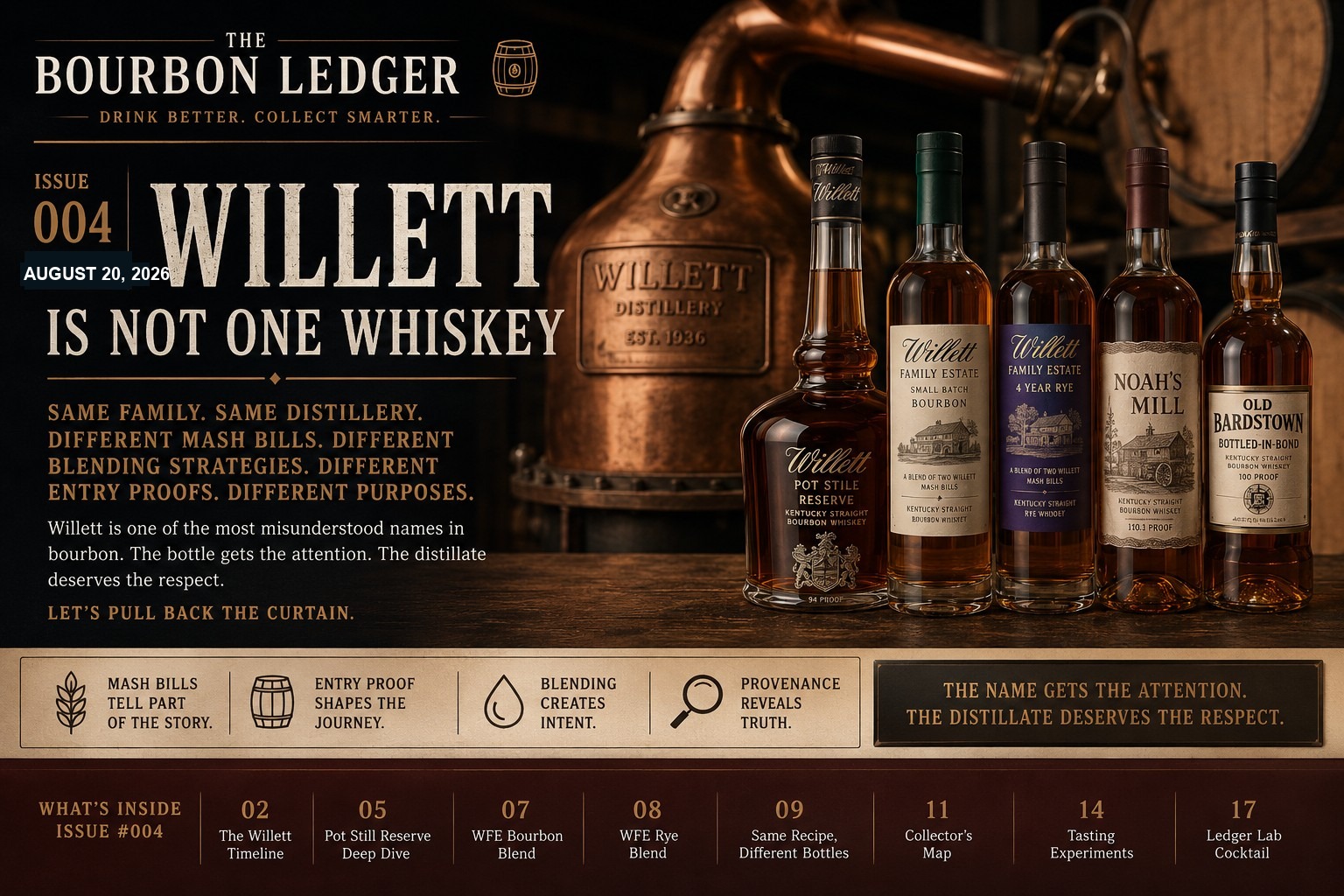
In this issue: The Turning Point — how Willett came back to distilling. Bourbon School — brand ≠ recipe ≠ provenance. The Lineup — how mash bills and proofs change. Ledger Lab — The Copper House.
Why Willett Is Confusing
The label tells you where to start asking questions. It doesn’t give you the answers.
Willett has one of the strongest visual identities in bourbon. The family name is on the distillery, on coveted Family Estate releases, and on one of the most recognizable bottle shapes in whiskey.
That makes it tempting to think there is one “Willett profile.”
There isn’t.
| Era | Milestone |
|---|---|
| 1936 | Original Willett distilling era begins. |
| Later decades | Independent bottling and sourced whiskey become central. |
| 2012 | Modern Willett distillation resumes. |
| Estate whiskey matures | Willett's own distillate enters more products. |
| Today | Willett intentionally blends multiple recipes and proof strategies. |
Bottle of the Week
Willett Pot Still Reserve
94 Proof | 65% Corn / 20% Wheat / 15% Barley | 115 Entry Proof
Pot Still Reserve is often dismissed as “the fancy bottle.” That’s understandable. The packaging is much more recognizable than the liquid.
But the modern version is now a useful production lesson. Willett publishes the recipe and presents it as distilled, aged and bottled by the distillery.
| Metric | Ledger Rating |
|---|---|
| Ledger Quality | 7.6/10 |
| Drinkability | 8/10 |
| Value | 7.5/10 |
| Collectibility | 4/10 |
| Teaching Value | 10/10 |
Buy ≤ $50 • Fair $50–60 • Pass > $65
Why it matters: it gives us an accessible modern Willett wheated bourbon with a published recipe and lower entry proof.
Why it isn’t the “best Willett”: Family Estate releases, single barrels and higher-proof expressions can offer much more complexity and collector interest.
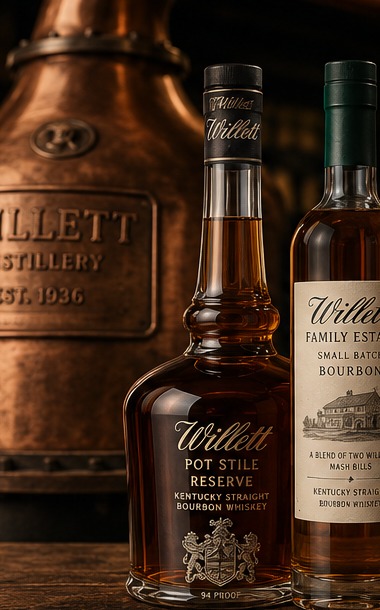
Wheated Bourbon
Willett Pot Still Reserve
Issue No. 004's Bottle of the Week — an accessible, wheated modern Willett with a published recipe and lower entry proof.
The Strongest Comparison in the Issue
Same recipe. Different bottle.
Noah’s Mill, Rowan’s Creek and Old Bardstown Bottled-in-Bond all use Willett’s 72% corn / 13% rye / 15% barley recipe.
| Expression | Base Recipe | Proof | What changes |
|---|---|---|---|
| Noah's Mill | 72 / 13 / 15 | 114.3 | Higher proof, more intensity |
| Rowan's Creek | 72 / 13 / 15 | 100.1 | More approachable proof |
| Old Bardstown BiB | 72 / 13 / 15 | 100 | Bottled-in-Bond constraints |
Three expressions. Same base mash bill. Different whiskey experiences.
Why Entry Proof Matters Again
Willett changes more than grain.
| Expression | Entry Proof |
|---|---|
| Pot Still Reserve | 115 |
| WFE Small Batch Bourbon | 125 |
| WFE Rye | 110 |
| Kentucky Vintage secondary component | 107 |
That variation connects directly to our earlier lessons: entry proof changes the water-to-ethanol ratio interacting with oak during maturation. Willett isn’t merely choosing grain recipes. It’s choosing different maturation environments.
The Collector's Map
Don’t chase the name. Know the lane.
| Action | Bottle & why |
|---|---|
| Drink | Pot Still Reserve — accessible, useful and educational. |
| Buy | WFE Rye — one of the cleanest ways to understand modern Willett distilling identity. |
| Try | WFE Small Batch Bourbon — the bottle itself demonstrates mash-bill blending. |
| Watch | Noah's Mill / Rowan's Creek / Kentucky Vintage — great study bottles without collector hysteria. |
| Chase | WFE Single Barrels — where barrel individuality and collector value become much more serious. |
| Learn | Old Bardstown BiB — cheap, useful and tied to Willett's classic 72/13/15 family recipe. |
Weekend Flight A
Change the recipe.
Pour Pot Still Reserve, WFE Small Batch Bourbon and WFE Rye. Ask: What happens when grain profile, entry proof and bottling strategy all change?
Weekend Flight B
Hold the mash bill.
Pour Noah’s Mill, Rowan’s Creek and Old Bardstown Bottled-in-Bond. Now the base recipe is held relatively steady. Ask: Which differences feel like proof? Which feel like barrel selection? Which feel like blending or age?
Ledger Lab
The Copper House
Ingredients
- 2 oz Willett Pot Still Reserve
- ¼ oz oloroso sherry
- 1 tsp demerara syrup
- 2 dashes black walnut bitters
- 1 dash orange bitters
Method
- Stir with ice and strain over one large cube.
Why it works: Pot Still's wheated profile gives the cocktail a softer foundation. Oloroso and walnut add structure and nuttiness, while orange keeps the drink from getting too dark or heavy. The experiment: make the same recipe with Noah's Mill. Same distillery. Different mash bill. Different proof. Different purpose.
Go Deeper
- Willett Distillery — Family & Distillery History (opens in a new tab)
- Willett Pot Still Reserve — Official Product Sheet (opens in a new tab)
- Willett Family Estate Bourbon — Official Mash Bill Blend (opens in a new tab)
- Willett Family Estate Rye — Official Mash Bill Blend (opens in a new tab)
- Noah's Mill — Official Product Page (opens in a new tab)
- Rowan's Creek — Official Product Page (opens in a new tab)
- Kentucky Vintage — Official Product Page (opens in a new tab)
- Breaking Bourbon — Willett Pot Still Reserve Review (opens in a new tab)
Drink Better. Collect Smarter. 🥃