Issue No. 001 · Originally published 30 July 2026 · Restored and expanded, October 2026
Pick up a bottle of Michter’s US★1 and you are holding an argument.
The star-and-numeral on the label is not decoration. US★1 is shorthand for America’s first whiskey company — the brand’s own claim, built into the name of its entire core range. Michter’s dates that company to 1753, in Schaefferstown, Pennsylvania, which would make it older than the republic it’s named after.
Then there is a second set of facts, equally real. The Pennsylvania distillery that date refers to has produced nothing since February 1990. The name “Michter’s” was not attached to it until 1975. And the company selling you that bottle acquired the name in 1997, as a lapsed trademark, for about $245.
Both of those stories are true. They are just not the same story.
IS TODAY'S MICHTER'STHE SAME MICHTER'S?
That question has no yes-or-no answer, and the reason it doesn’t is the most portable thing in this issue. “The same” can mean four completely different things, and Michter’s is the rare case where all four come apart cleanly enough to see.
Distillery
Is it the same physical place, still making whiskey?
Brand
Is it the same name, and has that name moved?
Ownership
Is it the same company, or anyone connected to it?
Production
Is the whiskey made by the same people, in the same way?
Keep those four words. Every revived historical bourbon on the shelf — and there are many — can be read with them.
The Claim
What 1753 actually documents.
Start with the strongest version of Michter’s case, because it is stronger than sceptics usually allow.
The Schaefferstown site is a genuine National Historic Landmark. The nomination that earned it that status is a federal document, and it is unambiguous. Under “specific dates” it reads “Site: 1753-present.” In its statement of significance it calls the property “both the Nation’s oldest distillery and a primary extant example of the small scale commercial distilling operations” that built the American whiskey trade. On a continuation sheet it is more specific still:
“In 1753 John Shenk, a Swiss Mennonite farmer, and his brother Michael built a gristmill and distillery on the banks of Snitzel Creek on the present Bomberger site.”
That is the federal government, in writing, saying there was a distillery there in 1753.
Now read the rest of the document.
The nomination was prepared in March 1978 by a historian at the American Association for State and Local History. Its bibliography — the list of what the claim is built on — contains general histories of American eating and manufacturing, two publications from liquor-industry trade bodies, a magazine feature, and two primary items of a particular kind: a letter dated 23 February 1978, and an interview conducted on 11 February 1978. Both are with the same person.
His name was Louis Forman. He was the distillery’s president. He was also, by most accounts, the man who had given it the name Michter’s.
There is a further wrinkle worth having. Local Pennsylvania history traces the 1753 date to a Lebanon County tax record showing a Michael Shenk among the taxpayers of Heidelberg Township. A tax roll proves a man was there and paying. It does not prove what he was making.
And the physical evidence is younger than the claim. The nomination dates the surviving buildings to about 1840 — a distance of nearly ninety years from the founding story they’re used to support.
The Pennsylvania Century
Four families, one site, and a gap nobody mentions.
What the record does support is a long and genuinely impressive run of Pennsylvania whiskey-making. The federal nomination traces it in order.
- The Shenks John and Michael, from 1753 — an adjunct to the gristmill and the farm
- Rudolph Meyer Michael Shenk's son-in-law, from the early 1780s. Two stills by 1782, a third by 1790
- John Kratzer From 1827, through his wife Elizabeth Shenk Kratzer, a founder's granddaughter
- The Bombergers Abe Bomberger from 1861, then his son Horst — the name the site carried into the twentieth century
That is four surnames across roughly 165 years, and none of them is Michter.
It is also not continuous. The federal nomination has Horst Bomberger running the site “until the implementation of prohibition in 1919” — other chronologies put the halt as early as 1917 — and it stayed dark until after repeal in 1933. Fourteen years, at least, and longer than national Prohibition itself. Whatever “unbroken since 1753” means, it cannot mean uninterrupted.
After repeal the site changed hands repeatedly — the Lebanon Valley Distilling Company, Schenley, Pennco among others. The nomination’s own description of that era is the detail most often left out of the romance: for the most part, it says, the distillery “has produced whiskey in bulk for other distillers.”
Long before the modern brand bought whiskey from other people, the historic distillery was selling whiskey to other people.
The Reframe
The name is younger than the moon landing.
Here is the fact that rearranges everything else.
“Michter’s” is not an eighteenth-century name, a Pennsylvania Dutch word, or a family surname. Louis Forman built it from the first syllables of his two sons’ names — Michael and Peter. And the company was reorganised under it in 1975.
Read that against the other dates. The name was fifteen years old when the distillery closed. The buildings it was painted on were roughly 135 years older than it was. A drinker buying a bottle of Michter’s in Pennsylvania in 1980 was holding a brand younger than the Apollo programme, on a site that had been making whiskey, on and off, for two centuries.
Valentine's Day, 1990
What exactly closed.
The end was not dramatic. It was a phone call.
The independent whiskey historian Chuck Cowdery, who has written the clearest account of it, reports that the bank ordered master distiller Dick Stoll to shut the plant down, send everyone home, and turn off the lights. The owners, facing an unpaid tax bill, had simply walked away. “On Valentine’s Day 1990,” Cowdery writes, “everything was abandoned.”
Everything is the operative word. Not just the stills and the warehouses — the company’s assets entire, including its name.
The whiskey still sitting in those warehouses was sold by the county for back taxes. Cowdery’s account of its fate is careful, and we’ll be equally careful: it was probably redistilled into ethanol. You will see that detail reported as certainty elsewhere. The best available source hedges it, so we do too.
One shared timeline · four separate answers
One name. Four lineages.
"Is it the same Michter's?" is four questions, and they do not resolve together. Read each line across, then read the same year down.
- 1753–1840 Schaefferstown, Pa.
- 2015–now Louisville, Ky.
- 1933–1990 Four families, then four owners
- 1997–now A company before a still
- 1975–1990 Incorporated, 1975
- 1997–now Bought for $245
- 2000–2015 Distilled by others
- 2015–now Own distillate
- Documented and operating
- Attested by tradition, not primary record
- Name alive, nothing behind it
- Whiskey distilled by someone else
- Abandoned outright
The name track is the one to read twice. For the first two hundred and twenty-two years of that timeline it does not exist at all — and it is the only line that crosses 1990.
$245
What the modern company actually bought.
Seven years later, two men went looking for the name.
Joseph J. Magliocco had sold Michter’s as a summer job between his sophomore and junior years of college; his family’s firm distributed it. Richard “Dick” Newman was a former Austin Nichols executive with Wild Turkey behind him. They discovered the trademark was unused and unclaimed, and filed.
United States Patent and Trademark Office records show the application for the MICHTER’S mark filed on 21 March 1997, registering in January 2002, with first use in commerce claimed as 11 October 2000.
To Magliocco’s considerable credit, he has never dressed this up. In his own account:
“we paid the $245 and we became the owner of the Michter’s name. We had no whiskey, no formulas, no packaging, nothing—just the name and an idea.”
That is a more honest sentence than most brand histories contain, and it is worth holding onto when the marketing elsewhere gets grander. The company’s own Legacy page likewise describes what it filed for as the “unused and abandoned” Michter’s trademark. Michter’s does not actually hide the gap. It simply doesn’t put it on the label.
Production
Whose whiskey was in the bottle?
A name and an idea do not fill a bottle. For its first eighteen years, modern Michter’s sold whiskey other people had made.
The outlines are documented, mostly through labels. From September 2000 to spring 2002, Julian Van Winkle III bottled Michter’s casks in Lawrenceburg, Kentucky — the 10 Year Rye and Bourbon of that era carry it. From July 2002, bottling moved to Kentucky Bourbon Distillers in Bardstown, the Willett operation, and the labels say Bardstown accordingly. From the mid-2000s, an undisclosed Kentucky distillery made whiskey to Michter’s account.
Undisclosed is the accurate word. Michter’s has never named that distillery. A particular producer is very widely reported, and we are not going to print it as established fact on the strength of repetition.
Bourbon School NDPs & Sourced Whiskey Buying whiskey rather than distilling it isn't a scandal — but who made your bottle is a question the label can answer.Sourcing whiskey is not a crime. Selling a two-hundred-year story while doing it is a different question.
Building Backwards
A distillery, acquired last.
Most distilleries start with a still and add a brand. Michter’s did it in the opposite order, and finished the job properly.
Construction at Shively, in Louisville, began in 2012; the first whiskey distilled there ran in 2015. The restored Fort Nelson building downtown opened to the public on 2 February 2019. Which means the young whiskey in the range is now the company’s own, while the oldest bottlings still draw on whiskey acquired from others. By the construction dates, the oldest Michter’s-made stock is around a decade old — our arithmetic, not a company announcement.
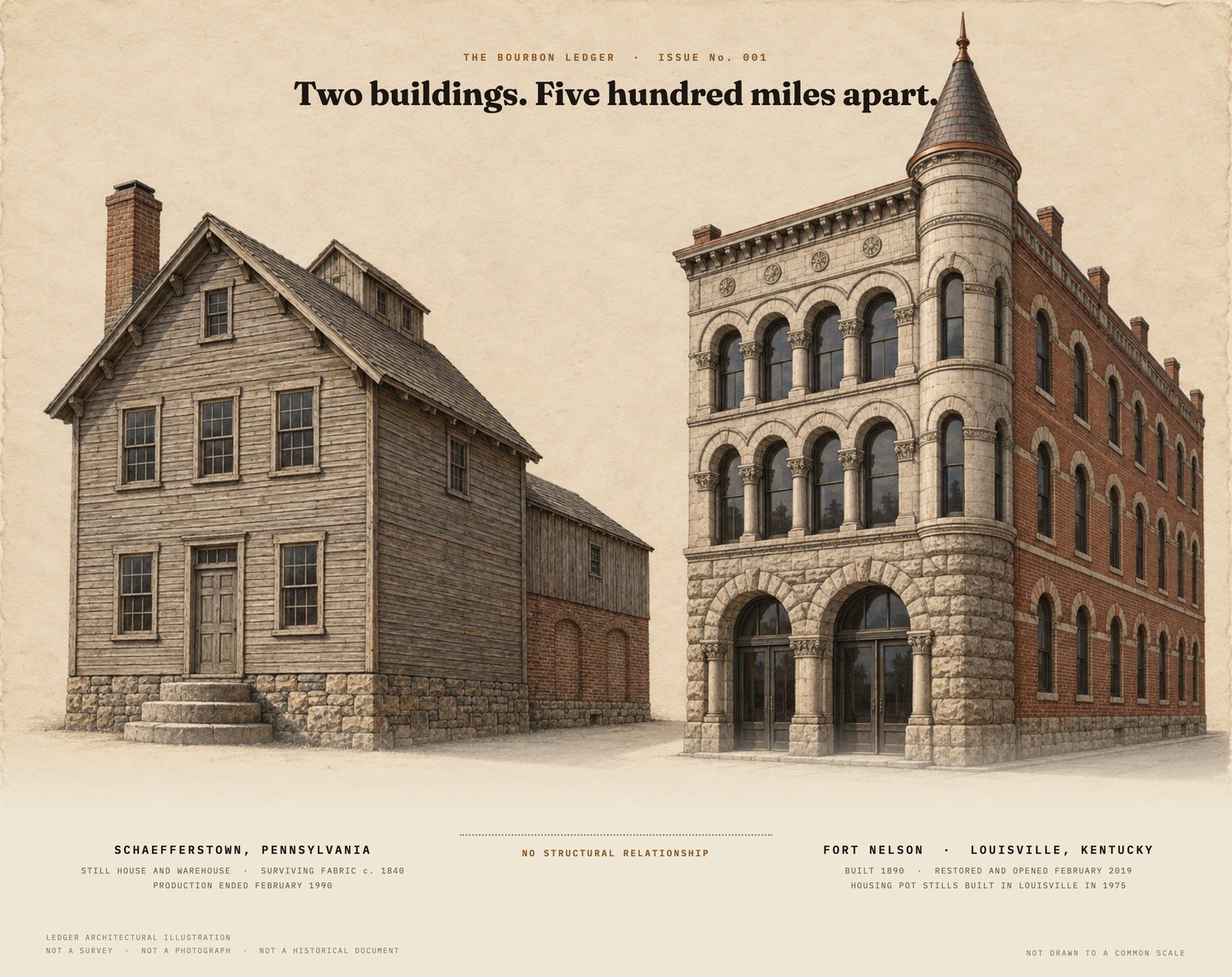
Then there are the pot stills at Fort Nelson, which are usually told as the issue’s romantic ending: the original Schaefferstown stills, rescued and brought home.
They are real, and the journey is real. But the dates deserve a look. Vendome Copper & Brass Works in Louisville quoted the equipment in December 1975 and shipped it to Schaefferstown in February 1976.
THE STILLS ARE EXACTLYAS OLD AS THE NAME.
They are not eighteenth-century artefacts. They are 1970s equipment, built in Louisville, that went to Pennsylvania, outlived the company that ordered them, and came back to within a few miles of where they were made. That is a better story than the one it replaces, and it has the advantage of being true.
Pennsylvania → Kentucky
The name crossed this gap. The distillery did not.
Each beat is marked with the kind of evidence behind it, because a founding tradition and a trademark filing are not the same class of fact.
- 1753 Schaefferstown, Pa.
John and Michael Shenk build a gristmill and a distillery
The founding date on the label, and the anchor for every claim that follows.
Brand claim / traditionThe documentary chain we can follow begins with a 1978 federal nomination whose cited sources include an interview with the distillery's own president — not with an eighteenth-century deed, tax list or court record.
- c. 1840 Schaefferstown
The surviving buildings go up
The physical fabric that carries the 1753 story is itself nearly ninety years younger than it.
Documented - 1861 Schaefferstown
The Bombergers take over
Abe Bomberger, then his son Horst — the fourth family on the site, and the name it carried into the twentieth century.
Documented - 1919 Schaefferstown
Prohibition stops production
The site stays dark until after repeal in 1933 — at least fourteen years, longer than national Prohibition itself.
Sources conflictThe federal nomination says 1919. Other chronologies put the halt as early as 1917. We follow the primary document and flag the conflict.
- 1933–1970s Schaefferstown
Whiskey in bulk, for other distillers
The nomination's own description of the post-repeal era: the site largely made whiskey for other people to bottle.
Documented - 1975 Schaefferstown
The name “Michter's” is invented
Louis Forman builds it from his sons' names — Michael and Peter — and the company reorganises under it.
Documented - 14 Feb 1990 Schaefferstown
The bank orders the lights turned off
Everything is abandoned: the stills, the warehouses, the whiskey, the company's assets entire — including its name.
Documented
1990 — 1997
Seven years. No owner, no production, no whiskey.
Nothing bridges this. The remaining stock went to the county for back taxes, the buildings stood empty, and the trademark simply lapsed. The line below does not continue the line above — it starts again.
- 21 Mar 1997 Trademark filing
Two men file for a lapsed name
Joseph Magliocco and Richard Newman pay about $245 for the unused MICHTER'S mark. No whiskey, no formulas, no buildings.
Documented - 2000–2015 Kentucky
Whiskey other people made
Van Winkle in Lawrenceburg, then Kentucky Bourbon Distillers in Bardstown, then an undisclosed Kentucky distillery.
DocumentedThe later producer has never been named by the company. One is very widely reported; we do not print it as established fact on the strength of repetition.
- 2014–2015 Shively, Louisville
Michter's begins distilling its own whiskey
The building was bought in 2012 and a still installed in 2014, with barrels filling from around 2015. Roughly eighteen years after buying the name, the company finally had one.
DocumentedAccounts differ on the exact first run. Trade reporting has the still in place in 2014 and the company saying it stopped buying whiskey in 2015; we give the range rather than pick a date.
- 2019 Fort Nelson, Louisville
The restored downtown distillery opens
Housing the pot stills Vendome built in Louisville in 1975 and shipped to Pennsylvania in February 1976.
Documented - 2015 onward Louisville
The range splits in two
Everything young in the lineup is now Michter's own whiskey. Everything old still predates the distillery.
DocumentedIf distilling began in 2014–2015, the oldest house-made whiskey is about a decade old. That is arithmetic from the construction dates, not a company announcement, and the label does not tell you which distillate is in any given bottle.
From here the issue stops asking what Michter’s inherited and starts asking what it built.
Bourbon School
Same family tree. Different question.
Michter’s is not unusual in having a complicated lineage. It is unusual in how cleanly its four lines separate. Most revived brands are murkier. The questions, though, are always the same four, and you can ask them in a store in under a minute.
The Other Claim
Bomberger’s, and who gets to own local history.
In December 2012, a Pennsylvania venture filed to use the name Bomberger’s — the family that ran the Schaefferstown distillery for half a century. Behind it was Erik Wolfe, working with Dick Stoll, the same master distiller the bank had phoned in 1990.
Michter’s had meanwhile released Bomberger’s Declaration, and asserted earlier use. Its counsel wrote that Chatham “began referencing ‘Bomberger’s’ and using its Bomberger’s Declaration trademark in commerce prior to your client’s alleged first use in commerce date of September 23, 2014,” and asked the Pennsylvania side to withdraw.
Both men went on the record. Magliocco: “We wholeheartedly believe in good faith that both the facts and the law support our rights to the brand Bomberger’s Declaration.” Wolfe, more bluntly, called it “them using further legal wrangling to export our local history,” and added the line that sticks: “We are just trying to keep local history local.”
We could not establish how it formally ended. The trade coverage leaves it unresolved in March 2015. What is on the record is what happened next: the Pennsylvania distillery opened in 2017 under a different name — Stoll & Wolfe — about eight miles from the original site. Dick Stoll died in 2020.
The Verdict That Isn't One
What the claim requires you to accept.
So: is Michter’s America’s first whiskey company?
It depends entirely on what you’ll accept as continuity. The claim holds only if you accept a 1753 founding with no primary distilling record behind it, and treat a company as continuous across a sixteen-year production halt, a bankruptcy, the total abandonment of every asset, seven years of dormancy, a change of state, and complete replacement of the owners, the staff, the buildings, the equipment and the recipes.
Under a narrower definition — continuous operation, or continuous ownership, or continuous production — it does not hold.
Michter’s isn’t lying to you. It’s using a definition of “same” that it has never been asked to defend.
And the company’s current wording shows someone has thought about this carefully. The website says the whiskey company “which ultimately became known as Michter’s” was founded in 1753. That construction asserts a line of descent without claiming unbroken anything. It is doing a great deal of quiet work.
Where Michter’s is plainly straight with you is the folklore. Asked about George Washington buying whiskey there, the company itself files the story under “Pennsylvania historical lore” rather than history. That is the right call, and more than most brands make.
The Bottles
What each expression is actually for.
The current range is best read not as a ladder but as a set of questions. One caution first, and it applies to every row below: Michter’s publishes no mash bills. Any percentage you’ve seen attached to these whiskeys is inference.
| Bottle | Proof | What it's for |
|---|---|---|
| US★1 Bourbon | 91.4 | The house baseline — the reference everything else is measured against |
| US★1 Rye | 84.8 | Same house, different grain. Single barrel, so expect variation |
| US★1 Sour Mash | 86 | A whiskey that is legally neither bourbon nor rye — the odd one, and the interesting one |
| US★1 American Whiskey | 83.4 | Aged in used barrels. Shows you what new charred oak was contributing by removing it |
| Toasted Barrel Finish | 91.4 | The baseline, then a second toasted barrel. A single-variable experiment |
| Barrel Strength Rye | 108–111 | The rye with proof as the variable instead of grain |
| 10 Year Bourbon / Rye | 94.4 / 92.8 | Age. As of 2025 this can be Michter's own distillate |
| 20 / 25 Year | varies | Legacy stock — whiskey distilled by someone else, before Michter's had a distillery |
| Shenk's · Bomberger's | 91.2 / 108 | The Pennsylvania names, on Kentucky whiskey |
Collect Smarter
Which Michter’s should you actually buy?
Not a ranking. A decision, by what you want.
- Want the house style? US★1 Bourbon. It is the control glass for everything else.
- Want to learn something? US★1 American Whiskey, against the bourbon. Used barrel against new charred oak, same house.
- Want the single most interesting bottle? Sour Mash — a whiskey that fits no standard category.
- Want the story in the glass? Shenk's or Bomberger's, knowing exactly what you're buying.
- Chasing the 20 Year? Know that you are buying someone else's distillate at a collector's price.
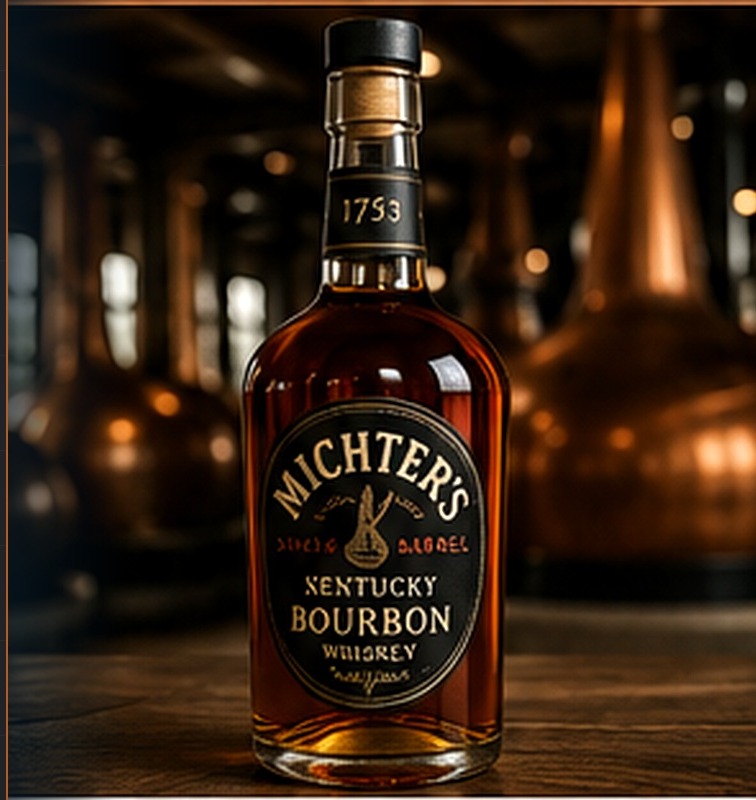
US★1 Small Batch
Michter's US★1 Bourbon
Issue No. 001's featured bottle — the modern Michter's house style, and the reference point the rest of the range is measured against.
The Ledger Lab
One house, three legal categories.
Here is the exercise this issue is built for, and it needs no allocated bottle.
Pour US★1 Bourbon, US★1 Sour Mash and US★1 American Whiskey side by side. Same producer, same era, same broad house character — but three different legal categories and, critically, three different relationships to the barrel.
Score only three things: sweetness, wood, and finish length. Write your scores down before anyone says anything out loud. Groupthink is real, and bourbon people are not magically immune to it.
The question is not which is best. It is which differences come from the grain and which come from the wood — because the American Whiskey, matured in used barrels, is the one that tells you what new charred oak was doing in the other two.
Barrel entry proof
Why 103?
125
Legal maximum
The ceiling federal rules set for bourbon entering the barrel.
103
Michter's stated entry
Twenty-two points under the ceiling, by the company's own account.
- New make
- Cut to 103
- New charred oak
- Maturation
- Selection & proofing
- Bottle
Arithmetic
What is true by the numbers
- A barrel filled at 103 holds proportionally more water and less ethanol than one filled at 125.
- Water and ethanol pull different compounds out of charred oak at different rates, so the extraction starts differently on day one.
- Filling lower means more barrels for the same volume of finished whiskey — a real cost, borne for years.
Company statement
What Michter's says
- That the lower entry proof is a deliberate quality decision rather than a default.
- That it sits alongside air-dried wood, a specified toast, and heat-cycled warehousing as part of one house specification.
Ledger reading
What we will and won't conclude
- A producer who names a number this specific is treating it as a signature, the way others treat mash bill or char.
- We will not tell you it makes the whiskey taste a particular way. No published work isolates entry proof in these bottles, and the number itself is unaudited.
Modern identity
If the liquid lineage broke, what makes modern Michter's Michter's?
Not an inheritance — a set of production decisions, each of which can be stated, and most of which only the company can confirm.
- Distillation Own, from 2015 Independently documented
- Barrel entry 103 Company specification — unverified
- Wood & toast Air-dried Company specification — unverified
- Warehousing Heat-cycled Company specification — unverified
- Selection & finishing Barrel by barrel Company specification — unverified
- Independently documented
- Company specification
Read left to right, in the order the whiskey actually moves. Nothing in this chain was inherited: every link is a decision the modern company made, can state, and can repeat. That repeatability is what a house style is — and it is a different kind of claim from an unbroken barrel.
The same five decisions, in detail
Barrel entry proof
103 proof
Company specification — unverifiedWhiskey is cut to 103 before it goes into wood, rather than to the 125 the law allows.
A deliberate, cost-bearing choice that shapes maturation from the first day.
The most specific number the company publishes, and the one it is most willing to be held to. Treat it as the keystone of the stated house style.
Wood and toast
Company specification — unverifiedBarrels are specified rather than bought to a generic standard — air-dried staves, with a toast applied before the char.
That seasoning the wood outdoors and toasting beneath the char produces a rounder, less aggressively oaky whiskey.
Standard among producers who compete on quality, and genuinely expensive. We found no independent audit of the seasoning times or the toast regime.
Warehousing
Company specification — unverifiedHeat-cycled warehouses, where temperature is raised in cold months rather than left to the weather.
That forcing the whiskey in and out of the wood produces more consistent maturation than passive ageing.
A real and verifiable practice in the industry generally; in this case still a company description of its own buildings.
Distillation
Independently documentedSourced from other distilleries from 2000; own production at Shively from the mid-2010s, with the company saying it stopped buying whiskey in 2015.
That the company built a distillery properly rather than remaining a brand with a bottling line.
The one pillar with an external record — labels, the building's construction dates and trade reporting all corroborate it. It is also the pillar that took eighteen years.
Selection & finishing
Company specification — unverifiedBarrels are chosen individually for single-barrel releases, and some whiskey is moved into a second, toasted barrel before bottling.
That selection and a second barrel are where the house character is finally set.
The finishing is the one part you can verify from the shelf — the Toasted Barrel Finish exists as a product. How barrels are chosen is the company's account of its own tasting room.
Modern Michter's identity is a production system — repeatable, specified, and twenty years old. It is not a barrel of whiskey that has been rolling since 1753.
The Ledger Cocktail
103
This issue’s cocktail keeps the name it was given in 2026, because the name is the lesson: 103 is the entry proof, and the drink is built to put texture — the thing that number is supposed to affect — in front of everything else.
The build is deliberately spare. Sugar and bitters only, no citrus, no vermouth, nothing aromatic competing with the whiskey’s own weight.
We haven’t made it yet, and we’re publishing it anyway. That’s deliberate: you get the spec before we do, which makes this an actual experiment rather than a verdict handed down. Run it, and judge it.
Ledger Lab — Working Recipe
103
Ingredients
- 2 oz Michter's US★1 Bourbon
- 1 tsp rich (2:1) demerara syrup
- 2 dashes Angostura bitters
- 1 dash black walnut bitters
- 1 large clear cube
Method
- Combine the bourbon, syrup and both bitters in a mixing glass with cold ice.
- Stir 25–30 seconds.
- Strain over one large clear cube in a chilled rocks glass.
- No garnish. Nothing expressed over the top.
Untested on purpose — this is a spec, not a verdict. The question to answer in the glass: do the walnut bitters chase the rounded, slightly oily texture the low entry proof is supposed to produce, or do they flatten it? If it is the second, drop them. Your palate settles this one, not ours.
Deep Cut
The only thing that made the trip.
Of everything that existed at Schaefferstown — the warehouses, the jug house, the mash tubs, the yeast, the recipes, the people — almost nothing crossed into the modern company. The whiskey went to the county for back taxes. The buildings stayed and fell down. The master distiller stayed too, and spent his last years making Pennsylvania whiskey eight miles away under another name.
What crossed was a trademark filing and, eventually, a pair of pot stills that Vendome had built in Louisville in 1975 and shipped east in February 1976. They went to Pennsylvania, outlived the company, passed through Ohio, and came back to a building a few minutes from the shop that made them.
They are the same age as the name. Both of them are younger than almost everything the brand invokes, and both of them are, in the most literal sense, the real inheritance.
The reckoning
What did Michter's actually inherit?
The name
Did the name pass from one owner to the next?
It was abandoned in 1990 and lapsed. Nobody handed it over; two men found it unclaimed seven years later and filed for about $245. A revival is a real act — it is simply not an inheritance.
Equipment
Did anything physical make the journey?
The pot stills did. Vendome built them in Louisville in 1975, shipped them to Pennsylvania in 1976, and they outlasted the company that ordered them. They now run at Fort Nelson, a few minutes from the shop that made them.
Place & history
Does the modern company hold the ground the story refers to?
No. The Schaefferstown landmark sold separately in 2011 — reported at $250,000 — to a buyer with no connection to the whiskey company. The history is invoked from five hundred miles away; the real estate went elsewhere.
Liquid
Is any of the old whiskey in any modern bottle?
None. The stock left in the warehouses was sold by the county for back taxes and, on the best available account, probably redistilled into ethanol. Not one drop of Pennsylvania Michter's reaches a modern bottle.
Knowledge & intent
Did the people who knew how to make it carry it forward?
The master distiller the bank phoned in 1990, Dick Stoll, did not join the modern company. He spent his last working years making Pennsylvania whiskey eight miles from the original site, under a different name. The human thread continued — just not here.
A brand can inherit a name without inheriting a distillery.
Go Deeper
- National Register / National Historic Landmark nomination — Bomberger's Distillery (NPS, March 1978) (opens in a new tab) The federal document behind the 1753 claim, including its statement of significance and — in item 9 — the bibliography that rests on an interview with the distillery's own president.
- National Park Service — List of National Historic Landmarks by State (opens in a new tab) Bomberger's Distillery, designated 16 January 1980, Lebanon County. The same page marks withdrawn designations; this one carries none.
- USPTO — MICHTER'S, serial 75261367 (opens in a new tab) The federal trademark record: filed 21 March 1997, registered January 2002, first use in commerce claimed 11 October 2000.
- Chuck Cowdery — The End Came for Michter's 25 Years Ago Today (opens in a new tab) The best independent account of the February 1990 closure, the abandonment of the assets, and the fate of the remaining whiskey.
- Unicorn Auctions — Joseph Magliocco on the slow-burn success of Michter's (opens in a new tab) Magliocco's own first-person account of buying the name for $245 with 'no whiskey, no formulas, no packaging, nothing.'
- Fred Minnick — Michter's and a Pennsylvania distillery trade blows over 'Bomberger's' (opens in a new tab) The trademark dispute, with both sides quoted directly.
- Fred Minnick — Michter's responds; Bomberger's calls it 'legal wrangling' (opens in a new tab) The follow-up, which leaves the dispute unresolved in the trade record.
- Vendome Copper & Brass Works — the Fort Nelson stills (opens in a new tab) The cooper-smith's own record of quoting the equipment in December 1975 and shipping it to Schaefferstown in February 1976.
- Stoll & Wolfe — Pennsylvania Whiskey Legacy (opens in a new tab) The Pennsylvania side's account — which makes the same 1753 claim as the brand it fought.
- Michter's — Legacy (opens in a new tab) The company's own current wording, including 'the whiskey company which ultimately became known as Michter's' and its description of the trademark as 'unused and abandoned.'