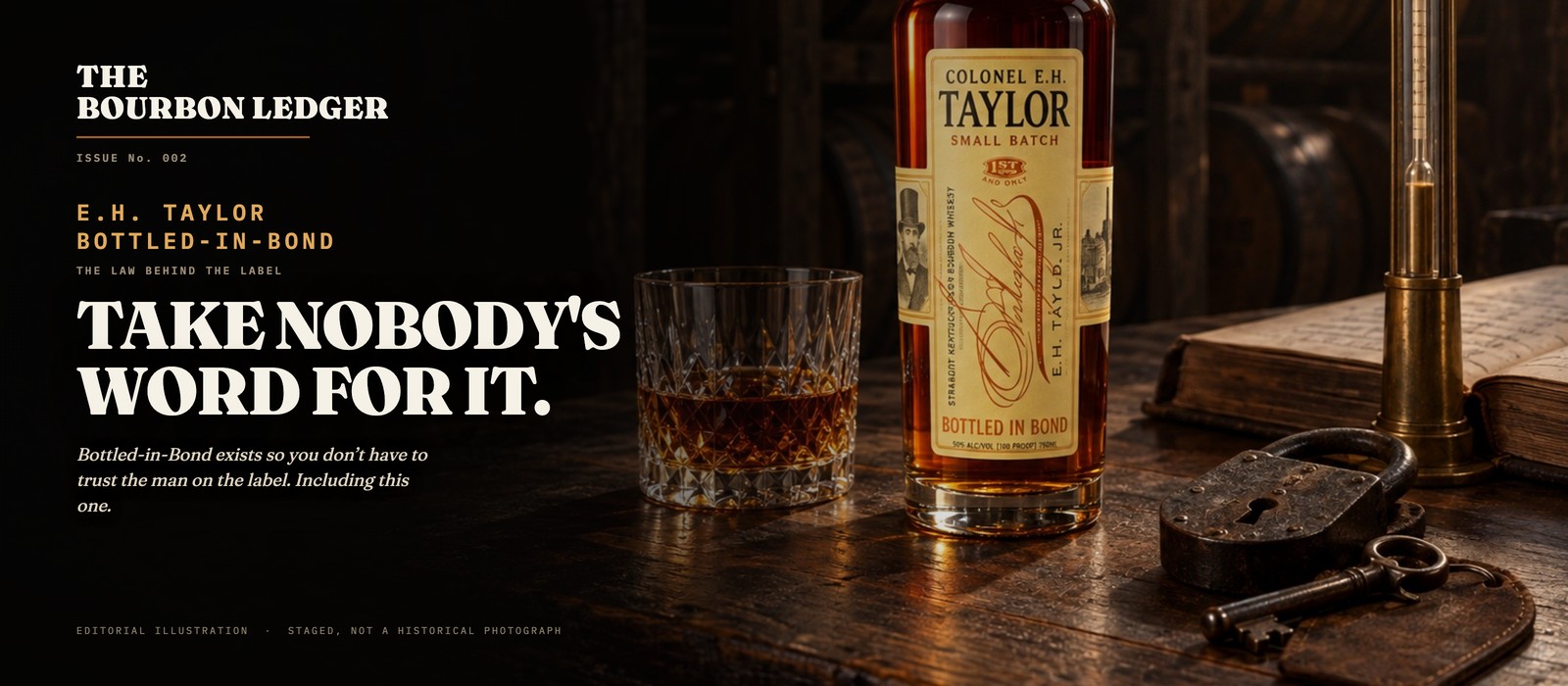
Issue No. 002 · Originally published 6 August 2026 · Restored and expanded, October 2026
There is a sentence printed on a few hundred bourbon labels that most people read straight past: Bottled in Bond.
It looks like the same decorative vocabulary as “handcrafted” or “small batch” or “reserve.” It isn’t. It is the only phrase on an American whiskey bottle whose every word is fixed by federal regulation, and the only one that was put there to solve a specific problem: in the 1890s, an ordinary person buying an ordinary bottle of whiskey had essentially no way of knowing what was in it.
TAKE NOBODY'SWORD FOR IT.
That is the whole idea. Not “this is good whiskey.” Something much narrower and much more useful: here are facts you do not have to take on trust.
The man whose name is on the most famous bonded bourbon in America is Colonel Edmund Haynes Taylor, Jr. He is a genuine part of this story. He is also a bankrupt, a defendant, a man who once sold the same whiskey to two different buyers, and someone who spent thirteen years in court over a signature — and lost most of that fight.
None of that makes the trust problem fake. It makes the man credited with solving it a far better character than the marketing version.
The Problem
What you were actually buying in 1890.
To understand the law you have to understand the market it landed in, and that market was a mess.
Most whiskey did not reach drinkers from a distillery. It reached them through rectifiers — middlemen who bought bulk spirit, blended it, and sold the result under whatever name they liked. Some of that work was legitimate blending. Some of it was neutral spirit dressed up to look and taste like aged whiskey.
Accounts of the period describe the dressing: burnt sugar and prune juice for colour, tobacco extract and tincture of iodine for the look of age, with clarifying agents to settle it. We have not been able to trace those specific adulterants to a primary document, so treat them as the period’s own reporting rather than established chemistry. What is not in dispute is the structural problem. There was no reliable way to know a whiskey’s age, its origin, or whether it contained any aged whiskey at all.
Harvey Wiley — the government chemist who became the Pure Food and Drug Act’s chief advocate — later reckoned that more than nine in ten American whiskeys reached the drinker adulterated in some form. That is his figure, and Wiley was anything but a neutral party. Keep both halves of that sentence.
The Colonel, Honestly
A banker who failed, and a title he was given.
Start by stripping the portrait back to what the archives support.
Edmund Haynes Taylor, Jr. was born in 1830 and died in 1923. He was a banker first: he entered the firm Taylor, Turner & Co. in 1853 and was forced out in 1857 when a financial panic collapsed it. The whiskey career came after the bank failed.
The “Jr.” is not his father’s name. His father died when he was a child, and he was raised and educated by an uncle in Lexington — a banker also called Edmund Haynes Taylor — and took the name from him, adding “Jr.” to tell the two apart.
He is very widely described as a relative or ward of President Zachary Taylor. The Filson Historical Society, which holds the Taylor family papers, notes in its own finding aid that the collection documents no relation to the president. The claim may still be true. It is simply not something the family’s archive supports, which is a useful reminder of how far a good story travels on its own momentum.
And “Colonel” was an honorific. No military service appears in the record.
He was a Kentucky banker with a courtesy title, who got into whiskey after his bank went under.
O.F.C.
What he actually built.
In 1870 Taylor bought a distillery on the Kentucky River at Leestown, near Frankfort, and three years later tore down the old stone building and rebuilt it in brick. He called it O.F.C.
Even the initials are contested. Serious accounts give both “Old Fire Copper” and “Old Fashioned Copper,” and we are not going to pretend to settle it.
What was in the plant is better documented than what Taylor personally invented: copper-lined fermentation tanks set in limestone, among Kentucky’s first all-copper column stills, copper doublers, and — the detail that matters most to the modern legend — steam-heated pipes running through the warehouses to control maturation temperature.
That last one is real. Whether Taylor invented temperature-controlled ageing, or simply built an unusually good version of something others were also reaching for, is not established. And here the strongest available document cuts against the marketing. The National Historic Landmark nomination for a distillery Taylor spent $25,000 improving states the position plainly:
“While documentation of the changes and improvements made by Edmund Taylor and James Pepper have never been concretely substantiated…”
Set that against Buffalo Trace’s own brand page, which calls Taylor “the father of the modern bourbon industry” and credits him with “copper fermenters, column stills and climate-controlled aging warehouses.”
Both of those statements exist. Only one of them is a federal document.
1877
The year it all came apart.
Taylor’s empire did not survive the 1870s, and the way it failed is documented in a place brand histories tend not to look: a published court opinion.
In the spring of 1875 Taylor sold 150 barrels of bourbon to a Henry County banker named J. S. Baskett. Baskett paid for the whiskey and paid the tax on it. Taylor then sold the same 150 barrels again, to a Louisville firm, against his mounting debts. Some of those barrels were sold on; roughly a hundred were shipped to his creditor Stagg in St. Louis. When Baskett came looking for whiskey he had already bought, it was gone.
The Kentucky courts sorted it out four years later in Newcomb-Buchanan Co. v. Baskett, and found for Baskett: Taylor had no authority to resell. The opinion also records, in the driest possible language, what Taylor did when the bill came due:
“In May, 1877, Taylor left the state on account of pecuniary troubles…”
His creditor, Gregory, Stagg & Co. of St. Louis, covered him. The price was everything he had built. As the federal nomination puts it, the rescue caused “Taylor’s distillery properties to be deeded to George T. Stagg” — including O.F.C. and the neighbouring Carlisle distillery.
The Signature War
Thirteen years over a piece of handwriting.
The fight that followed is the most human thing in this issue, and the part the marketing never mentions.
The famous script signature was not an heirloom. By the trial testimony’s account, Taylor saw a striking script signature on packages of imported brandy in St. Louis and suggested using his own the same way. The court’s own characterisation of it was unsentimental: “a mere fancy,” meant to show his “personal identification with the distilling operations.” It began appearing on labels around 1880.
After the split with Stagg’s company, Taylor built a new distillery and a new brand around the name he had just lost control of. When the Stagg company resumed using his signature in January 1889, Taylor sued that October.
Here is how it actually ended, because the usual retelling gets it backwards:
- 1889 Taylor sues to stop the Stagg company using his name and signature
- 1894 He wins an injunction — but the court holds the registration's essential feature was 'O.F.C.', with his name merely identifying the distiller
- 1896 His damages claim is rejected; the court notes its earlier ruling issued 'with some reluctance'
- 1902 He loses the damages question permanently
Thirteen years. He stopped another company putting his handwriting on whiskey he hadn’t made. He never got paid for the years they had.
The signature on the bottle you can’t buy is one a court twice refused to compensate him for.
1897
The law, and who actually wrote it.
The document itself
An Act To allow the bottling of distilled spirits in bond
Approved 3 March 1897. Everything below is the government’s own scan, shown unretouched — no toning, no ageing, no cropping into the text block.
The Act, as approved
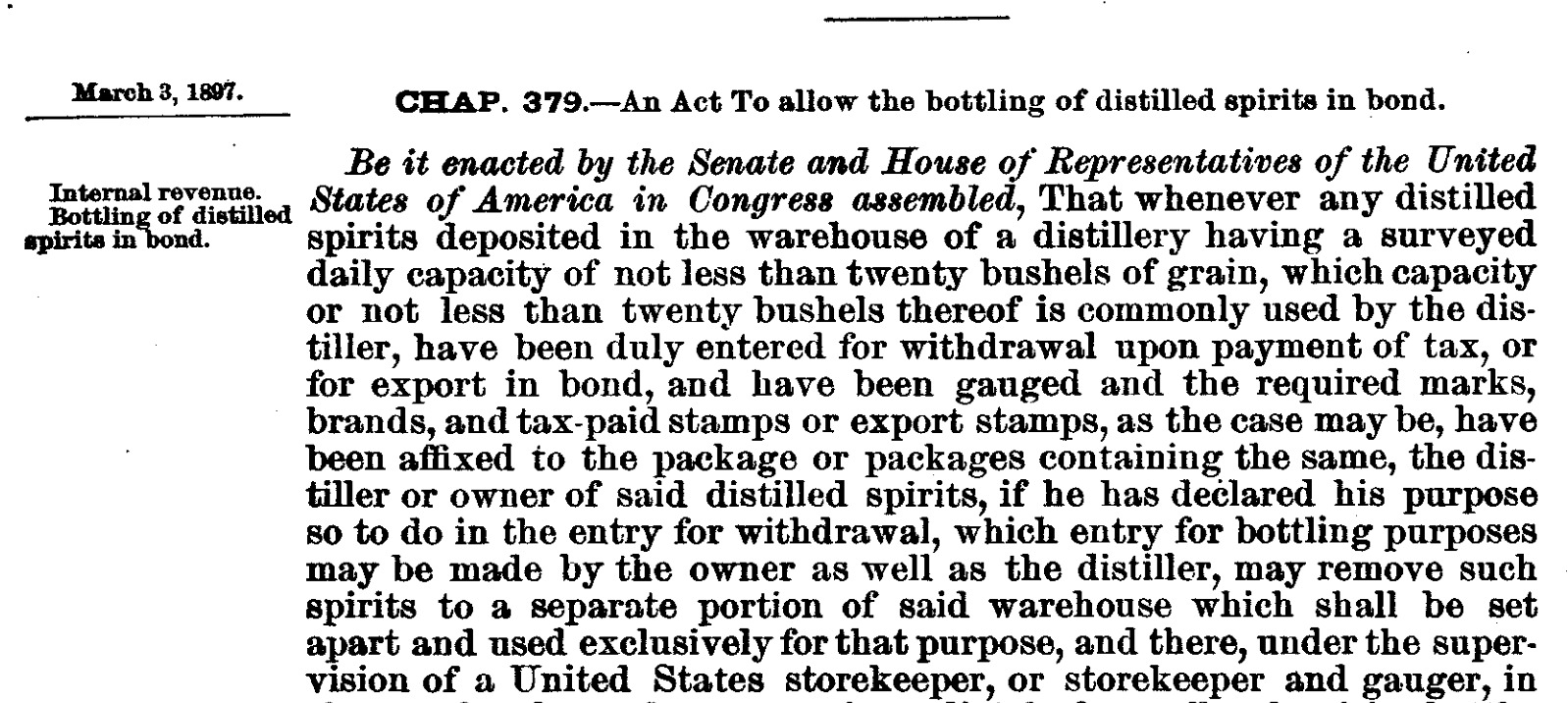
An Act To allow the bottling of distilled spirits in bond.
In plain EnglishThat is the entire title. Not an act to guarantee quality, not an act to define whiskey — an act about bottling spirits while they are still under bond.
The identity clause
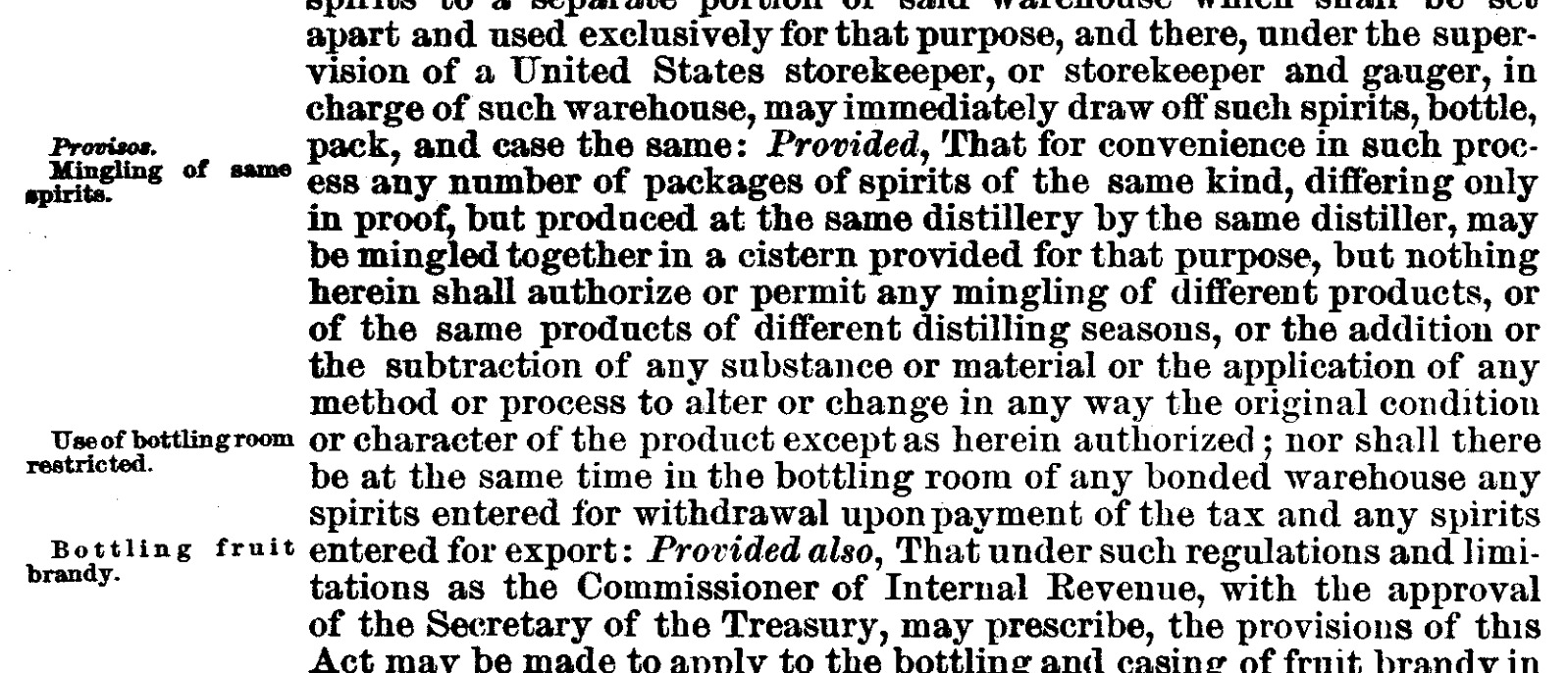
… produced at the same distillery by the same distiller … but nothing herein shall authorize or permit any mingling of different products, or of the same products of different distilling seasons, or the addition or the subtraction of any substance or material …
In plain EnglishOne distillery, one distiller, one season — and nothing added or taken away. This single sentence is the ancestor of four of the six conditions still in force today.
Read it again and notice what is not there: no minimum age. The four-year requirement is nowhere in the 1897 Act. It entered law in 1911.
The proof clause
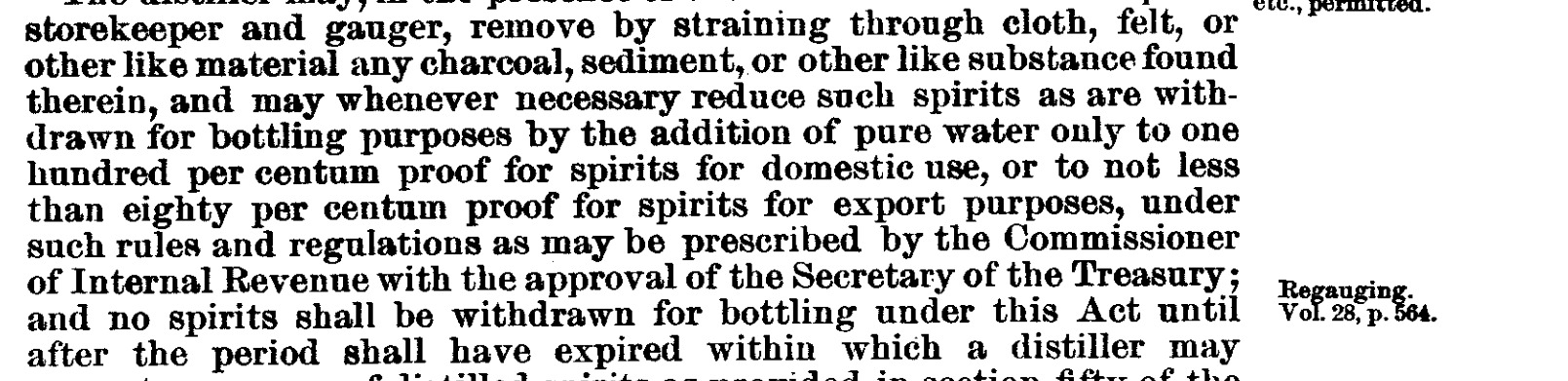
… reduce such spirits as are withdrawn for bottling purposes by the addition of pure water only to one hundred per centum proof for spirits for domestic use, or to not less than eighty per centum proof for spirits for export purposes …
In plain EnglishPure water, nothing else. Exactly 100 proof if it is sold here; at least 80 if it is shipped abroad. The number that defines bonded whiskey applies only to the domestic bottle.
How the proof requirement got there
The bill that passed the House set a floor — “not less than eighty per centum proof” — rather than a fixed figure.
Senate Finance substituted an exact number for domestic spirits. The committee reported the bill orally; no written report survives to explain the choice.
The approved Act carries both: exactly 100 per centum for domestic use, not less than 80 for export. Both are visible in the scan above.
The Bottled-in-Bond Act was signed by Grover Cleveland on 3 March 1897, as chapter 379 of the Statutes at Large. The bill was H.R. 8582 — and because it is a public law, its passage is documented, minute by minute, in the Congressional Record. We went and read it.
The first thing that record does is correct the way almost everyone describes the 1897 law. This publication included, until now.
What the Act did carry from the beginning: bottling under a United States storekeeper or gauger, a strip stamp over the mouth of every bottle, the registered distillery number and distilling season burned onto the case — and one clause that reads like the ancestor of every modern provenance argument.
“no trade-marks shall be put upon any bottle unless the real name of the actual bona fide distiller shall also be placed conspicuously on said bottle.”
That sentence is 1897. It is doing the same job the plant number does today.
Now: who wrote it?
Not Taylor. H.R. 8582 was introduced by Walter Evans, a congressman from Kentucky, and reported from Ways and Means as House Report 1595. The House debated it on the merits in 1896. In the Senate it went to Finance, where Nelson Aldrich of Rhode Island rewrote it and reported it from the floor, and Joseph Blackburn of Kentucky moved it — telling the chamber he was “certain that it will not take more than two or three minutes to act upon this important bill.” He was right. The House then concurred in the Senate’s amendments without debate.
Treasury’s fingerprints are on it, but as reviewer rather than author. Evans told the House the bill’s provisions “meet the approval of the Secretary of the Treasury and the Commissioner of Internal Revenue, with whom … the subcommittee on internal revenue consulted upon every point in the measure.” John G. Carlisle was that Secretary. He is never named in connection with the bill anywhere in the Record.
And Taylor?
HE ISN'T IN IT.NOT ONCE.
We searched the Congressional Record indexes and the debates for both sessions. Colonel E.H. Taylor, Jr. does not appear in the debate, in the bill’s committee history, or among the petitioners for or against it.
That is an absence worth trusting rather than a hole in our searching. The indexes do list other Taylors. They also list individual firms that petitioned on this very bill, by name. Had he lobbied Congress on the record, he would most likely be in there.
The Floor
What they actually argued about.
Purity is in the record, and it is explicit. Evans said the object was that a buyer should have “a certainty that he is getting a pure article,” rather than whiskey leaving government supervision where others “can put whatever stuff they please into it.” His Kentucky colleague David Colson was blunter, and named the trade: the rectifying houses, he said, were putting goods on the market “labeled as straight whisky, but not such in fact.”
So the trust argument is real, contemporaneous, and spoken on the floor of the House in 1896. It is not something later marketing invented.
It was also not the only argument — and the sponsor said so himself. Evans told the House that one of the chief objects of the bill was Canada:
“nearly all so-called [bottled] spirits come from Canada… Gentlemen who travel on the cars… buy it because it is supposed to be pure on account of being under a government bottling stamp… keeping the American producer out of his home market.”
Bottled-in-Bond was, among other things, an American answer to Canadian Club.
The opposition was not the tidy villain the story usually wants, either. The loudest objection was monopoly: wholesale dealers argued the bill handed the bottling business to the distillers. Senator Nelson of Minnesota relayed constituents who called it exactly that. The formal remonstrance against H.R. 8582 came from W. E. Broderick of the National Wholesale Liquor Dealers’ Association — and from the Hannis Distilling Company. Note that second name. Some distillers opposed it too; this was never a clean distillers-against-rectifiers split.
There was temperance opposition, from Morse of Massachusetts. And there was plain scepticism about the ageing rationale: when the earlier extension of the bonding period came up, Representative Dingley remarked that it was intended to “mature” the pockets of the distillers. The Record records the response. [Laughter.]
And how did the bill finally clear the Senate? Not by winning the purity argument. Nelson’s monopoly objection was answered by inserting the words “or owner” wherever the bill said “distiller,” so that whoever owned the spirits could have them bottled. A competitive fix, not a consumer one.
In the wider fight outside Congress, the straight-whiskey side is usually described as led by Taylor and James E. Pepper — whose legal guardian, years earlier, had been Taylor himself. And the rectifiers’ side had its own respectable faces, including George Garvin Brown, the man whose name is on Old Forester, and Isaac Wolfe Bernheim. Their argument was that government was interfering in business and handing straight producers an unfair edge.
Bourbon School Bottled-in-Bond, Explained What the designation requires today, what it rules out, and the three conditions almost nobody quotes.The Honest Version
Both sides were protecting a business.
The best scholarship on this fight is not a whiskey book. It is a peer-reviewed article in the Business History Review by Jack High and Clayton Coppin, and it argues something more interesting than the heroes-and-villains story.
Straight distillers backed reform in significant part because it would damage their competitors. Wiley’s bureau stood to gain authority. Both sides, the authors argue, strategically invoked consumer protection while pursuing commercial self-interest — and the law advanced private interests at least as much as public ones.
That does not mean the adulteration was invented. People really were selling coloured neutral spirit as aged whiskey. It means the people who fixed it had a side.
Good laws are often passed by interested parties. That’s not a scandal. It’s how most laws get passed.
Did It Work?
The fight Taylor actually fought — and partly lost.
Here is the irony at the centre of the modern brand. Taylor’s best-documented personal campaign came not in 1897 but nearly a decade later.
After the Pure Food and Drug Act of June 1906, the question became whether rectified product could be called whiskey at all. Wiley’s position was strict: straight whiskey was whiskey, and everything else was “imitation.” Taylor, by Veach’s account, “worked tirelessly” to defend that reading — writing for newspapers, trade magazines and industry newsletters, and testifying before President Taft.
On 27 December 1909, Taft decided it. Rectified product would be labelled “blended whiskey.” Traditional product would be “straight whiskey.” And both had an equal right to the word whiskey.
That was not what Taylor wanted. He had argued for “imitation.” He got a decision that gave his competitors the name.
THE FIGHT WE CAN DOCUMENTIS THE ONE HE LOST.
The Decoder
What bonded guarantees now — and what it doesn’t.
The modern rule lives at 27 CFR § 5.88, and it is worth reading clause by clause, because each one closes a door and leaves another open.
The Bonded Decoder
What does “Bottled in Bond” actually guarantee?
Six conditions, all of them about identity and process — not one of them about whether the whiskey is any good.
- 01 The same kind of spirit, from the same class of materials “composed of the same kind … of spirits distilled from the same class of materials”
- 02 One distilling season, one distiller, one distillery “distilled in the same distilling season … by the same distiller at the same distillery”
- 03 At least four years in wood “stored for at least 4 years in wooden containers wherein the spirits have been in contact with the wood surface”
- 04 Nothing added, nothing taken out “unaltered … by the addition or subtraction of any substance other than by filtration, chill proofing, or other physical treatments”
- 05 Brought to strength with pure water only “reduced in proof by the addition of only pure water to 50 percent alcohol by volume”
- 06 Bottled at exactly 100 proof “bottled at 50 percent alcohol by volume (100 degrees of proof)”
And it has to tell you where. Subsection (c) requires the label to carry the distillery’s real name or trade name, the plant number where it was distilled, and the plant number where it was bottled. That is the identity guarantee made checkable — you can read the plant number off the bottle.
1897 was not today’s rule
Minimum age
No four-year minimum. The Act’s only timing provision deferred to an existing regauge period.
At least four years in wood.
The four-year rule entered law in 1911, not 1897. Representative Evans did describe four-year spirits on the floor, so the idea was current — but it was not what Congress passed.
Bottling proof
The House bill said “not less than 80 per cent proof.” Exactly 100 arrived as a Senate Finance amendment, and applied to domestic sale only.
Exactly 100 proof, no range.
Where it was kept
Bottled in a government-supervised bonded warehouse, under federal strip stamps.
The regulation no longer says “bonded warehouse” at all — only “wooden containers.”
The name outlived the mechanism. Nothing on a modern bonded bottle is held under a government lock.
What bond does not guarantee
- That the whiskey is good. Bond says nothing about quality.
- That it is rare, allocated or collectible.
- That it is a single barrel — bonded whiskey is usually batched.
- Any particular mash bill, grain recipe or flavour profile.
- That it is old. Four years is a floor, not a claim.
- That the brand on the front distilled it — read the plant number.
Why 100?
The number is documented. The reason is not.
Of all six conditions, the one people ask about is the proof. Exactly 100 — not 90, not 110, not a range. There is a tidy answer in circulation, and it does not survive checking.
Why exactly 100?
We can document what 100 proof means. We cannot document why Congress chose it.
What we know
- House bill ≥ 80 proof The version that passed the House set a floor, not a fixed figure.
- Senate Finance Amended The committee struck the floor and substituted an exact number, for domestic sale only.
- Final law 100 proof Exactly 100, and still exactly 100 today.
That is not a coincidence or an interpretation — it is definitional. Federal law defines a proof gallon as a gallon containing 50% alcohol by volume, and a wine gallon as the ordinary liquid gallon. At exactly 100 proof the volume you bottle and the volume you are taxed on are the same number, which makes the accounting trivial in a system built on supervision.
What we don’t
So why did the Senate choose 100?
The surviving record doesn’t say.
There is no written Senate Finance report to consult — the committee reported the bill orally. We searched the Congressional Record for both sessions and found no statement of reasons for the figure. The tax-unit relationship above is real and it is suggestive, but nobody involved wrote down that it was the reason, and we are not going to supply the sentence they didn’t.
The popular explanation — that 100 proof was the traditional benchmark for a full-strength, unadulterated spirit — circulates widely, and we could find no primary source establishing it as the Senate’s reasoning.
A Live Example
Same name. Same designation. Different distillery.
If you want proof that clause five still does work, look at Early Times Bottled-in-Bond.
Brown-Forman sold the Early Times brand to Sazerac in 2020. Production moved from Brown-Forman’s plant to Barton in Bardstown. The whiskey in the bottle is now made somewhere else, by someone else — and the bottle still says Bottled in Bond, because it still meets every condition.
The thing that changed, visibly, is the plant number.
The brand name stayed the same. The DSP number didn’t. That’s the difference between a story and a fact.
The Modern Line
Same Colonel. Different experiment.
The Colonel E.H. Taylor, Jr. range that exists today is not an unbroken inheritance either. Beam acquired the Taylor brand in 1987 as part of National Distillers. In June 2009 it traded the brand and its inventory to Sazerac — in a swap that sent Effen Vodka the other way. Buffalo Trace relaunched it as the Colonel E.H. Taylor, Jr. collection in 2011.
Read as a range, it is a set of single-variable experiments on one house.
| Expression | The variable | Note |
|---|---|---|
| Small Batch | The baseline | 100 proof. Buffalo Trace names it Mash Bill #1 but publishes no percentages |
| Single Barrel | Barrel variation | 100 proof. One barrel instead of a blend — variation is the product |
| Straight Rye | Grain | 100 proof. The house, moved to a different grain bill |
| Barrel Proof | Strength | Cannot be Bottled-in-Bond — bonded requires exactly 100 proof, and this isn't |
| Amaranth · Cured Oak · Seasoned Wood · Four Grain · Warehouse C | Wood, grain, time, place | Limited releases. Specifications vary release to release |
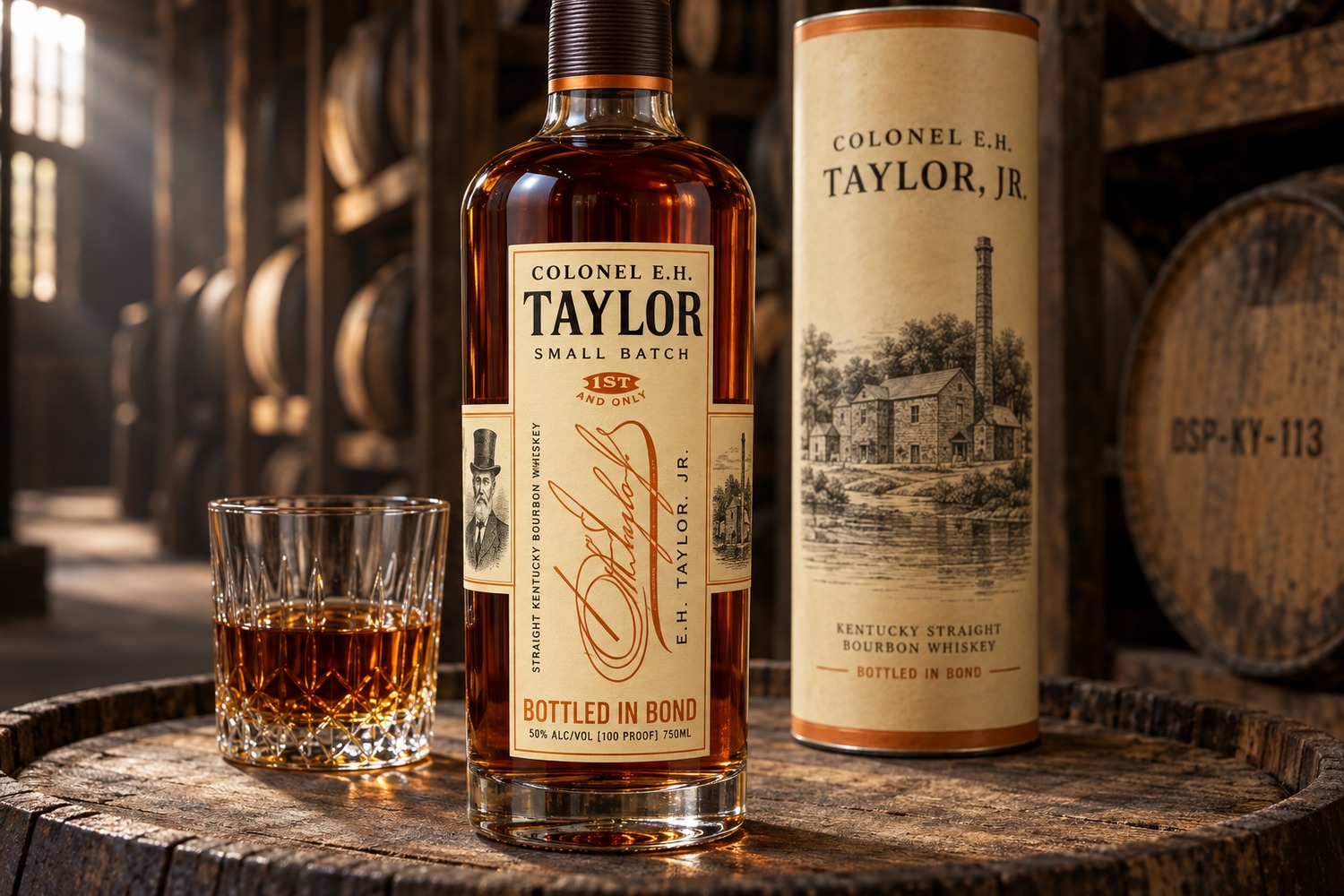
The Label Decoder
What can you actually learn from a bonded label?
The label tells you
- The class and type — what legal category of whiskey this is.
- That it carries the bonded designation.
- The strength, which for a bonded bottle is always the same number.
- The plant where it was distilled and the plant where it was bottled.
The law then tells you
- It is at least four years old, even with no age statement printed.
- It came from one distilling season, by one distiller, at one distillery.
- Nothing was added or removed but water and physical filtration.
- The strength is exactly 100 proof — not approximately, not a range.
- You can check the distiller yourself, because the plant number is required to be there.
The label does not tell you
- The mash bill. Grain percentages are almost never published.
- The actual age beyond the four-year floor.
- Which warehouse or floor it matured on.
- Whether it is a single barrel. Bonded whiskey is usually batched.
- Whether it is any good. Bond is an identity standard, not a quality score.
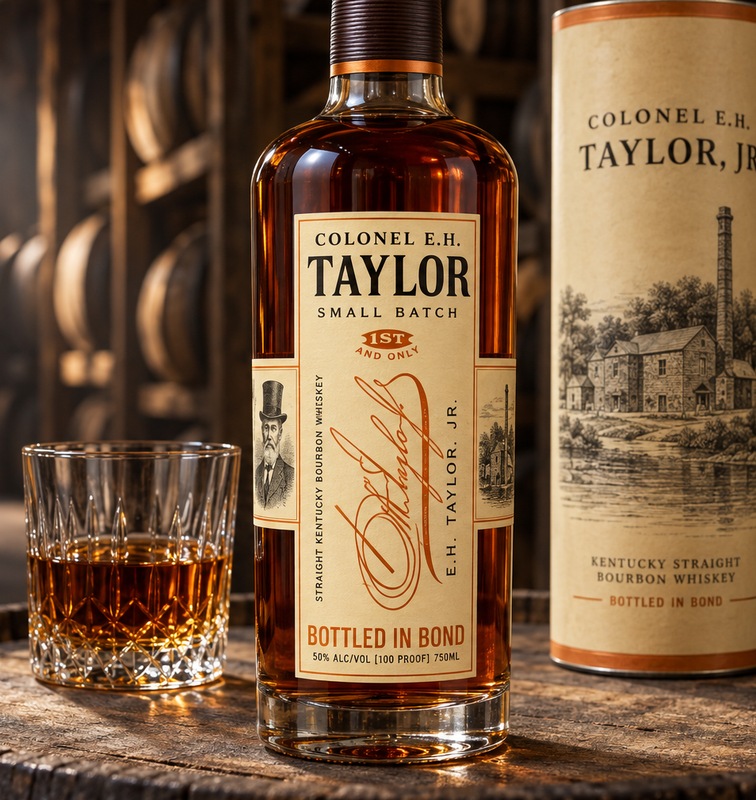
Small Batch · Bottled-in-Bond
E.H. Taylor, Jr. Small Batch
Issue No. 002's featured bottle — a bonded, 100-proof reference point, and a lesson in what a federal designation does and doesn't guarantee.
Collect Smarter
Four prices, and only one of them is about whiskey.
Here is the tension this brand cannot escape. The designation on the label was invented so that an ordinary person could walk into a shop and buy a known quantity without trusting anybody. Today the bottle carrying that designation is allocated, hunted, marked up, and frequently bought to be resold rather than opened.
We are not going to tell you what to pay. We are going to give you the ladder, because the ladder survives price changes and a printed number doesn’t.
| Tier | What you're paying for | Reasonable? |
|---|---|---|
| MSRP | The producer's suggested price — increasingly theoretical for allocated bottles | Always |
| Reasonable premium | A shop's margin on something genuinely hard to get and hold | Usually |
| Collector premium | Scarcity itself — age, a discontinued release, a sought batch | If you know that's what you're buying |
| Hype premium | Demand feeding on demand. Nothing about the liquid has changed | Only if you'd still be glad holding it when the hype moves on |
The Ledger Lab
The one variable you can rely on.
Bonded whiskey is the best teaching tool in the aisle for a simple reason: it fixes proof by law. Everything you taste that differs is therefore not a proof difference.
- Pour E.H. Taylor Small Batch against Buffalo Trace — same distillery, 100 proof against 90.
- Ask only: is the Taylor hotter, or fuller? Those are different sensations and people confuse them constantly.
- Now add a second bonded bourbon from a different distillery — Old Grand-Dad Bonded is easy to find.
- Same law, same proof, same minimum age. Everything you can taste comes from grain, wood, warehouse and selection.
Then do the part nobody does: turn the bottles around and find the plant numbers. Two bonded whiskeys that taste nothing alike, with two different DSPs, is the 1897 Act doing precisely the job it was written to do — telling you where something came from so you can draw your own conclusions about why it tastes that way.
The Ledger Cocktail
The Bonded Line
This issue’s cocktail keeps the name it was given in 2026, and now it has a job to match it.
Bonded whiskey guarantees exactly one thing about strength: 100 proof, every time, by law. That makes it the most reliable spirit base in the house for a stirred drink — you can build a spec around it and know the proof will not drift between bottles or batches the way a barrel-proof or a no-age-statement pour might.
So the drink is built to sit right at the edge of what 100 proof will carry: enough sweetness and bitters to frame it, not enough to cover it. The maple is there because a bonded bourbon’s extra weight over an 80- or 90-proof pour will take a richer sweetener without going flabby.
We haven’t made it yet either. You get this one first — which suits it, because the whole point of a bonded base is that the experiment is repeatable by anyone.
Ledger Lab — Open Experiment · Untested
The Bonded Line
Ingredients
- 2 oz Bottled-in-Bond bourbon — bottle A
- 1 tsp rich (2:1) demerara syrup
- 2 dashes Angostura bitters
- 1 dash orange bitters
- 1 large clear cube
Method
- Build the identical spec twice, changing only the bourbon: E.H. Taylor Small Batch in one glass, a different distillery's bonded bottle in the other.
- Combine bourbon, syrup and both bitters in a mixing glass with cold ice.
- Stir 25–30 seconds. Same count both times.
- Strain over one large clear cube.
- Express an orange peel over the surface and discard it — the oil, not the peel.
OPEN EXPERIMENT — the Ledger has not tasted this. It is a protocol, not a verdict, and nothing here is validated until it is actually made. The sweetener is plain rich demerara on purpose: the earlier maple build put two components in the sweetener slot, and the whole point is that only one thing changes between the two glasses. Bond fixes the proof at 100 by law and the age floor at four years. Hold the spec constant and the distillery becomes the only variable left — which is the issue's thesis, in a glass you can actually test.
Deep Cut
The castle and the name went to different people.
Two distilleries
His name is on whiskey from the distillery he lost.
E.H. Taylor · the one he lost
O.F.C. → Buffalo Trace
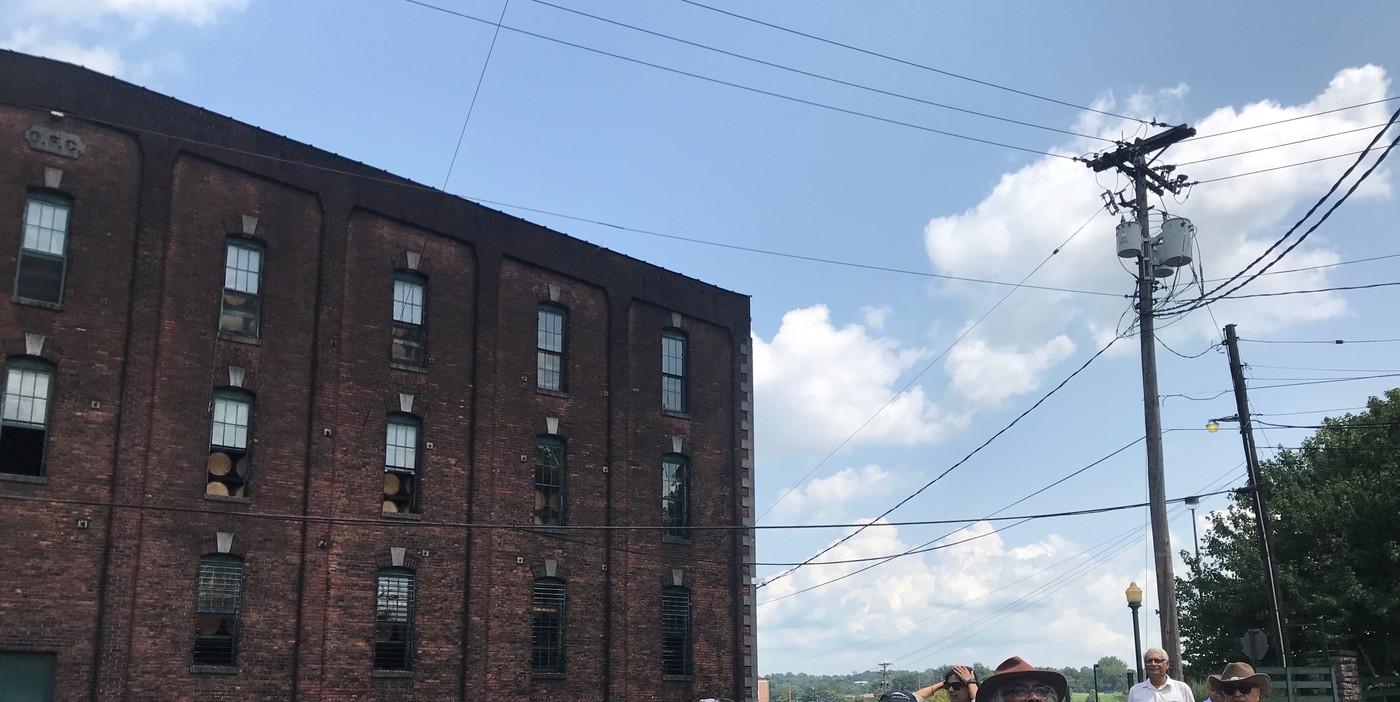
Buffalo Trace barrel-ageing warehouse, 2018. Photograph by Jaimin Trivedi, via Wikimedia Commons, licensed CC BY-SA 4.0.
- 1870Taylor buys the Leestown distillery and names it O.F.C.
- 1877–78His businesses fail. The property passes to his creditor, George T. Stagg.
- 1904Renamed the George T. Stagg Distillery.
- 1942Schenley era; the plant becomes Ancient Age.
- 1992Bought by Sazerac.
- 1999Renamed Buffalo Trace.
This is where E.H. Taylor bourbon is made today — at the distillery he lost in his forties, under a name he never chose.
E.H. Taylor · the one he built
Old Taylor → Castle & Key
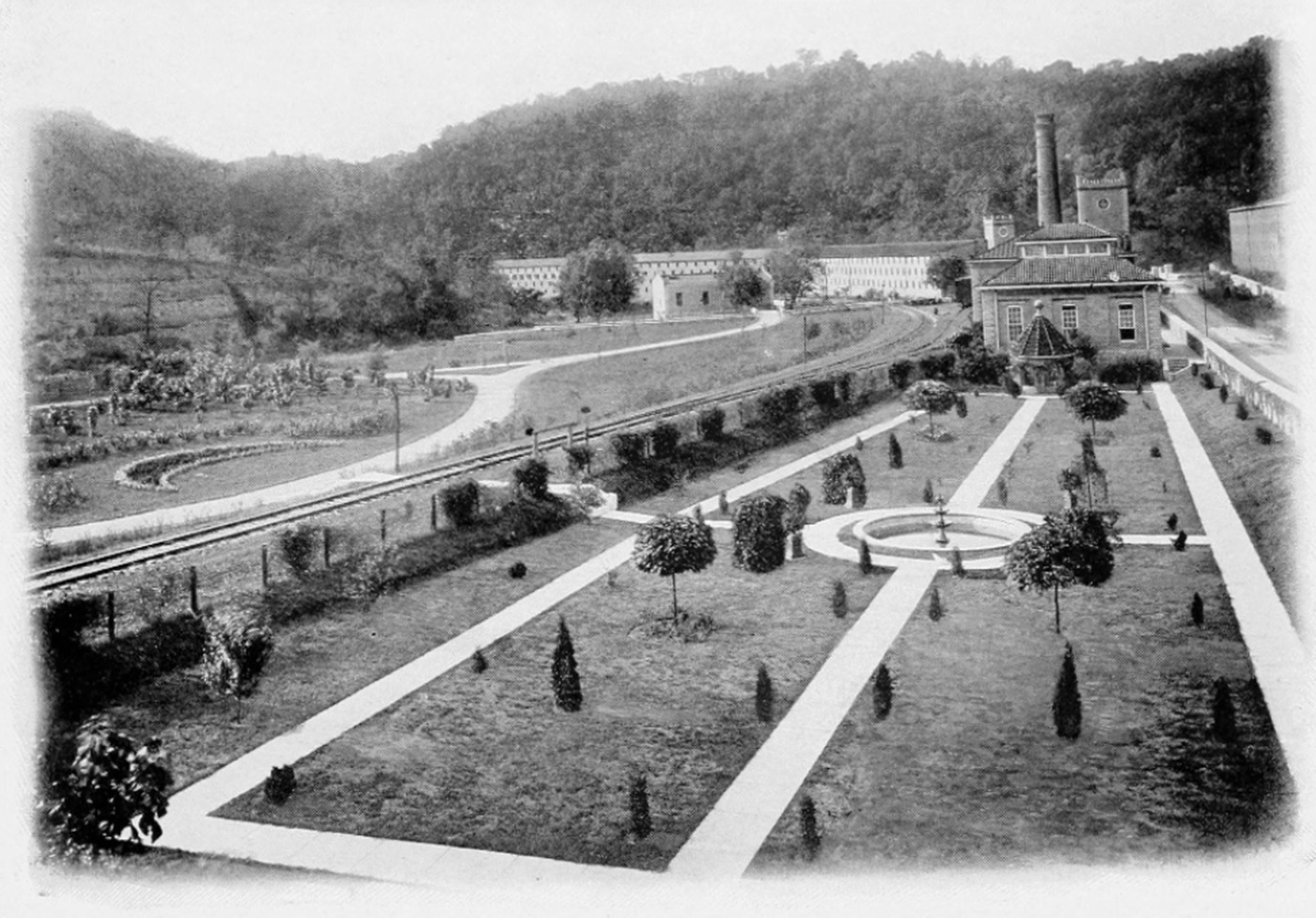
The Old Taylor distillery, c. 1916, from Press Reference Book of Prominent Kentuckians. Public domain. Reproduced as published.
- 1887The castle still house goes up — a distillery built to be visited.
- 1923Taylor dies.
- 1972National Distillers stops distilling on the site.
- 1987Bottling ends. The buildings are left to fall.
- 2014Bought by Will Arvin and Wes Murry.
- 2018Reopens as Castle & Key — an independent company.
The distillery Taylor actually built survives, restored and working. It does not make a drop of E.H. Taylor bourbon.
The name and the place came apart, and never came back together.
Taylor’s showplace — the limestone castle at Millville with the sunken garden and the columned springhouse, built, in the federal survey’s own words, “all intended as a tourist attraction” — outlived him, then outlived its usefulness. It sat derelict for decades.
In 2014 a Lexington attorney named Will Arvin bought it. It reopened in 2018 as Castle & Key, and makes whiskey there today.
Castle & Key has no corporate relationship whatsoever to the Colonel E.H. Taylor, Jr. brand. The brand lives at Buffalo Trace, which is the site Taylor lost in 1877. The building he actually built belongs to somebody else entirely.
The distillery he built and the name he fought for are owned by two different companies, and neither of them is his.
If that sounds familiar, it should. It is the same structure as Issue No. 001: a building and a name, travelling separately, long after the man is gone. Michter’s is the clearer case only because the gap is wider.
Go Deeper
- The Bottled-in-Bond Act of 1897 — 29 Stat. 626, ch. 379 (opens in a new tab) The statute itself, as approved 3 March 1897 — including the clause requiring the real name of the actual distiller beside any trade mark, and containing no four-year minimum.
- Congressional Record, 54th Congress, 1st Session — House debate on H.R. 8582 (opens in a new tab) Walter Evans introduces and defends the bill (pp. 5377–5380): the "pure article" argument, the Canadian Club competition argument, and Dingley's remark about maturing the distillers' pockets.
- Congressional Record, 54th Congress, 2nd Session — Senate passage (opens in a new tab) Aldrich reports the Finance Committee's amendments and Blackburn moves the bill (pp. 2243–2244); the House concurs without debate (p. 2465).
- Congressional Record, 54th Congress, 2nd Session — the remonstrance against H.R. 8582 (opens in a new tab) W. E. Broderick of the National Wholesale Liquor Dealers' Association and the Hannis Distilling Company petition against the bill.
- American Grain Stream — the fifth requirement for Bottled-in-Bond spirits (opens in a new tab) Dates the four-year minimum to 1911 rather than to the 1897 Act.
- 27 CFR § 5.88 — Bottled in bond (current regulation) (opens in a new tab) The modern rule, including the 'unaltered' and 'only pure water' clauses most summaries leave out.
- National Historic Landmark nomination — Labrot & Graham's Old Oscar Pepper Distillery (NPS) (opens in a new tab) The federal document recording Taylor's 1877 failure, the deeding of his properties to Stagg, the 'model whisky barrel of the world' assessment, his 1909 credit to James Crow — and the finding that his improvements 'have never been concretely substantiated.'
- Filson Historical Society — Taylor-Hay Family Papers (opens in a new tab) The archival finding aid: the banking career and its 1857 collapse, the uncle whose name he took, and the note that no relation to President Zachary Taylor is documented.
- Michael Veach — The Fight For Bottled-in-Bond (opens in a new tab) John G. Carlisle's role, and the rectifiers' side — including George Garvin Brown and Isaac Wolfe Bernheim.
- Michael Veach — E.H. Taylor, Jr. and Bottled-in-Bond Whiskey (opens in a new tab) The source for 'a firm supporter' in 1897, and for the documented 1906–09 campaign that Taylor only partly won.
- High & Coppin — Wiley and the Whiskey Industry, Business History Review 62:2 (1988) (opens in a new tab) Peer-reviewed scholarship arguing both sides invoked consumer protection while pursuing commercial advantage.
- Brian Haara (Sipp'n Corn) — The origin of Col. E.H. Taylor, Jr.'s signature (opens in a new tab) A trademark attorney's reading of the three signature rulings, including the 1894 injunction and the damages losses in 1896 and 1902.
- Brian Haara (Sipp'n Corn) — Col. E.H. Taylor, Jr., running from his debts (opens in a new tab) The double-sold barrels and Newcomb-Buchanan Co. v. Baskett, including the court's note that Taylor left the state in May 1877.
- Chuck Cowdery — Sazerac acquires Old Taylor (opens in a new tab) The June 2009 transfer of the Taylor brand from Beam to Sazerac, and what came the other way.
- Buffalo Trace — Colonel E.H. Taylor, Jr. (opens in a new tab) The company's own claims, including 'the father of the modern bourbon industry' — quoted here as a current claim, not as history.