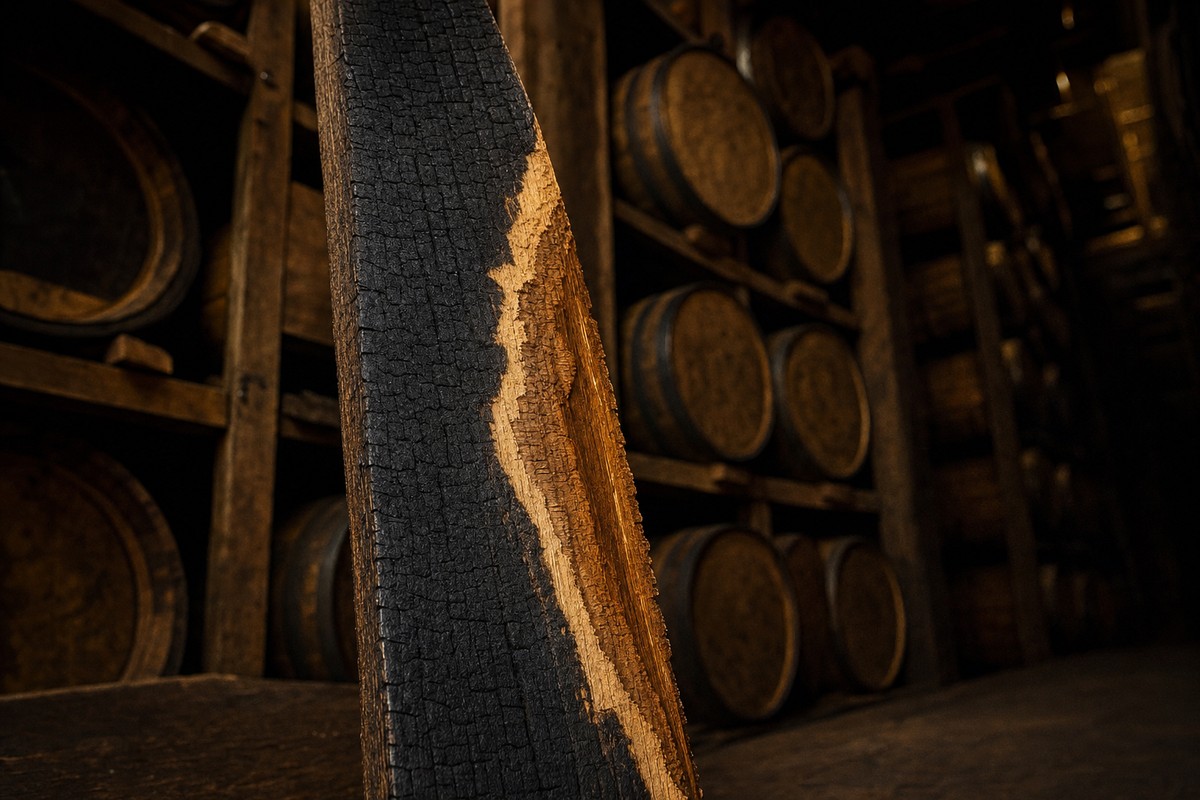
Bourbon may enter the barrel at no more than 125 proof — a legal ceiling, not a requirement to hit it. Some producers choose to enter wood at a lower proof than the maximum allows, on purpose.
Why It Matters
Water and ethanol don’t extract from wood the same way.
Because water and alcohol pull different compounds out of charred oak at different rates, entry proof is part of the barrel recipe from day one — not an afterthought that only matters once the whiskey is proofed down for bottling. A barrel filled at a lower entry proof spends its whole maturation extracting differently than one filled near the legal maximum, even with an identical mash bill, char and warehouse.
The interesting question isn’t only “what proof did they bottle it at?” It’s also: what proof did they put it into wood at?
Ledger Example
Distillers who talk about proof usually mean this.
When a producer’s own materials emphasize a specific entry proof as a deliberate choice — rather than defaulting to the legal maximum — that’s usually a signal they consider it part of their house style, the same way mash bill or char level gets treated as a signature decision.
Michter’s is the most-cited example: the company says it enters at 103 proof, well under the ceiling. Hold that the way you should hold nearly every production specification in whiskey — it is a company statement, not an audited one. Entry proof isn’t printed on the label and isn’t independently reported; what circulates is the producer’s own number, repeated. That isn’t a reason to disbelieve it. It is a reason to know what kind of fact it is. Issue No. 001 works through that distinction in detail.