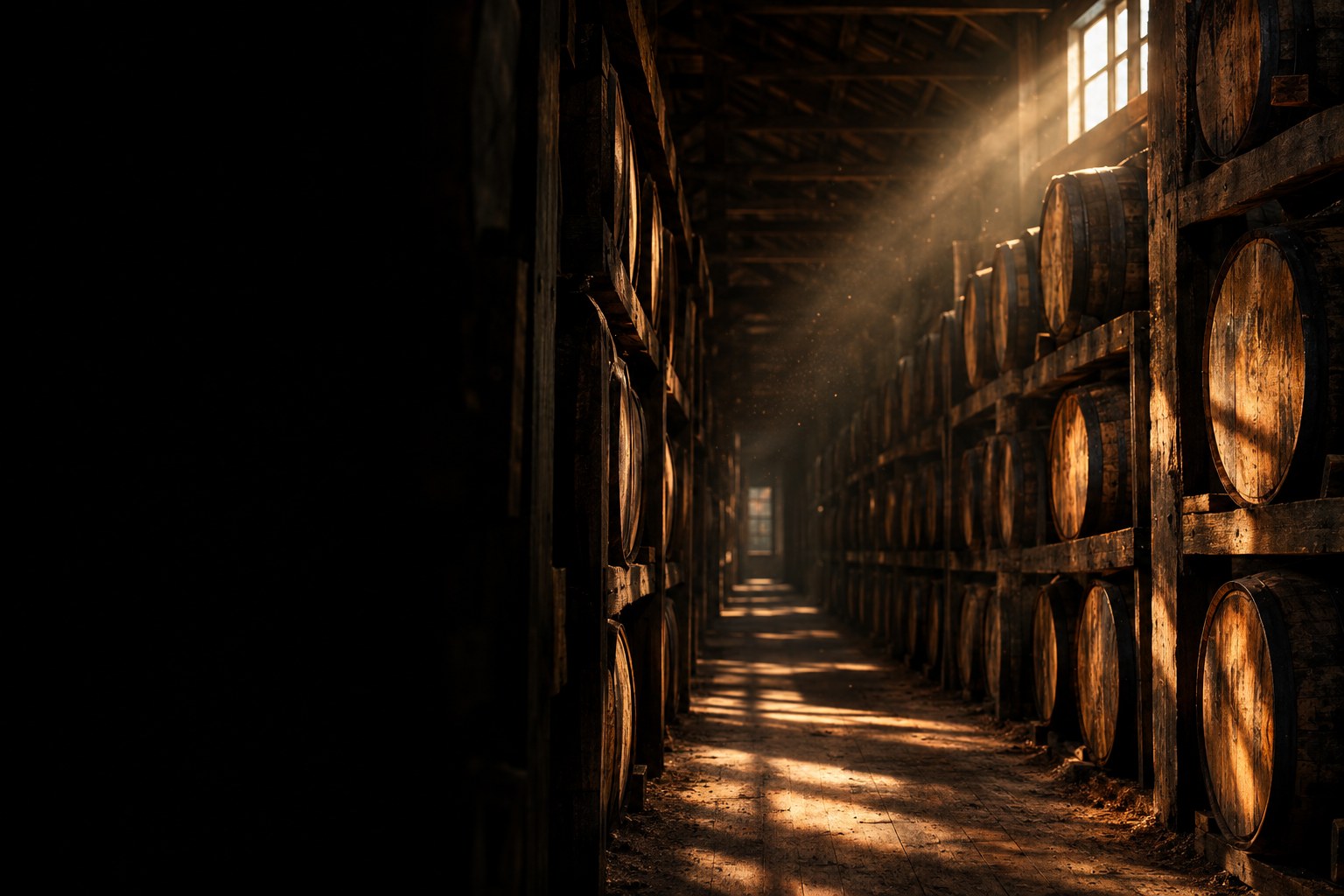
The Question
The problem with a really good bourbon
Some bottles make the next purchase easy.
You taste the entry-level expression, find it pleasant but limited, and begin wondering what the producer can accomplish with more age, more proof, or better barrel selection.
Russell’s Reserve 10 Year creates a different problem.
It is already a mature Kentucky straight bourbon. It carries a ten-year age statement, comes from the Wild Turkey distillery, and bears the names of Jimmy and Eddie Russell, two men whose combined careers span more than a century.
It isn’t a whiskey that needs to apologize for what it is.
And yet, the same family produces considerably more expensive bourbons aged thirteen and fifteen years, single-barrel releases, and limited editions selected from individual rickhouses.
If ten years can produce a wonderful bourbon, why wait thirteen?
If thirteen is better, why stop before fifteen?
And if fifteen is the answer, why not twenty?
The questions expose a peculiar assumption embedded in modern whiskey collecting: that age is a ladder and quality lives somewhere near the top.
The Russell family has spent decades producing evidence that the relationship is considerably more complicated.
To understand it, we need to understand the family first.
Chapter I
The man who stayed
Jimmy Russell joined Wild Turkey in 1954.
He began working in whiskey before bourbon’s modern revival, before single-barrel bourbon became a major consumer category, and long before bottles with double-digit age statements routinely attracted hundreds of dollars.
He experienced changing ownership, consumer tastes, equipment, and expectations. His career remained anchored to the same distilling tradition in Lawrenceburg, Kentucky.
Jimmy’s reputation was built on continuity. That doesn’t mean Wild Turkey never changed. Distilleries evolve, equipment changes, and production methods are refined. It means that the brand maintained a recognizable identity through an industry that repeatedly reinvented itself.
In 1981, Jimmy’s son Eddie joined the operation.
He didn’t begin as a celebrity master distiller. He started as a relief operator and learned the distillery through its everyday work.
There is something important about that apprenticeship.
Making whiskey is partly a technical discipline. You can measure grain percentages, fermentation temperatures, distillation proofs, barrel-entry proof, warehouse conditions, and bottling strength.
But deciding which mature barrels belong in a particular expression also requires sensory judgment. That judgment develops through repeated exposure, comparisons, mistakes, and years of experience.
Eddie eventually became a master distiller in his own right, receiving the title in 2015.
Russell’s Reserve became one of the clearest expressions of his approach.
-
Jimmy Russell
1954to 2026Joined in 1954 and stayed through every change of ownership, taste and equipment the industry put in front of him.
-
Eddie Russell
1981to 2026Joined in 1981 as a relief operator. Learned the distillery through its everyday work before any title arrived.
-
Bruce Russell
No dated span published
The family’s third generation in whiskey, publicly associated with the continuation of that work. We have not sourced a start year or a current title, so this timeline draws neither.
-
1954
Jimmy Russell joins Wild Turkey.
Before bourbon’s modern revival, and before single barrel was a consumer category.
Official history
-
1981
Eddie Russell joins the distillery.
As a relief operator, not as an heir apparent.
Official history
-
1998
Eddie creates a bourbon honoring Jimmy’s 45 years.
A tribute first. A brand second.
Official history
-
2001
Russell’s Reserve arrives commercially.
A ten-year-old bourbon bottled at 101 proof.
Official history
-
2015
Eddie receives the title of master distiller.
Thirty-four years after he started.
Official history
Era bands cover documented working presence only and are not a claim about anyone’s current role or title. The date on which the 10 Year moved from 101 proof to 90 is not established by the brand’s official history and is deliberately absent from this timeline.
1998
A tribute becomes a brand
In 1998, Eddie created a special bourbon honoring Jimmy’s 45 years at Wild Turkey.
Russell’s Reserve emerged commercially in 2001 as a ten-year-old bourbon bottled at 101 proof.
Later, the ten-year expression changed to 90 proof, the strength familiar to contemporary drinkers. The brand’s official history establishes the change but does not establish the precise year or the reasoning behind it. We should not invent either.
What we can say is that the change altered how the whiskey was presented to the drinker.
The original and modern bottles share a ten-year age statement, but they don’t deliver the same concentration of alcohol.
This is our first important lesson: age is only one part of a whiskey’s identity.
Chapter II
What Wild Turkey puts into the barrel
Before we examine ten years versus fifteen, we need to understand what is aging.
Wild Turkey is known for traditional Kentucky straight bourbon production, including a relatively low barrel-entry proof compared with the legal maximum of 125 proof. Its widely reported barrel-entry proof is 115, although historical practices and the production period of a particular bottle should be considered before treating any number as universal.
Why does that matter?
Because the proof at which newly distilled whiskey enters the barrel influences the mixture of alcohol and water interacting with the oak.
Different compounds have different solubilities in ethanol and water. Changing their proportions can influence extraction and the developing balance of the whiskey.
But the relationship is not as simple as lower proof always producing more flavor or higher proof always producing more intensity.
The final result also depends on barrel construction, char, warehouse conditions, age, and subsequent proofing.
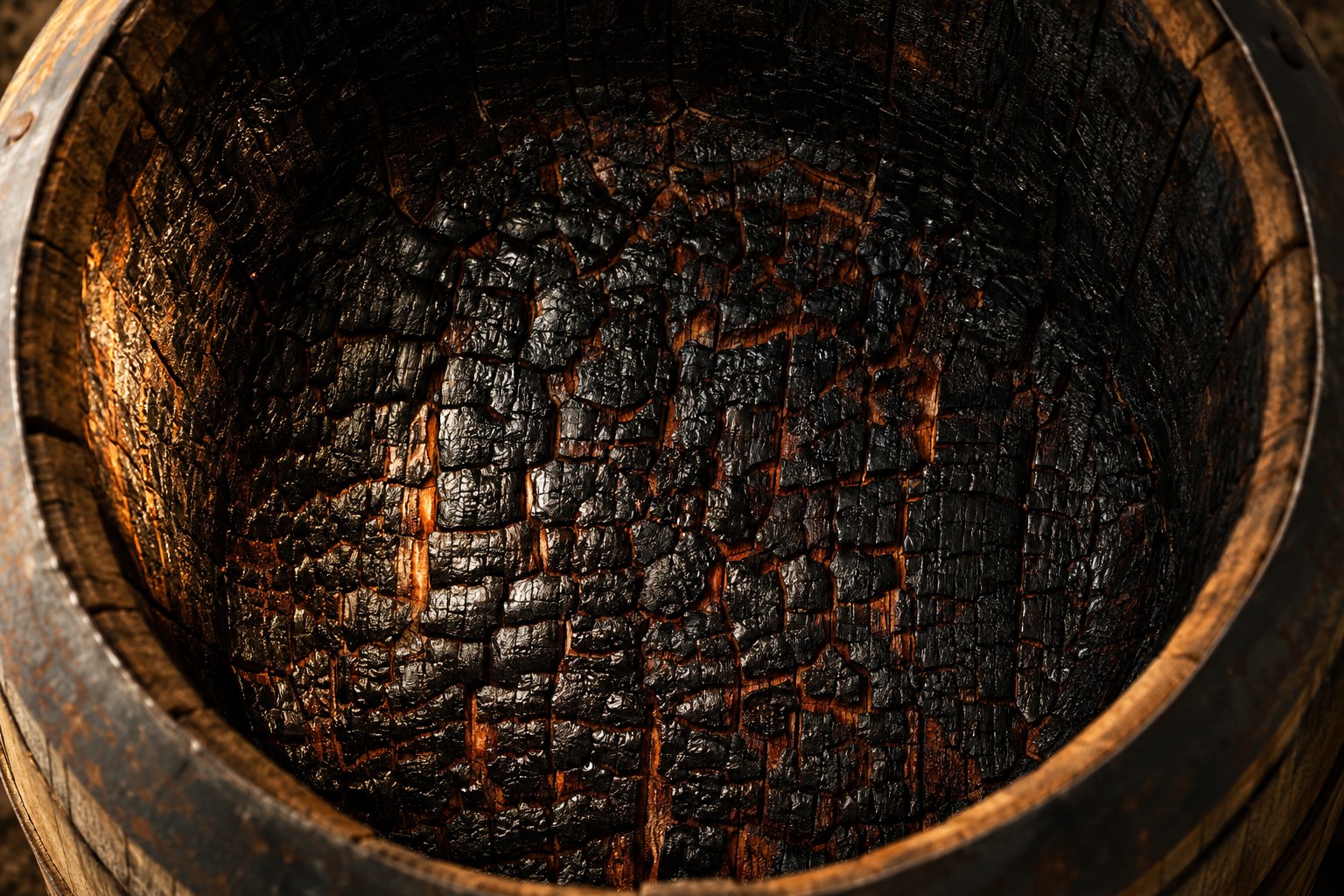
Russell’s Reserve 10 Year is associated with heavily charred new American oak barrels, including the No. 4, or alligator, char commonly cited in Wild Turkey production. This is one of the important variables shaping its maturation.
Bourbon School Barrel Entry Proof The strength at which new make goes into the wood. It is capped by law at 125 proof, and where a distillery sits under that cap is one of its quieter signatures.No. 4 char
What the char actually does
 № 012
№ 012When the interior of a bourbon barrel is charred, the wood undergoes thermal changes.
A layer of charcoal develops on the surface. Beneath it, heat transforms wood components that can contribute flavors associated with vanilla, caramel, spice, and toasted wood.
The barrel does several jobs at once.
It contributes compounds. It provides an environment for chemical change. Its charred surface interacts with components of the distillate. And the barrel allows limited exchange with the surrounding environment.
Whiskey side Outside of the barrel
-
Char layer
A crust of carbon on the surface the whiskey touches, cracked into the pattern that gives alligator char its name.
Interacts with components of the distillate.
-
The heat-changed wood beneath
Wood that the fire altered without carbonising, where thermal change has transformed the oak’s own components.
Associated with vanilla, caramel, spice and toasted wood.
-
Warmed oak
Oak that felt the heat but was not transformed by it.
Part of the structure the whiskey moves through.
-
Raw stave
Oak the fire never reached, holding the barrel together.
Allows the limited exchange with the outside air that maturation depends on.
Schematic. Layer depths vary by cooperage, char level and individual stave, and no measured depths are published in our sources, so none are drawn here. Flavor associations are associations, not guarantees.
This is why a whiskey’s maturation cannot be reduced to time spent sitting in a container.
The container is an active part of the process.
A No. 4 char does not guarantee a specific flavor profile, just as ten years does not guarantee a specific degree of maturity.
But it gives us another piece of the Russell’s Reserve foundation.
Chapter III
The difference between age and maturity
A ten-year age statement is objective.
Maturity is not.
An age statement on a blend of straight whiskeys tells us the minimum age of the whiskey in that bottle. It doesn’t reveal the complete age distribution, the character of every barrel, or whether additional aging would have improved the final product.
Maturity is the point at which the people selecting the whiskey believe it has developed the characteristics they want.
That judgment may involve richness, complexity, balance, oak integration, texture, and the relationship between sweetness, spice, and dryness.
Those qualities do not necessarily peak simultaneously.
The oak problem
Why older whiskey can become less enjoyable
Oak contributes desirable flavors, but it can also introduce bitterness, dryness, and astringency.
Over time, some barrels may become increasingly dominated by wood. Others develop remarkable complexity.
The difference is influenced by how the whiskey interacts with its barrel and environment.
Consider two hypothetical barrels.
Barrel A develops rich vanilla, mature fruit, oak spice, and a balanced finish after ten years. Barrel B remains relatively restrained at ten years but develops exceptional depth after fifteen.
Neither barrel is automatically superior because of its age.
-
Barrel A
Rich vanilla, mature fruit, oak spice and a balanced finish after ten years.
Ready from year 9 to year 13.Ready at ten. Five more years is a gamble, not an upgrade.
-
Barrel B
Relatively restrained at ten years, then develops exceptional depth.
Ready from year 14 to year 18.Pulled at ten, it would have been the lesser whiskey.
Illustrative. These two barrels are the manuscript’s own hypotheticals, drawn to show the argument, and are not measurements from real barrels. The windows have no quality scale and no peak, because a readiness window is a judgment with a start and an end.
Now imagine Barrel A remains in the warehouse for five more years.
Does it become better? Possibly.
Does it become more concentrated, woody, and dry? Also possible.
The only reliable way to make that decision is to evaluate the whiskey. And that evaluation is exactly where experienced barrel selectors become important.
The angels’ cut
Why evaporation complicates the equation
Whiskey evaporates during aging.
The familiar term angel’s share describes liquid lost through the barrel over time.
But evaporation doesn’t always affect alcohol and water in the same proportions. Warehouse temperature, humidity, airflow, and location influence how proof and volume change.
An older barrel may contain substantially less liquid than when it was filled.
That means extended aging has economic consequences beyond simply waiting longer. The producer has less whiskey to bottle, more time invested in it, and a greater chance that a barrel will no longer meet the desired flavor profile.
Older whiskey is often genuinely more expensive to produce. That does not mean it will be more enjoyable to drink.
Chapter IV
The rickhouse changes everything
A rickhouse is not a climate-controlled laboratory where every barrel experiences identical conditions.
Traditional warehouses contain different temperature and humidity environments. Upper floors may experience more heat and greater temperature fluctuations. Lower floors are often cooler.
Barrels also vary by their position within the building. Sun exposure, airflow, building construction, and seasonal weather all matter.
Russell’s Reserve traditionally emphasizes barrels selected from the middle sections of its rickhouses, sometimes described as the center cut.
The logic is that these locations can offer favorable maturation conditions for the profile the family wants.
But the Single Rickhouse collection reveals something more interesting.
Single Rickhouse
When the exception becomes the release
In 2022, Russell’s Reserve launched Single Rickhouse with a release from Camp Nelson C. The whiskey came from 72 barrels selected from floors three and four. The distillery had already dismantled that rickhouse, making the release a record of a maturation environment that no longer existed.
In 2023, the Camp Nelson F release drew from floors four and five. The 2024 Camp Nelson B release explored another warehouse location. In 2025, Camp Nelson E focused on barrels from the fifth floor and was released at 128 proof.
Floor 7
Upper floors may experience more heat and greater temperature fluctuation.
Floor 6
Upper floors may experience more heat and greater temperature fluctuation.
Floor 5
Transitional. Warmer than the center, steadier than the roof.
- Camp Nelson F 2023
- Camp Nelson E 2025 128 proof
Floor 4
Center cut. The traditional house preference.
- Camp Nelson C 2022 72 barrels
- Camp Nelson F 2023
Floor 3
Center cut. The traditional house preference.
- Camp Nelson C 2022 72 barrels
Floor 2
Lower floors are often cooler.
Floor 1
Lower floors are often cooler.
The traditional center cut, shown as a wash rather than a ranking.
Only releases whose floors are documented in our sources are marked. The 2024 Camp Nelson B release explored another warehouse location and is described in the text; its floor is not marked here because we have not sourced it. Floor climate uses our sources’ own relative language; no temperatures are published and none are invented.
Think about the implications.
The brand has a preferred maturation philosophy, but it also recognizes exceptional whiskey from distinct warehouse environments.
That’s not necessarily a contradiction. It’s the difference between a general production preference and the evaluation of particular barrels.
The middle floors might provide a reliable source of whiskey for a desired house profile. An individual barrel from another location might produce something extraordinary but less suitable for the standard blend.
The important point is that the warehouse’s influence is real, but it isn’t a simple ranking of floors from best to worst.
Chapter V
Five expressions, five different decisions
The reference
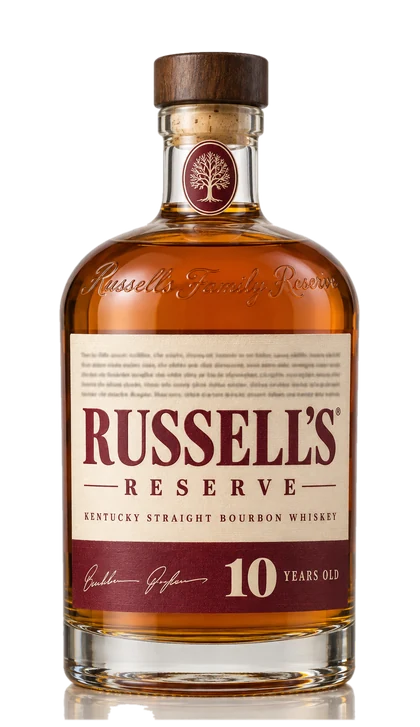
Russell’s Reserve 10 Year
10 years · 90 proof · small batch
The house character, before any variation. Many barrels selected and blended into one consistent expression.
Everything below is described as a move away from this bottle, not a step above it.
-
 02
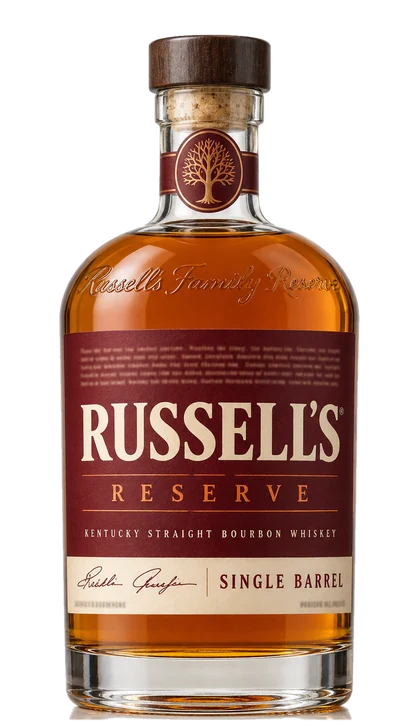
02 The single voice
Single Barrel Bourbon
110 proof · non-chill filtered · no age statement
- Blending
- Proof
- Age statement
What one barrel sounds like when nothing is blended around it.
-
 03
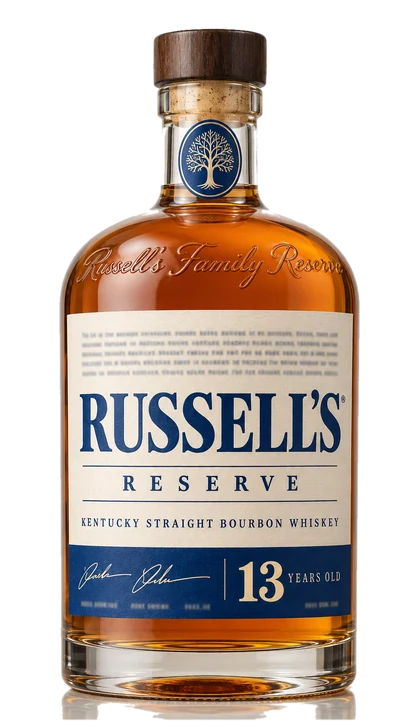
03 The longer hold
Russell’s Reserve 13 Year
at least 13 years · proof varies by release
- Age
- Batch
Why a batch number matters as much as an age statement.
-
 04
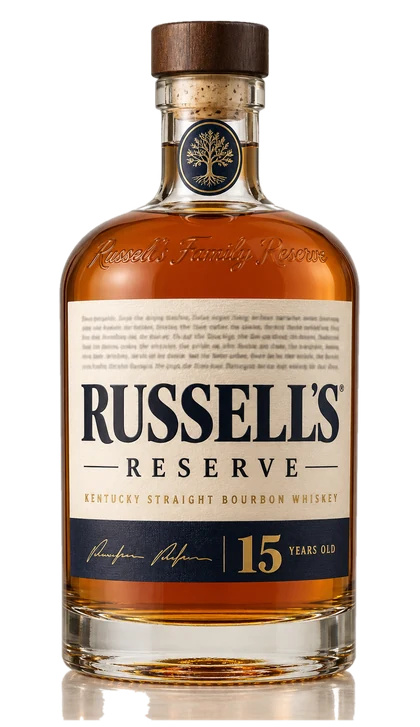
04 The deep cut
Russell’s Reserve 15 Year
15 years · 117.2 proof · 2024 limited release
- Age
- Proof
- Scarcity
That long maturation can be exceptional when the barrels earn it.
-
 05
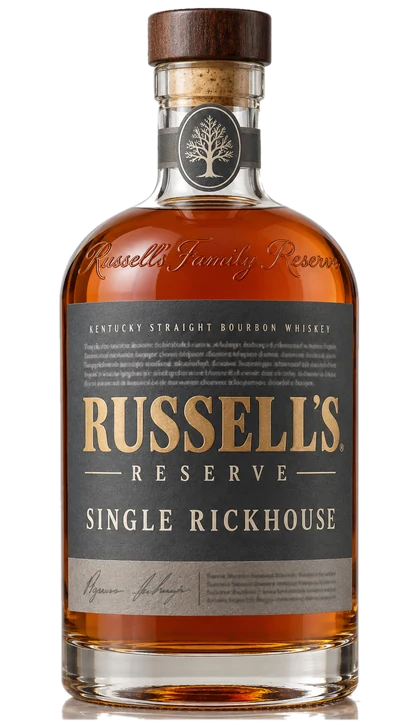
05 The address
Single Rickhouse
warehouse-specific · specifications vary by release
- Place
- Scarcity
How much of a whiskey’s identity is where it rested.
-
 06
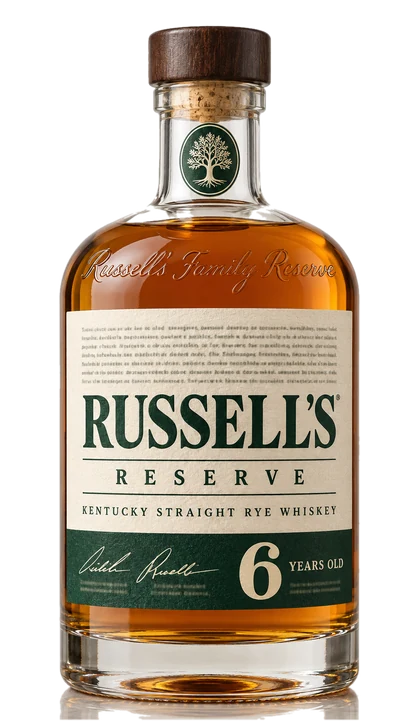
06 The other grain
Russell’s Reserve 6 Year Rye
6 years · 90 proof
- Grain
- Age
The house rye voice, held at the 10 Year’s strength so only the grain moves.
Each entry names the variable it moves relative to the 10 Year. Read the Changes column downwards and the lineup stops being a line. Numbers are for reference, not rank.
Every proof, age and price in this issue is sourced in the text, never read off one of these illustrations.
Editorial illustrations, not photographs. Drawn to the producer’s own current packaging so the expressions can be told apart; no proof statement, batch code or warehouse name is rendered on any of them.
The reference point
Russell’s Reserve 10 Year
10 years | 90 proof | Small batch
The reference point for the entire story. Multiple barrels are selected to create a consistent expression. The producer describes notes such as vanilla, spice, caramel, and toffee. Those are producer descriptions, not independent tasting findings from The Bourbon Ledger.
This is the bottle for learning the Russell’s Reserve house character before exploring variations.
One barrel
Russell’s Reserve Single Barrel Bourbon
110 proof | Non-chill filtered | Single barrel
This is not simply the ten-year-old with less water. It represents an individual barrel selected for bottling, with its own character and no standard age statement.
It introduces the reader to barrel variation and the effects of higher bottling proof. Individual barrels can differ from one another, which is part of the appeal and part of the uncertainty.
Longer
Russell’s Reserve 13 Year
At least 13 years | Limited releases | Proof varies by release
This is where longer aging and selective blending become more prominent. Different releases can vary in proof and character, so the batch matters.
No two Russell’s Reserve 13 releases should be assumed to share a proof or a barrel composition. Where we have seen reported specifications for a particular batch without an independently accessible source behind them, we have left them out.
Deep maturity
Russell’s Reserve 15 Year
15 years | 117.2 proof | 2024 limited release
An exploration of deeply mature bourbon. Independent Wild Turkey specialist David Jennings of Rare Bird 101 praised the 2024 release’s complexity, mature oak, and long finish, while examining its proof and approximately $250 suggested retail price.
It is an important counterweight to any simplistic argument that older bourbon is inherently worse.
One warehouse
Russell’s Reserve Single Rickhouse
Warehouse-specific | Limited batches | Specifications vary
These releases emphasize the influence of a particular maturation location. They are useful for understanding how the environment becomes part of the whiskey’s identity, although differences between releases prevent clean one-variable comparisons.
The 2025 Camp Nelson E release at 128 proof is a verified example. A further release has been reported since; we have not printed its specifications here, because we could not confirm them against an accessible source.
The trap
The mistake collectors make
A lineup like this invites the consumer to imagine a progression: ten-year, then Single Barrel, then thirteen-year, then fifteen-year, then Single Rickhouse.
But that isn’t how the portfolio works.
Single Barrel is not automatically older than the 10 Year. Single Rickhouse is not automatically superior to the 15 Year. And a limited release’s price may reflect rarity and collector demand as much as its particular flavor.
Each bottle represents a different selection decision.
The best way to navigate the lineup is to understand what changed and decide whether that change matters to you.
Each bottle represents a different selection decision, not a higher rung.
Chapter VI
The fifteen-year-old makes the case for age
It would be tempting to write this issue as a defense of affordable whiskey against expensive whiskey.
That would be too easy.
Russell’s Reserve 15 is a serious counterargument.
In his August 2024 review, Wild Turkey specialist David Jennings of Rare Bird 101 described the fifteen-year-old as an exceptional release, praising its maturity, complexity, and finish.
He also addressed criticism about the whiskey being bottled at 117.2 proof rather than at a higher strength.
That matters because whiskey enthusiasts sometimes assume the highest possible proof is inherently preferable. But barrel proof is not a universal guarantee of balance.
The producer may decide that a different bottling strength better presents the selected whiskey.
A fifteen-year-old bourbon can absolutely be remarkable.
The lesson isn’t that ten years is better than fifteen.
The lesson is that fifteen yearsmust justify itself in the glass.
Money
The value question
The Russell’s Reserve 15 launched with a suggested price around $250. That’s substantially more than a typical bottle of Russell’s Reserve 10.
Part of the difference is understandable. Fifteen-year-old barrels require more storage time, experience more evaporation, and offer less remaining inventory.
But the premium also reflects the economics of a limited release.
For some buyers, the difference will be worth it. For others, a ten-year-old bourbon they enjoy regularly will provide greater satisfaction.
Both are rational outcomes.
What isn’t rational is assuming the more expensive bottle must deliver proportionally more enjoyment.
Chapter VII
The Ledger Cocktail: The Russell’s Old Pal
We have spent most of this issue talking about maturation, but Russell’s Reserve also makes rye whiskey.
And that gives us a particularly useful way to experience how a different whiskey changes a cocktail.
The Old Pal is a classic drink associated with the 1920s Paris cocktail world and documented in the 1927 book Barflies and Cocktails. Arthur Moss is associated with its historical account; Harry MacElhone published the book. Neither detail establishes that MacElhone invented the cocktail.
The historical recipe and the modern standard aren’t identical. Modern Old Pals commonly combine rye whiskey, Campari, and dry vermouth, while early descriptions involved different whiskey and vermouth choices.
Unlike a Manhattan, which usually uses sweet vermouth, the modern Old Pal has a drier and more bitter structure.
That makes it an interesting test for whiskey.
Campari brings pronounced bitterness and citrus-herbal character. Dry vermouth contributes wine acidity, botanical complexity, and comparatively little sweetness.
The whiskey must provide enough body, character, and balance to remain recognizable.
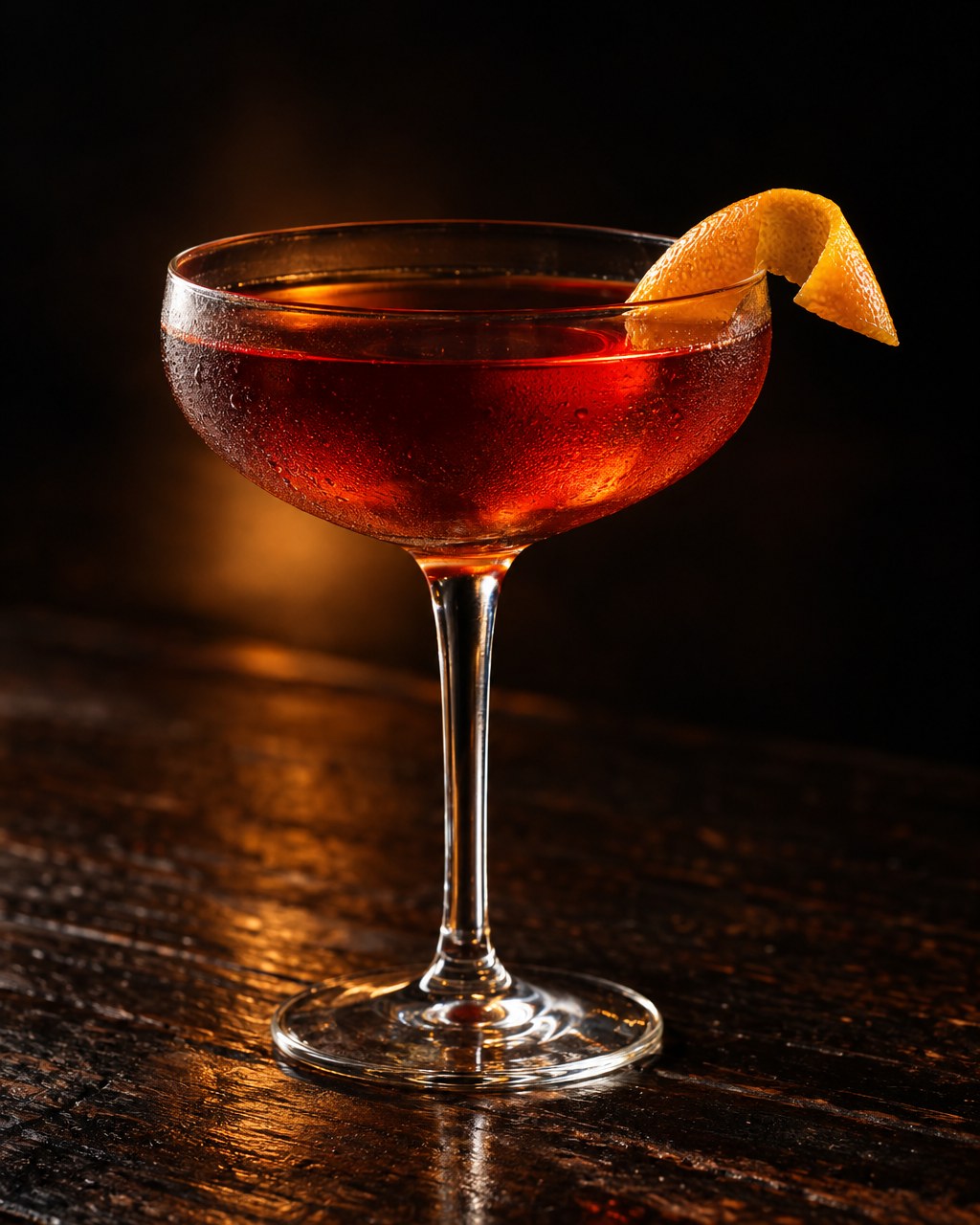 № 012
№ 012The recipe
The Russell’s Old Pal: Ledger adaptation
The Ledger Cocktail
The Russell’s Old Pal
Ingredients
- 1½ oz Russell’s Reserve 6 Year Rye
- ¾ oz Campari
- ¾ oz dry vermouth
Method
- Stir all liquid ingredients with ice until thoroughly chilled and diluted.
- Strain into a chilled coupe.
- Express an orange peel over the drink and garnish.
Spirit-forward, bitter, dry, stirred. This is The Bourbon Ledger’s proposed 2:1:1 adaptation, not the original historical recipe and not a drink we claim to have independently taste-tested.
Why this whiskey
Why Russell’s 6 Year Rye?
Russell’s Reserve 6 Year Rye is bottled at 90 proof, the same labeled proof as the standard 10 Year Bourbon.
That creates a convenient comparison.
We can make two cocktails with the same recipe, using whiskeys from the same distilling family at the same bottling strength.
The producer describes the rye in terms that include spice, citrus, caramel, and pepper. Those characteristics suggest an interesting interaction with Campari and dry vermouth. This is a hypothesis to test, not a guaranteed tasting result.
The variation
The controlled variation: bourbon versus rye
Make a second Old Pal, changing only the whiskey.
Replace the 1½ ounces of Russell’s Reserve 6 Year Rye with 1½ ounces of Russell’s Reserve 10 Year Bourbon. Keep everything else identical.
| Rye version | Bourbon version | |
|---|---|---|
| Whiskey | Russell’s Reserve 6 Year Rye | Russell’s Reserve 10 Year Bourbon |
| Bottling proof | 90 | 90 |
| Age | 6 years | 10 years |
| Grain recipe | Rye | Bourbon |
| Campari, vermouth, ratio, ice, glass, method | Identical | Identical |
| Variables actually isolated | None. Proof is held constant, but grain recipe, maturation history and barrel selection all differ at once. |
The reader should look for the following differences, without assuming they will necessarily appear:
- Does rye spice reinforce Campari’s bitter structure?
- Does bourbon’s sweeter grain profile soften the bitterness?
- Which version feels leaner, rounder, or more integrated?
- Does the finish emphasize spice, oak, citrus, or sweetness?
- Which version would you actually order again?
The two whiskeys share a producer and a 90-proof bottling strength. But one is six-year-old rye and the other is ten-year-old bourbon.
If the drinks taste different, it would be wrong to attribute the difference solely to four additional years in oak. The grain recipes, selected barrels, and maturation profiles differ.
The comparison reinforces the issue’s central lesson: a number on a bottle is useful, but it never tells the entire story.
Chapter VIII
The Ledger Lab: Does proof explain your preference?
The cocktail teaches the difference between rye and bourbon.
Now let’s return to barrel selection and proof.
Ledger Lab Card
Does proof explain your preference?
Open experiment — result not in
- Samples
- Russell’s Reserve 10 Year (90 proof) and Single Barrel Bourbon (110 proof)
- Isolating
- Bottling strength, as far as two different bottlings allow
- Not isolating
- Barrel selection, age, filtration, batch composition
- Dilution target
- 20 mL of 110 proof plus approximately 4.4 mL water, for a nominal 90 proof
- Result
- Not in. This is your experiment to run, not ours to report.
For this experiment, use Russell’s Reserve 10 Year and Russell’s Reserve Single Barrel Bourbon.
The first is bottled at 90 proof. The second is bottled at 110.
Begin by tasting both neat, ideally blind and in identical glassware. Record aroma intensity, sweetness, spice, oak, texture, finish, and overall preference.
Then dilute a measured portion of the Single Barrel toward 90 proof.
For 20 mL of 110-proof whiskey, approximately 4.4 mL of water produces a nominal 90-proof mixture, allowing for small deviations due to volume contraction when ethanol and water are mixed.
Let both samples rest for comparable periods. Taste again.
What changed?
Did the Single Barrel retain more intensity? Did its oak become more noticeable? Did the standard 10 Year seem better balanced? Or did the Single Barrel remain your favorite?
This isn’t a perfectly controlled experiment. The bottles differ in barrel selection, potentially age, filtration, and composition. Dilution also affects aroma and texture.
But it helps separate one obvious variable from the others.
The goal isn’t to declare a winner. It’s to understand why you prefer one.
Chapter IX
The Russell’s Reserve buying guide
Rather than assigning universal numerical scores, organize the portfolio by buying purpose.
| What you want | Where to start | Why |
|---|---|---|
| Everyday mature bourbon | 10 Year | Age statement, consistency, approachable proof |
| More intensity and barrel individuality | Single Barrel Bourbon | Higher proof, individual-barrel character |
| A deeper exploration of mature bourbon | 13 Year | Older selected stock and batch variation |
| A special long-aged experience | 15 Year | Extended maturation and selective release |
| Warehouse-specific exploration | Single Rickhouse | A study of location and barrel selection |
| A Russell-family rye experience | 6 Year Rye | A practical introduction to their rye style |
| Higher-proof rye | Single Barrel Rye | More intensity and individual-barrel character |
In order
What I’d actually buy first
The 10 Year.
Then the Single Barrel Bourbon.
Then, if the rye Old Pal appeals to you, the 6 Year Rye.
Those three bottles offer more educational value than immediately pursuing the most expensive release.
The 13 Year and 15 Year become more meaningful purchases once you understand what you like about the house style.
And if you discover that you prefer a more mature, oak-driven profile, then the limited releases may be exactly where your money belongs.
A collector should know what they’re collecting.
A drinker should know what they’re enjoying.
Ideally, you’re both.
Chapter X
What a third generation inherits
Jimmy and Eddie Russell’s careers demonstrate how a distillery passes along something more valuable than a formula.
Bruce Russell, part of the family’s third generation in whiskey, has been publicly associated with the continuation of that work. His precise role and title are not stated here; no title is necessary to tell the story.
A person can document a mash bill. They can record fermentation parameters. They can specify distillation and barrel-entry proofs.
But explaining why a particular barrel should be bottled today rather than left for another year requires a more complicated kind of learning.
That judgment can be informed by science and historical records, but it also depends on the ability to recognize how the whiskey is developing.
The Russell family has built a public identity around that combination of tradition and evolving judgment.
The question for the next generation is not simply whether it can reproduce Jimmy’s whiskey.
It’s whether it can preserve the family standard while making decisions that are genuinely its own.
That is a more interesting definition of legacy than merely maintaining a familiar label.
Chapter XI
A warehouse is a philosophy, not a rulebook
Consider the verified Single Rickhouse releases. Camp Nelson C represented a particular place and time, including barrels from floors three and four of a building later dismantled. Camp Nelson F came from another warehouse and different floor selections. Camp Nelson E highlighted fifth-floor whiskey at a striking 128 proof.
The point is not that one floor is best.
It is that warehouse location matters, and a skilled selector still has to decide what to do with the whiskey that location produces.
A general preference for middle floors can guide consistent production. A special release can explore something more specific.
That is why Russell’s Reserve is more interesting than a simple series of age statements. The brand makes visible the decisions that age statements leave out.
Time is measurable.Readiness requires judgment.
The Last Drop
The Last Drop
A ten-year-old bourbon is not unfinished fifteen-year-old bourbon.
It is a whiskey that has been selected, blended, proofed, and bottled for a particular purpose.
Russell’s Reserve 10 Year makes that point unusually well.
The Single Barrel asks what happens when an individual barrel gets its own stage.
The 13 Year asks what additional maturity can contribute.
The 15 Year shows how exceptional extended aging can become when the right barrels are selected.
Single Rickhouse reminds us that time is experienced differently depending on where the barrel rests.
And the rye reminds us that the whiskey’s character began developing long before it entered the warehouse.
Each expression answers a different question. None can be understood by age alone.
So when you see a ten-year-old bourbon beside a fifteen-year-old bourbon, don’t immediately ask which one is better.
Ask what the distiller was trying to accomplish. Ask which barrels were chosen. Ask how proof changes the experience.
And most importantly, ask which one you actually enjoy.
Because the hardest decision in whiskey isn’t always knowing how long to wait.
Sometimes it’s knowing when you’ve already made something worth drinking.
Drink better. Collect smarter. Live curious.
Sources & Further Reading
- Russell’s Reserve — Our Story (opens in a new tab) The 1998 tribute to Jimmy’s 45 years; the 2001 commercial debut at 101 proof; the later move to 90 proof, with no year given. Jimmy and Eddie described as the longest-tenured father and son duo in the industry.
- Russell’s Reserve — Our Products (opens in a new tab) The current portfolio, expression names and the producer’s own tasting descriptions. Producer language throughout, attributed as such.
- Russell’s Reserve — Single Rickhouse (opens in a new tab) The release record: Camp Nelson C (2022, floors three and four), F (2023, floors four and five), B (2024), E (2025, fifth floor, 128 proof).
- Rare Bird 101 — Russell’s Reserve 15, David Jennings, 9 August 2024 (opens in a new tab) Independent review of the 2024 release: 117.2 proof, approximately $250 suggested retail. Critical opinion attributed to Jennings, not to the producer and not to The Bourbon Ledger.
- Barflies and Cocktails, Harry MacElhone, 1927 The book in which the Old Pal is documented, and with which Arthur Moss is associated. Publication is not authorship; nothing here establishes who invented the drink.