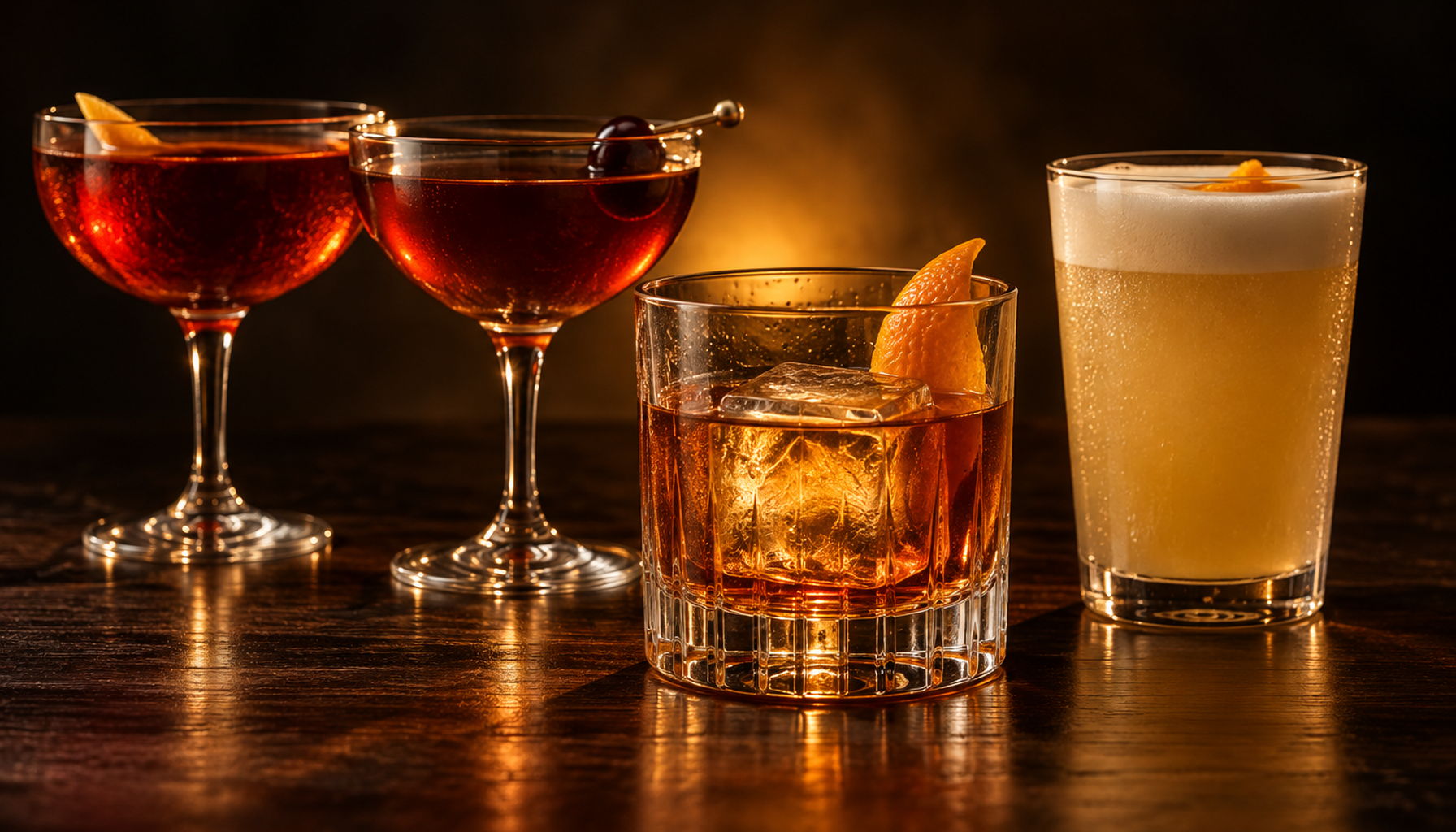
A cocktail recipe is a strange document. It tells you, to a quarter-ounce, what somebody else poured — on a particular day, with a particular bottle, over particular ice, for a particular palate. Then it hands you the number as though it were a law.
It isn’t. It’s a coordinate. It records where one person found balance.
Your bourbon is not their bourbon. Your vermouth has been open three weeks. Your ice is wetter. Your palate is, with complete certainty, not theirs. Follow the coordinate exactly and you will reliably produce a drink that was balanced somewhere else.
DON'T MEMORIZE THE RECIPE.UNDERSTAND THE DRINK.
This Master Class is not a collection of recipes. Recipes appear in it constantly, but only ever as teaching instruments — each one chosen because it isolates something. The actual curriculum is cocktail fluency through bourbon: knowing what every ingredient is structurally doing, how your specific bottle changes the balance point, how to tell which variable is wrong when a drink disappoints you, and how to change one thing at a time until it’s right.
The end state isn’t a repertoire. It’s the ability to taste a drink, name the problem, and fix it.
Part I · Before the Recipe
Why humans started mixing spirits at all.
Every mixed drink is an answer to the same question: raw spirit is difficult. It is hot, strong, and — before modern production — frequently rough. Everything we do to it is an attempt to make it more drinkable, more interesting, or both.
The answers arrived as two separate lines, and almost every popular account collapses them into one.
The punch line came first. Punch is generally traced to English sailors and merchants in the India trade in the early 1600s — on the best available account, the first spirits-based mixed drink we have record of, improvised where beer and wine weren’t available. That reconstruction is David Wondrich’s, and it is a scholarly argument from fragmentary evidence rather than a settled date. Its structure is spirit, citrus, sugar, water and spice, served large and shared.
The toddy line is the other one, and it’s the one that matters most here. A toddy is spirit, sugar and water — dilution and sweetening, nothing else. A sling adds aroma, typically grated nutmeg. And then:
- Toddy Spirit + sugar + water. Dilution and sweetening only
- Sling The same, plus an aromatic
- Cocktail The same, plus bitters
The only structural difference between a toddy and a cocktail is bitters.
These two lines are parallel, not sequential. The cocktail is not a descendant of punch — punch is large-format and citrus-driven; the cocktail is small-format, spirit-forward and originally contained no citrus at all. They are cousins that happen to share a century.
Part I
What “cocktail” actually meant.
On 13 May 1806, a reader of The Balance and Columbian Repository in Hudson, New York wrote in to ask what a word in the previous week’s paper meant. The editor’s answer is the founding document of the whole category:
“a stimulating liquor, composed of spirits of any kind, sugar, water, and bitters.”
Three things about that definition get lost in retelling.
It describes one specific drink, not a category. In Jerry Thomas’s 1862 How to Mix Drinks — the first American cocktail book — the Cocktail is one chapter among many, sitting alongside Punch (by far the largest section), Cobbler, Sour, Fix, Flip, Sling, Toddy, Sangaree, Julep, Fizz, Smash, Crusta and Daisy. It was a peer of the julep, not its parent.
It wasn’t a whiskey drink. The original Cocktail was made for the most part with Dutch-style gin. American whiskey came to the format later. Bourbon inherited the cocktail; it didn’t invent it.
And the word swallowed everything else. Somewhere between the early 1900s and the 1920s — when “cocktail lounge” became an acceptable synonym for “bar” — “cocktail” stopped meaning spirit-sugar-water-bitters and started meaning any mixed drink. No source gives a clean date for that shift, and anyone who offers you one is guessing.
Part I
Whiskey takes over — and the thing that made it possible.
Before any of this could happen, somebody had to solve ice.
Frederic Tudor shipped his first cargo of Boston ice in 1806 — the same year as the Balance definition, which is a coincidence worth enjoying. By the 1820s he was supplying New Orleans, Charleston and the Caribbean; by the 1850s ice was standard in American bars. That is the structural reason American drinks diverged from European ones, and it means the entire category rests on a logistics innovation.
Controlled chilling and controlled dilution are the founding variables of the American cocktail, not afterthoughts to it.
The rest of the timeline, with the honest confidence levels attached:
| When | What | How well documented |
|---|---|---|
| 1806 | The Balance definition; Tudor's first ice cargo | Primary / strong |
| 1820s–1850s | Ice becomes reliably available in American bars | Strong secondary |
| 1824 / 1830s | Angostura; Peychaud's in New Orleans | Secondary — 1824 unverified here |
| 1844–1870s | Vermouth reaches America, then becomes a cocktail ingredient | Dates vary by source — treat as a range |
| 1862 | Jerry Thomas: the Cocktail is one chapter among many | Primary |
| Sept 1882 | Earliest known Manhattan reference, the Olean Democrat | Strong secondary |
| 1884 | Byron prints two Manhattans — 1:1 and 2:1 | Primary |
| Feb 1880 / 1888 | First print 'old fashioned cocktails'; first recipe under the name | Secondary / strong |
| 1897–1909 | Bottled-in-Bond, Pure Food & Drug, the Taft Decision | Primary — see Issue No. 002 |
| 1920–1933 | Prohibition | — |
| post-repeal | Rye never recovers; bourbon takes its place in the classics | Consensus narrative, not primary |
| 1960s–80s | Bottled sour mix; vodka eclipses whiskey | Secondary |
| 1987 / 1999 / 2005 | DeGroff at the Rainbow Room; Milk & Honey; Pegu Club | Strong secondary |
That second-to-last line deserves a pause, because it connects directly to our own archive. On the consensus account — which is a narrative historians agree on rather than something we verified in primary sources — rye was the default before Prohibition for Manhattans, Old Fashioneds and Sazeracs, with Pennsylvania and Maryland distilleries far outnumbering the southern bourbon houses. Rye never recovered, and bourbon moved into the classics by default.
Which means: every Old Fashioned you have ever been served with bourbon is, in part, a consequence of the collapse documented in Issue No. 001. The death of Pennsylvania whiskey didn’t just close distilleries. It changed what the canonical American cocktails taste like.
Part II · Anatomy
Bourbon is not a neutral base.
Most cocktail writing treats the base spirit as a volume of alcohol with a flavor attached. For bourbon that is badly wrong, and it is the single most consequential misunderstanding this Master Class exists to correct.
A bourbon arrives in your mixing glass carrying, at minimum:
Proof
Ethanol, which is itself a flavor-perception variable — not just strength
Grain
Rye spice, wheat softness, corn sweetness — the mash bill's signature
Wood
Vanillin, caramel, tannin and color, all extracted from char
Age
How far that extraction has gone, and what oxidation has added
Texture
Viscosity and mouth-coating, strongly tied to proof and entry proof
Every one of those is a decision made years before the bottle reached you — and each is covered in depth elsewhere in this curriculum. The grain is Understanding Mash Bills; the wood, the char and the entry proof are Barrel & Char.
What matters here is the consequence: the same recipe built with two different bourbons is two different drinks, and not in a subtle way. A 94-proof wheated bourbon and a 120-proof high-rye in the same Old Fashioned spec will not merely differ in strength. One will need less sugar; the other will need more. One will carry an amaro; the other will be flattened by it.
Bourbon School What Proof Changes Proof is not a quality score. It changes extraction, texture, aroma delivery and how much dilution a drink can survive.This isn’t theory; it’s our own archive. Issue No. 003 ran one cocktail across three mash bills, Issue No. 005 ran one spec at two proofs, Issue No. 006 ran a control against a double-oaked version of the same whiskey, and Issue No. 008 built the same Manhattan twice and changed only the bourbon. Four experiments, one finding: the base is the loudest ingredient in the glass.
Part II
Sweetness, which is not the same thing as sugar.
The sweetener’s job is not to make the drink sweet. It is to give the bourbon’s rough edges something to sit against, to add body, and — in the case of everything beyond plain sugar — to contribute flavor of its own.
| Sweetener | Beyond sugar | Use when |
|---|---|---|
| Simple syrup (1:1) | Almost nothing — and that's the point | You want a pure control, or the bourbon to carry everything |
| Rich syrup (2:1) | Noticeably more body at the same sweetness | The drink tastes thin rather than under-sweet |
| Demerara / turbinado | Molasses, faint bitterness, depth | Working with oak-forward or high-proof bourbon |
| Honey | Floral aroma, real viscosity, acidity of its own | You want texture as well as sweetness — see Gold Rush |
| Maple | Distinct and assertive; competes rather than supports | You intend to taste it |
| Liqueur | Sugar, flavor and alcohol simultaneously | See the Godfather — this is a structural substitution |
And a critical separation, because it governs everything in Part VII: measured sugar concentration is not perceived sweetness. The same quantity of sugar tastes dramatically different depending on the drink’s ethanol content, acidity, temperature and dilution. A drink that reads “too sweet” may contain less sugar than one that reads “balanced.”
This is also why we are not going to express cocktail sweetness in degrees Brix, despite the temptation. Ethanol has a higher refractive index than water, so a refractometer reads alcohol as though it were sugar — a spirit-heavy, essentially sugar-free batch can return 8–10 Brix. Correction formulas exist only for simple water-sugar-ethanol systems, which a drink containing vermouth, amaro, bitters and citrus is not. Compute sugar from your spec instead. It’s arithmetic you can actually do, and it’s honest about its assumptions.
Part II
Bitterness, and what a dash really is.
Bitters A concentrated, highly aromatic flavoring agent used in small dashes to add complexity and balance to a cocktail — the defining ingredient of an Old Fashioned. Open in Dictionary → are the ingredient people most often believe don’t matter, and the evidence says otherwise.
The sensory literature on mixture suppression — how tastes interfere with one another — shows that small bitter additions measurably reshape how sweet a solution tastes. That is not a metaphor about complexity; it’s a measured interaction. Bitters are a structural ingredient disguised as a seasoning.
Two practical cautions. First, a “dash” is not a unit. Different dasher bottles deliver wildly different volumes, and two dashes from a nearly empty bottle is not two dashes from a full one. If you are running an experiment, count drops or weigh them. Second, bitters work mostly on the nose. Much of what you attribute to their bitterness is aroma arriving before the liquid does.
Worth noting against our own practice: the Ledger’s published Manhattan uses six dashes of Angostura and six of orange — a markedly bitters-forward build by any historical standard. Part VIII comes back to it.
Part II
Acid changes the architecture.
Adding citrus is not adding an ingredient. It is changing what kind of drink you are making.
In an Old Fashioned, sugar’s job is to soften. In a sour, sugar’s job is to counterweight an acid — it stops being a sweetener and becomes one arm of a balance. The technique changes too: acid drinks are shaken, because they need the aeration and the faster, colder, wetter treatment that shaking provides.
The sensory reason is specific: sweet–sour suppression is asymmetric. How much the sweetness is suppressed depends only on the acid level; how much the sourness is suppressed depends on both. Which is why adding sugar to an over-sour drink works better than adding acid to an over-sweet one.
Part II
Modifiers are structural, not flavorings.
A Modifier A cocktail ingredient (vermouth, amaro, liqueur) that adjusts and complements the base spirit's character, rather than serving as the primary flavor itself. Open in Dictionary → is the ingredient most often misunderstood as “another flavor.” It is not. When you add Vermouth A fortified, aromatized wine used as a cocktail modifier — the defining ingredient of a Manhattan, adding sweetness, herbal complexity, and dilution to a bourbon-based stirred drink. Open in Dictionary → to whiskey you are adding, in one pour: sugar, acidity, botanicals, water, oxidative character — and a large volume of something at roughly 16–18% ABV, which drags the whole drink’s strength down.
That last point is the one that matters. A syrup occupies 1–2% of a drink’s volume. Vermouth occupies 25–33%. It dilutes as it sweetens. Change a Manhattan’s ratio and you have moved four variables at once, which is precisely why ratio arguments about Manhattans never end.
| Modifier | Brings | Watch for |
|---|---|---|
| Sweet vermouth | Sugar, acid, botanicals, water, lower ABV | Oxidation — it is wine. Refrigerate it; replace it monthly |
| Dry vermouth | The same, drier and more herbal | Oxidizes faster than sweet |
| Amaro | Bitterness plus sweetness plus botanical intensity | Will dominate if treated as a vermouth substitute |
| Liqueur | Concentrated flavor, high sugar, real alcohol | Sweetness and flavor cannot be adjusted independently |
| Oloroso sherry | Nut, dried fruit, oxidative depth, low sugar | Our own most-used modifier — see Part VIII |
Part II
Aromatics, and the ingredient you throw away.
Most of what you call taste is smell, which makes the expressed citrus peel one of the highest-leverage moves available — and the only ingredient commonly discarded after use.
Squeezing a peel over the surface sprays a fine layer of volatile oil across the drink. You then meet that oil before the liquid, on every sip. A rinse works the same way from the other direction: a few milliliters of absinthe swirled and discarded leaves an aromatic film that flavors the nose without adding measurable volume.
We’ll be honest about the evidence level here: the mechanism is well understood and consistent with what’s known about aroma delivery, but we found no quantified study measuring how much expressed oil reaches the nose. Treat it as sound reasoning rather than a measurement.
Part II
Texture is an independent variable.
A drink can be correctly balanced for sweet, sour and bitter and still feel wrong — thin, watery, hollow. Texture is its own axis, and it has its own levers: rich syrup instead of simple, honey instead of sugar, a higher-proof base, less dilution, egg white, or a few drops of saline.
The egg case is real chemistry rather than mystique. Egg white is roughly 90% water and 10% protein; vigorous shaking denatures those proteins, exposing regions that bind the spirit’s oils and the citrus compounds and hold air in a stable foam. A whiskey sour with egg white — a Boston Sour — adds no flavor worth naming. It changes how the drink feels, which is the entire point.
Part III · Water, Ice & Temperature
The ingredient nobody measures.
Here is the fact that reorganizes everything you think you know about ice, shaking and stirring. It is measured, not asserted, and once you have it the rest of this section is mostly consequences.
Ice does not chill a drink by being cold. It chills a drink by melting. Warming one gram of ice from 30°F up to its melting point at 32°F absorbs about half a calorie; melting that same gram absorbs about eighty. Even ice straight from a domestic freezer delivers roughly ninety per cent of its cooling through melt.
Which means the cold is paid for in water. There is no other currency.
The coupled variable
Chilling and dilution are the same event.
Ice cools by melting. The cold is paid for in water.
You can choose how cold. You cannot separately choose how wet.
Dave Arnold puts it in one line: “There is no chilling without dilution. There is no dilution without chilling.” And the measurement most worth remembering is this — drinks that reach the same temperature by different routes arrive with the same dilution, regardless of method or how long it took.
You can choose how cold your drink is. You cannot separately choose how watered it is.
One more number, because it demolishes a very common rule: Arnold explicitly rejects the idea that there is a standard dilution. “Many folks think all drinks should be diluted some standard amount; 25% is often bandied about. Not true.” His own preferred Manhattan sits around 50% — considerably wetter than the rule of thumb most bartenders quote.
Part III
Ice, and the myths attached to it.
“Large ice doesn’t dilute” is false as stated, and useful as meant. Given the coupling above, large ice cannot dilute less for a given amount of chilling — that is thermodynamically impossible. What it does is chill and dilute more slowly. Arnold’s own data shows the cost: stirring with large ice took 220 seconds to reach only 25°F, while smaller ice plateaued faster and colder.
So a drink stirred briefly over large ice ends up both warmer and less diluted than one stirred over small ice. That’s a real and useful effect. It just isn’t immunity.
Two more, handled honestly:
Clear ice. Directional freezing produces genuinely clearer ice by pushing dissolved gas and impurities out of the freezing front. Camper English, who popularized the technique, is careful about the benefit: it is “a little bit harder and melts slower, though it’s really an aesthetic choice.” The widely circulated test purporting to prove dramatic melt resistance compares a regular cube to a clear sphere — confounding clarity with shape and size, so it proves nothing about clarity. Make clear ice because it looks beautiful. That’s a sufficient reason.
Ice temperature beats ice shape. Wet machine ice sitting near 32°F dilutes notably more than dry freezer ice. And counterintuitively, super-frozen ice chills more slowly — it has to warm toward 32°F before it can melt efficiently, and melting is where the cooling comes from. Reading those sources together, our own ranking of what actually matters runs: temperature and wetness first, then size, then clarity, then shape. That ordering is the Ledger’s synthesis of several sources, not a finding any one of them states.
Part III
Stirred versus shaken, minus the clichés.
The measurable differences are real but narrower than the folklore suggests.
| Stirred | Shaken | |
|---|---|---|
| Time to equilibrium | Slow — Arnold recommends ~45 seconds | 12–17 seconds |
| Final temperature | 27 to 23°F typically | 19 to 18°F |
| Aeration | Essentially none | Dense fine bubbles, visible at 200× magnification |
| Clarity | Clear | Cloudy — from entrained air, which straining cannot remove |
“Never shake whiskey” is wrong as physics and right as practice. There is no mechanism by which shaking damages a spirit; “bruising” describes nothing. But in Arnold’s own blind test — nine bartenders and colleagues tasting blindfolded, not a formal sensory panel — every one of them could distinguish shaken from stirred, and “almost always we liked the stirred ones” for spirit-forward drinks. The convention is sound. The reason usually given for it is not.
That distinction — right rule, wrong explanation — is worth carrying. It appears repeatedly in cocktail lore.
Part III
The life of a cocktail.
A drink is not a fixed object. It is a process that happens to be briefly delicious.
We want to be straight with you about the limits here: no published measurement exists for how a finished drink’s temperature, dilution and strength change minute by minute in the glass. We looked. What follows is therefore a direction of travel, with exactly two claims attached to it — one measured, one our own single observation.
Direction of travel · no numbers on purpose
A cocktail is never the same drink twice in one sitting.
Temperature
Rising from the moment it's poured
Dilution
Rising with it — the same event, as above
Strength
ABV falls as water arrives
Perceived sweetness & bitterness
Cold suppresses both; warming releases them
Those two rising curves — dilution and perceived sweetness — move in opposition. Dilution pushes flavor down while warming pushes perception up. That tension is the real explanation for the most common experience in cocktail drinking: it was perfect for about three minutes.
Part IV · The Family Tree
One question sorts almost everything.
We built a cocktail taxonomy for this Master Class, looked at it properly, and threw it away. It’s worth saying why, because the failure is instructive.
Our first draft sorted drinks into seven families: Old Fashioned, Manhattan, Sour, Liqueur, Highball, Julep/Smash and Punch. The problem is that those categories sort by three different rules at once. Old Fashioned, Manhattan and Sour sort by ingredients. Julep/Smash sorts by technique. Punch sorts by format and scale. A reader cannot internalize a system where the sorting rule changes between rows — they’ll memorize the list instead of understanding it, which is the exact failure this Master Class exists to prevent.
So here is the replacement, and it rests on one question.
Architecture, not ingredients lists
One question sorts almost every bourbon cocktail.
Acid?
Does the drink contain citrus or another acid?
No
Aromatic
Stirred. Spirit-forward, clear, served cold and strong.
Old Fashioned family
spirit + sweetener + bitters
Change the sweetener, change the name:
The Sazerac belongs here too, but varies a different slot — it swaps the bitters and adds an absinthe rinse while leaving the sweetener alone.
Vermouth family
spirit + aromatized wine + bitters
Change the bitter element, change the name:
Kept separate from the Old Fashioned family because vermouth is wine: it brings acidity, oxidative character and a quarter to a third of the glass at 16–18% ABV. A syrup does none of that.
Highball family
spirit + non-alcoholic lengthener
Change the lengthener, change the name:
Yes
Sour
Shaken. Acid demands aeration, speed and more dilution.
Sour family
spirit + acid + sweetener
The same slot, the same mechanism:
Three more belong here but vary something other than the sweetener: the Brown Derby keeps the honey and swaps lemon for grapefruit, the Boston Sour adds egg white for texture, and the New York Sour floats red wine. None is a new family — each is a Whiskey Sour with one thing changed.
Cross-cutting — these are not families
- Julep and Smash — techniques (crushed ice, muddled aromatics), and a technique can be applied across families.
- Punch — a format and a scale, not an architecture. A punch can be a sour.
- “Liqueur drinks” — look at the fills above: a liqueur sweetens the Godfather on the left and the Paper Plane on the right. It is a mechanism that operates inside families, never a family of its own.
- “Equal parts” — a ratio, not an architecture. The Boulevardier and the Paper Plane are both 1:1:1 and sit on opposite sides of the split.
That one question — is there acid? — determines technique, texture, glassware, dilution target and serving temperature. It is the highest-information binary available.
The graphic makes the case about liqueurs on its own, and three independent sources agree with it. Cocktail Codex treats a liqueur-as-sweetener as an Old Fashioned variation — their worked example, the Monte Carlo, is structurally a Godfather with the bitters kept. Gary Regan names the same move on the sour side. And Difford’s Guide says it almost verbatim about our case study: “The Godfather is basically a Scotch whisky-based Old Fashioned sweetened with flavorsome liqueur rather than relatively flavorless sugar.”
Two caveats we’ll own, because the difference between a sourced taxonomy and a house one matters.
The acid split itself is not ours — it is essentially David Embury’s 1948 division into aromatic and sour types, and we are elaborating a structure that already existed rather than proposing a new one.
The family divisions inside each branch are our judgment, and at least one of them is contested. Cocktail Codex would fold our Vermouth family into the Old Fashioned family; we keep it separate for the reason stated in the graphic. That is a defensible reading, not a settled fact, and you should treat it as the Ledger’s organizing choice rather than as how cocktails are classified.
Part V · The Classics as Experiments
Ten drinks, each adding exactly one variable.
What follows is a curriculum, not a recipe collection. The order matters: each drink introduces one new thing, and nothing introduces two.
| # | Drink | The new variable |
|---|---|---|
| 1 | Whiskey Highball | Dilution and carbonation, with nothing else in the way |
| 2 | Old Fashioned | Sugar and bitters — the control experiment |
| 3 | Sazerac | An aromatic rinse; a second bitters tradition |
| 4 | Manhattan | A fortified-wine modifier — four variables in one pour |
| 5 | Boulevardier | A competing bitter modifier |
| 6 | Whiskey Sour | Acid — the architecture changes |
| 7 | Gold Rush | Sweetener as texture |
| 8 | Paper Plane | Equal parts, four-way balance |
| 9 | Mint Julep | Dilution and temperature as the point |
| 10 | Godfather | One ingredient carrying sweet, flavor and alcohol at once |
1 · The Whiskey Highball. The simplest architecture there is, and the one most cocktail curricula skip. Bourbon and soda over ice isolates dilution and carbonation with nothing else competing. We’ve already published the case for it: Issue No. 009 built a highball specifically because a Manhattan’s vermouth and bitters would have masked the yeast signal being tested. If you want to know what a bourbon actually tastes like in a mixed drink, this is the format that tells you.
2 · The Old Fashioned. The control. Spirit, sugar, bitters, water — the 1806 definition, still standing. One historical correction worth carrying: “old fashioned” was originally an adjective, a request for the cocktail made the old way, in protest against 1870s bartenders adding maraschino, absinthe and Chartreuse. The name is a reaction; the formula is the original.
3 · The Sazerac. Structurally an Old Fashioned with two substitutions in the seasoning slot: Peychaud’s instead of Angostura, plus an absinthe rinse. It teaches the rinse — aroma contributed at negligible volume — which nothing else in the sequence covers. On its history, the tidy “Peychaud invented it in 1838” line is a traditional story; the better-supported and frankly better narrative is that it began as a cognac drink and switched to rye in the 1870s–80s after phylloxera destroyed French vine stock. The spirit swap was forced by an agricultural disaster.
4 · The Manhattan. The modifier experiment, and the best teaching drink in the set. O.H. Byron’s 1884 Modern Bartenders’ Guide prints two Manhattans — one at equal parts whiskey and Italian vermouth, one at 2:1 specifying French vermouth. So the drink began at 1:1, drifted to a 2:1 standard, and has drifted drier since.
5 · The Boulevardier. Bourbon, sweet vermouth and Campari — and the clearest documented case in cocktail history of the canon being deliberately revised. It appears in Harry McElhone’s Barflies and Cocktails (Paris, 1927), credited to Erskine Gwynne, at equal parts. In 2007 Ted Haigh revived it at 3:2:2, and that revision became the modern standard.
Somebody decided the 1927 recipe was under-whiskeyed, changed it, and the world agreed. That is this entire Master Class in one drink.
It also teaches the structural problem your draft recipes will keep hitting: at 1:1:1, the bourbon is only a third of the glass. This is where “the bourbon disappeared” actually comes from.
6 · The Whiskey Sour. Acid arrives and the architecture changes — shaken, colder, wetter, and sugar is now a counterweight rather than a softener. Common modern ratios run around 2:1:1 (spirit : citrus : sweet), though 3:2:1 and others circulate widely. A caution on provenance: the near-universal claim that it appears in Jerry Thomas’s 1862 guide is contested — at least one source that checked the original reports it isn’t there, and 1862 does contain Brandy and Gin Sours. We’re not printing the 1862 attribution.
7 · The Gold Rush. Bourbon, lemon, honey — three ingredients, created by T.J. Siegal at Milk & Honey in the early 2000s. Its job here is to show that a sweetener is not interchangeable: honey brings floral aroma, its own faint acidity, and real viscosity. Swap in simple syrup at the same sweetness and the drink doesn’t just taste different, it feels thinner.
8 · The Paper Plane. Sam Ross, 2008 — bourbon, Aperol, Amaro Nonino and lemon in equal parts, built as a riff on the Last Word. Two lessons. First, four-way equal-parts balance only works when the ingredients are chosen to cancel each other. Second, and better: Ross’s original used Campari, and he swapped it for Aperol to reduce the bitterness. That’s a documented single-variable correction by the drink’s own creator — the method in this Master Class, performed in public, by someone who wasn’t calling it a method.
9 · The Mint Julep. First in print in 1803, which makes it older than the cocktail. Bourbon, sugar, mint, and a mountain of crushed ice. Crushed ice has enormous surface area, so it chills very fast and dilutes heavily — and that is the design, not a flaw. The honest lesson is uncomfortable: the julep buries the bourbon. It is a magnificent drink and a poor way to taste whiskey. Knowing which of your drinks reveal the spirit and which conceal it is itself fluency.
10 · The Godfather. Last, because it’s the only drink in the sequence where a single ingredient supplies sweetness, flavor and alcohol simultaneously — and you can’t adjust any one of those without moving the other two.
Part VI · Ledger Lab
The Godfather, as an open experiment.
Everything up to here is settled enough to teach. This part isn’t, and we’re publishing it anyway — as a live protocol rather than a result.
First, the history, because it’s more interesting than the folklore.
| When | Source | Spirit : amaretto | Bitters |
|---|---|---|---|
| 1976 | Brian F. Rea, Brian's Booze Guide — earliest found | 3 : 2 | none |
| 1986–2020 | IBA official (delisted 2020) | 1 : 1 | none |
| current | Disaronno (the brand's own) | 2 : 1 | none |
| current | Difford's Guide | 3 : 1 | optional, plus orange zest |
| 2016 | Michael Dietsch | 4 : 1 | — |
Nobody knows who invented it. The film connection is chronologically plausible — Puzo’s novel 1969, Coppola’s film 1972, the drink appearing on menus in the 1970s — but no source produces a menu, advertisement or column tying the name to the film. Disaronno itself denies creating it. The Brando story is apocryphal, and we found no instance of the brand asserting it as fact.
And the finding that reframes this whole section: a bourbon Godfather is documented in 1977, and it has a period name. Stan Jones’s Complete Barguide records that made with bourbon instead of Scotch, “it’s simply The Boss.” Bourbon enters the printed record within a year of the earliest Scotch version. We are not taking a liberty with somebody’s classic. There has been a bourbon version almost as long as there’s been a drink.
Part VI
The protocol.
Two controls, because there are two legitimate starting points and they answer different questions.
Ledger Lab — Open Experiment
Control A — The Historical
Ingredients
- 1½ oz blended Scotch
- 1 oz amaretto (Disaronno)
- 1 large cube
Method
- Build over ice and stir briefly.
The earliest attested spec — Rea, 1976. No bitters, because no historical Godfather has them. This is the baseline the drink actually started from.
Ledger Lab — Open Experiment
Control B — The House
Ingredients
- 2 oz bourbon
- 1 oz amaretto (Disaronno)
- 2 dashes Angostura bitters
- 1 large cube
Method
- Stir with cold ice, strain over one large cube.
The Ledger editor's long-standing house drink, stated accurately: Disaronno's own recommended ratio, with bitters added. Published as a control to be tested, not as a recommendation.
Then change one thing at a time, in this order. Hold the amaretto brand constant throughout — sweetness and intensity vary substantially between brands and no published sugar figures exist for any of them, so a brand swap mid-experiment would invalidate everything downstream.
Ledger Lab Card
The Godfather — open protocol
Open experiment — result not in
- Question
- What is the right Godfather for this bourbon?
- Constant
- Disaronno. One large clear cube. Same stir count. Same glass.
- Variable 1 — bourbon
- Four structurally different bottles, deliberately spanning proof as well as flavor: a soft/wheated, a high-rye, an oak-forward mature, and a high-proof.
- Variable 2 — ratio
- 1:1 · 3:2 · 2:1 · 3:1 · 4:1 — every rung attested in a datable source, so none is filler.
- Variable 3 — bitters
- None (the historical baseline) · Angostura · orange. Hold any citrus twist constant, or it confounds the orange arm.
- Variable 4 — dilution
- Held constant during the ratio and bitters phases, then tested separately.
- Score on
- Bourbon visibility · sweetness · almond dominance · oak · spice · heat · texture · finish · balance · change over dilution
- Result
- Ledger spec
One published hypothesis is worth carrying into the tasting, and no more than that. Jeffrey Morgenthaler’s well-known argument about the Amaretto Sour is that cask-strength or high-proof bourbon is what keeps amaretto from tasting one-dimensional and candy-like. It is the only serious published work we found on bourbon–amaretto balance, and it transfers to this drink — but it is a hypothesis about a different cocktail, untested here. Do not let it pre-decide the result; it is a reason to include a high-proof arm in the protocol, not a prediction about which arm wins.
THE POINT ISN'TWHICH RATIO WINS.
It’s why it wins — and the answer will almost certainly be different for a 94-proof wheated bourbon than for a 120-proof high-rye. That’s not a hedge. That’s the thesis.
Part VII · Diagnosis
What to do when the drink is wrong.
This is the most useful page in the Master Class, and it works on one principle: a symptom is not a cause. Most cocktail advice pairs a complaint with a single fix, which is why people ruin their next three attempts — they correct the wrong variable confidently.
Diagnosis before correction
A symptom is not a cause, and most symptoms have several.
Too sweet
- Too much sweetener
- Under-diluted, so everything is concentrated
- Low-proof base — less ethanol bite to offset sugar
- Served too warm: warmth raises perceived sweetness
Add a few drops of water and taste again. If it improves, dilution was the problem, not sugar.
If water fixed it, stir longer. If not, cut the sweetener by a quarter — not half.
Too hot / too boozy
- High-proof base with a spec written for 90 proof
- Under-dilution
- Not cold enough — cold suppresses burn
Check the arithmetic: compute pre-dilution ABV before blaming the recipe.
Stir longer before cutting the bourbon. Dilution and temperature usually fix this without touching the ratio.
Thin / watery
- Over-dilution
- Simple syrup where rich syrup belonged
- Low-proof base
- Drink has been sitting
Make it again and taste at 30 seconds. If that version is right, the problem is time, not the spec.
Rich (2:1) syrup instead of simple, or a higher-proof base. Shorten the stir.
The bourbon disappeared
- Modifier is too large a fraction of the glass
- Modifier is too assertive (amaro treated as vermouth)
- Base too low-proof to carry it
Rebuild at a drier ratio — go from 2:1 to 3:1 and change nothing else.
Raise the ratio or raise the proof. Both work; they are not the same fix.
Too bitter
- Too many dashes — or a fuller dasher bottle than last time
- Bitter modifier competing with bitters
- Under-sweetened
Add a quarter-teaspoon of syrup. Sweetness is the strongest suppressor of bitterness.
Sugar first, bitters second. Measured mixture-suppression behavior is on your side here.
Muddy — nothing stands out
- Too many ingredients doing the same job
- Two modifiers in the same register
- Everything balanced to the point of cancellation
Rebuild omitting one ingredient entirely. If you can't tell it's gone, it wasn't earning its place.
Remove, don't add. Muddiness is almost never solved by another ingredient.
Great first sip, bad finish
- Over-dilution arriving late
- Sweetness that reads clean cold and cloying warm
- Large cube melting faster than expected
Taste the same drink at 1, 4 and 8 minutes and write down where it turns.
Serve colder, serve smaller, or cut the sweetener. See Part III — this is the two-curves problem.
Bad first sip, improves later
- Under-diluted at the point of service
- Too cold, suppressing everything
- High-proof base needing more water than you gave it
Stir an extra 10 seconds next time and taste immediately.
More dilution up front. This is the easiest fault to fix and the most commonly misdiagnosed as 'too strong a recipe'.
Part VIII
The house style we never wrote down.
Before telling anyone else how to build a cocktail, we turned the microscope on ourselves: ten issues, ten published drinks, read as data rather than as a back catalogue.
A template emerges that nobody ever sat down and decided on.
- 2 oz of bourbon — in all ten
- A sweetener at ¼ oz or 1 tsp — usually demerara
- Oloroso sherry as the modifier — 4 of 10
- Black walnut bitters — 4 of 10
- Angostura and orange bitters as the default pairing
- An expressed citrus peel, almost always orange
- One large cube
- Stirred — 10 of 10. Never once shaken
TEN DRINKS.NOT ONE CONTAINSCITRUS JUICE.
Every cocktail this publication has ever printed sits in the aromatic branch of the tree in Part IV. We have never published a sour. Not once, across ten issues, did anyone ask whether a drink wanted aeration — the answer was stirred before the question was put. Our Manhattan in Issue No. 008 carries twelve dashes of bitters across four ounces, which is a markedly bitters-forward build that arrived as a habit rather than a decision.
That is a palate. It emerged organically, it is internally consistent, and it rests on a real conviction — that bourbon is the most interesting thing in the glass and everything else exists to reveal it. The highball in Issue No. 009 is that conviction at its purest.
But a palate reported as a rule is how bad cocktail writing happens. So, explicitly:
| The Ledger tends to… | …which is not a finding about cocktails |
|---|---|
| Stir everything | Shaking is correct whenever there's acid. Our archive has no sours, so our record is silent on shaking — not evidence against it. |
| Pour 2 oz of bourbon | A house format for tasting one whiskey clearly. It is not a balance point, and plenty of good drinks aren't built on it. |
| Reach for oloroso | A preference we stopped noticing. Vermouth, amaro and a plain syrup each do a different job better. |
| Sweeten with demerara | It suits oak-forward bourbon. It is the wrong choice when you want the sweetener to disappear. |
| Load the bitters | Twelve dashes is our taste. Byron's 1884 Manhattan had none specified at all. |
| Serve on one large cube | A rate decision, not a quality one — and Part III is clear that it buys time rather than immunity. |
Part IX · Build Your Own
Start with the bourbon, not the cocktail.
The standard approach is backwards. People ask “what cocktail should I make?” and then go looking for a bottle to put in it. Reverse it.
Step one: taste the bourbon neat. Not as a ritual — as data collection. You are looking for specific things, because each one implies a different decision later.
| What you're noting | What it tells you about the drink |
|---|---|
| Nose | What a rinse or expressed peel will have to compete with |
| Entry and mid-palate | Whether there's enough mid-weight to carry a modifier |
| Finish length | Short finish wants less dilution; long finish can take more |
| Sweetness | How much sweetener the drink will actually need |
| Oak and tannin | Heavy oak plus heavy amaro equals mud |
| Spice | Rye spice is amplified by bitters, softened by sweetness |
| Proof and heat | How much water the drink can take before thinning |
| Texture | Whether you need rich syrup or can use simple |
Step two: decide what you want to do to it. This is the conceptual shift the whole Master Class is built toward. Not what cocktail can I make? but:
WHAT DO I WANT TO PRESERVE,SUPPRESS, OR AMPLIFY?
Preserve the oak. Soften the heat. Amplify the rye spice. Contrast the sweetness. Build texture. Brighten it. Keep the bourbon unmistakably in front.
Step three: choose the architecture that does that job. Now the family tree earns its keep — and the Bourbon School lesson on choosing a cocktail covers this decision in its own right.
| If you want to… | Reach for |
|---|---|
| Taste the bourbon as clearly as possible | Highball — nothing else gets out of the way this completely |
| Amplify what's already there | Old Fashioned, with a sweetener that echoes the whiskey |
| Add complexity without competition | Old Fashioned family with a low-volume modifier — a teaspoon of oloroso |
| Build weight and savory depth | Vermouth family — but mind the ratio, the base can vanish |
| Contrast and brighten | Sour — acid changes everything, deliberately |
| Soften a hot, high-proof bourbon | More dilution first, more sugar second |
Step four: build a defensible control — a historically or structurally sound starting ratio, not a guess. Step five: change one variable.
The Ledger Lab Method
Six steps, and only one of them involves changing anything.
- 01 Control Build a defensible starting spec. Write it down.
- 02 Diagnose Taste it and name the problem in one phrase.
- 03 Hypothesis State what you think is causing it — before you change anything.
- 04 One variable Change exactly one thing. Not two.
- 05 Retest Taste side by side against the control, in a fixed order.
- 06 Lock Record the spec, or go back to 02 with what you learned.
A locked spec becomes the control for the next question.
Rules that keep it honest
- State the hypothesis before tasting. Written down, it cannot quietly change to match the result.
- Change one variable. If you change two, you have learned nothing about either.
- Hold brand, ice format and stir count constant — these are variables whether you intended them or not.
- Score before you discuss. Groupthink is real, and bourbon people are not magically immune to it.
- Record how many times you made it. One tasting is one tasting, and should be labeled as such.
- A spec is WORKING until you have tasted it, and TESTED only after. Never relabel without new evidence.
This is not a new method. It’s what the Bourbon School lesson on tasting already teaches, and what this publication has been doing in cocktails since Issue No. 003 without ever naming it. Eight published experiments have used it. Giving it a name just means the next one doesn’t have to re-explain itself.
Part X · Advanced Fluency
Ratios, split bases, and the arithmetic.
Ratio thinking. A ratio isn’t a magic number, it’s a statement about who is in charge. 2:1 says the base leads and the modifier answers. 3:1 says the base dominates. 1:1:1 says nobody is in charge, which is a legitimate choice and a harder one to balance. The useful habit is to stop memorizing numbers and start reading them as a claim about hierarchy.
Split bases. Our own best worked example is The Inheritance, from Issue No. 010 — one ounce of Knob Creek 9 Year at 100 proof and one ounce of Elijah Craig Small Batch at 94, with oloroso, rich demerara and Angostura. The editorial reason was that the issue was about two branches of one family. The structural reason is more interesting, and it’s recorded in the issue: Knob Creek brought firmer oak, leather and a rye-driven finish; Elijah Craig brought creamier vanilla, caramel and softer spice. At equal parts, each covered the other’s weak spot.
That’s the case for a split base in general. Two bourbons outperform either alone when their weaknesses are in different places — and not otherwise. Two similar bourbons just make a more expensive version of one of them.
Proof engineering. Two formulas, and then a result worth the arithmetic:
Pre-dilution ABV = Σ(volume × ABV) ÷ Σ(volume) Final ABV = pre-dilution ABV ÷ (1 + d), where d is water added as a fraction of pre-dilution volume
Realistic d: roughly 0.25–0.35 for a stirred spirit-forward drink by common convention, though Arnold’s measured Manhattan sits at 0.50; 0.50–0.65 for a shaken sour.
Now apply it to the Godfather, holding everything constant except the thing being tested. Assume a 100-proof bourbon, Disaronno at 28%, and a stirred d of 0.30:
| Ratio | Pre-dilution | In the glass |
|---|---|---|
| 1 : 1 | 39.0% | 30.0% |
| 3 : 2 | 41.2% | 31.7% |
| 2 : 1 | 42.7% | 32.8% |
| 3 : 1 | 44.5% | 34.2% |
| 4 : 1 | 45.6% | 35.1% |
Now hold the ratio at 2:1 and change only the bourbon:
| Base | Pre-dilution | In the glass |
|---|---|---|
| 80 proof | 36.0% | 27.7% |
| 100 proof | 42.7% | 32.8% |
| 120 proof | 49.3% | 37.9% |
Put those two spans on the same axis and the comparison is the finding:
Calculated, not measured
Changing the bourbon moves finished strength twice as far as changing the ratio.
Change the ratio
The full historical ladder, 1:1 through 4:1, with the bourbon fixed at 100 proof.
≈ 5.1 points of finished ABV
Change the bourbon
80 to 120 proof, with the ratio fixed at 2:1.
≈ 10.2 points of finished ABV
Run It Yourself
A side-by-side you can actually do.
Four glasses, one bourbon, one afternoon. This is the smallest experiment that tests the prediction above.
- 1. Fix everything except ratio. One bourbon at a stated proof, one amaretto, the same ice, the same glass, the same stir count. Write the bourbon and proof down before you start.
- 2. Build four drinks at 1:1, 2:1, 3:1 and 4:1. Use the same total volume each time so dilution is comparable.
- 3. Taste them in a random order, not ascending. Ascending order tells you what you expect to find.
- 4. For each glass, score only four things: sweetness, almond intensity, bourbon visibility, and perceived heat. Four axes, not a paragraph.
- 5. Then ask the one question that matters: did perceived heat track the ABV arithmetic, or did it track the sugar?
- 6. Record the bourbon, the date and the room temperature. A result without its conditions is an anecdote.
If perceived heat moves with sweetness rather than with strength, the prediction holds. If it moves with the ABV figures, the arithmetic was the better guide and this section is wrong — which is a result worth having, and one we would print.
What the ratio is actually changing, none of which is visible in an ABV figure:
- Amaretto concentration — the sugar load moves far more steeply than the alcohol does
- Almond and apricot-kernel aroma, which scales with the liqueur, not the proof
- Bourbon visibility — whether oak, grain and spice reach the front of the palate at all
- Modifier dominance — the point where amaretto stops supporting and starts leading
- Relative flavor contribution — which ingredient the drink is 'about'
- How much sweetness there is to be suppressed as the drink warms
So the honest statement of the pair is narrower than it first looks. Proof is the larger lever on finished strength. Ratio is the larger lever on nearly everything you actually notice — and the two are not alternative ways of solving the same problem. If a Godfather is too strong, a drier ratio is a poor tool: it moves the number barely while substantially changing what the drink tastes like.
Two cautions, both of which limit the numbers above rather than extend them. These are calculations, not measurements — a model of mixing and dilution, not a tested cocktail; treat them as a way of thinking, not a result. And ABV predicts strength, not intensity: a 100-proof wheated bourbon and a 100-proof high-rye produce identical arithmetic and completely different drinks.
Part XI · Myths
Claim, reality, why.
| Claim | Reality |
|---|---|
| “Never shake whiskey.” | Right rule, wrong reason. No mechanism damages the spirit — but blind panels distinguished shaken from stirred and preferred stirred for spirit-forward drinks. It's about texture and clarity, not chemistry. |
| “Large ice doesn't dilute.” | False as stated. Chilling and dilution are inseparable. Large ice is slower, not inert — it buys time. |
| “Clear ice melts much slower.” | Overstated. A small real effect; the widely circulated proof compares a cube to a sphere, confounding shape with clarity. Make it because it's beautiful. |
| “25% is the standard dilution.” | Explicitly rejected by the person who measured it. Optimal dilution varies widely by drink. |
| “A Manhattan is always 2:1.” | Byron's 1884 guide prints it at 1:1. 2:1 is a convention that arrived later, and modern practice has drifted drier still. |
| “Bitters don't matter.” | Measured mixture-suppression work shows small bitter additions reshape perceived sweetness. They're structural. |
| “Better whiskey makes a better cocktail.” | Not reliably. A delicate, expensive bourbon can be erased by a modifier that a cheaper, louder one would survive. Function beats prestige. |
| “Cocktails hide bad whiskey.” | Partly historical — speakeasy practice. But a cocktail amplifies structural faults as often as it conceals them; harsh is harsh under sugar. |
| “More ingredients means more sophisticated.” | The opposite, usually. See 'muddy' in Part VII — the fix is removal. |
| “Colder is always better.” | No. Cold suppresses sweetness and bitterness both, and below roughly −4°F a drink is simply painful. |
Part XII · The Practicum
Three labs. Do the work.
Reading this changes nothing. These three exercises are the Master Class.
Lab 01 — The Old Fashioned
Question: Change only the sweetener. What moved besides sweetness?
Taste for
- Same bourbon, same bitters, same ice
- Body and viscosity
- How the finish changes length
- Whether the oak reads differently
Lab 02 — The Godfather
Question: Change only the bourbon at a fixed 2:1. Which one survives the amaretto?
Taste for
- Same amaretto, same ratio, same ice
- Whether the almond dominates or integrates
- Where the bourbon reappears — mid-palate or finish
- Whether high proof genuinely rescues it, as Morgenthaler argues
Lab 03 — your house cocktail. Start from a bottle you actually own. Taste it neat and write the diagnostic. Decide what you want to preserve, suppress or amplify. Choose an architecture from Part IV. Build a defensible control. Then run the loop.
Ledger Lab Card
Bourbon Ledger Lab Card
Working spec — untasted
- Bourbon
- Neat profile
- Goal
- Architecture
- Control
- Problem
- Hypothesis
- Variable changed
- Result
- Final spec
- Score
Go Deeper
- The Balance and Columbian Repository, 13 May 1806 — the first definition (opens in a new tab) "Spirits of any kind, sugar, water, and bitters." The founding document of the category, with the original wording.
- Jerry Thomas, How to Mix Drinks (1862) — EUVS Vintage Cocktail Books (opens in a new tab) The first American cocktail book, digitized. Note how many categories sit alongside the Cocktail chapter.
- Oxford Companion to Spirits & Cocktails — "cocktail" (opens in a new tab) David Wondrich's encyclopedia entry: the Cocktail as one specific gin-based drink, and how the word later absorbed everything else.
- David Wondrich, Punch (opens in a new tab) The case for punch as the first spirits-based mixed drink — and Wondrich's own skepticism about the tidy 'paanch means five' etymology.
- Dave Arnold — Cocktail Science in General, Part 1 of 2 (Cooking Issues) (opens in a new tab) The ice-size stirring experiments behind Part III: big uncracked ice plateaus in a whopping 220 seconds at about 25°F, while small ice passes 32°F in roughly 20 seconds. Also the source for the honest version of the big-rock claim — large ice does dilute less over time, but it will not keep the drink as cold.
- Dave Arnold — Cocktail Science in General, Part 2 of 2 (Cooking Issues) (opens in a new tab) Arnold's own specs and his rejection of a standard dilution — a Manhattan at 50% and a whiskey sour at 63%, both measured as water added as a percentage of the initial mix volume, which is the convention this Master Class uses throughout. Also the shaken-versus-stirred tasting behind "almost always we liked the stirred ones."
- Dave Arnold — The Science of Shaking II (Cooking Issues) (opens in a new tab) Shaking measured for temperature and dilution, with the shakes almost leveled out by twelve seconds. Worth reading for what it refuses to claim: it states plainly that it does not address texture at all.
- Difford's Guide — advanced shaking: tips, myths and lessons (opens in a new tab) Independent corroboration of shake temperatures and the finding that cube size matters less than ice dryness.
- Camper English — clear ice and directional freezing (Alcademics) (opens in a new tab) The authority on clear ice, and notably careful about how small the melt-rate benefit actually is.
- Modulation of taste processing by temperature — American Journal of Physiology (opens in a new tab) Peer-reviewed: cooling measurably reduces perceived sweetness and bitterness. The basis for the two-curves problem.
- Taste mixture interactions: suppression, additivity, and the predominance of sweetness (opens in a new tab) Why sugar is the strongest corrective lever in the troubleshooting matrix.
- Effects of ethanol on flavor perception in alcoholic beverages (opens in a new tab) Ethanol as sweet at low concentrations, bitter and burning higher up — proof as a perception variable, not just a strength.
- Karlsson & Friedman — Dilution of whisky, the molecular perspective (Scientific Reports, 2017) (opens in a new tab) The 'water opens up whiskey' mechanism — a molecular-dynamics simulation, not a sensory trial. Read with the caveat.
- Godfather cocktail — Difford's Guide (opens in a new tab) The 3:1 modern spec, the Rea 1976 citation, and the observation that the Godfather is structurally an Old Fashioned sweetened with liqueur.
- The unlikely comeback of the Godfather — PUNCH (opens in a new tab) Including Disaronno's denial that it created the drink.
- Boulevardier history — Imbibe (opens in a new tab) McElhone 1927 at equal parts, Erskine Gwynne, and Ted Haigh's 2007 revision to 3:2:2 that became the standard.
- The famous cocktail with a bogus origin story — The Takeout (opens in a new tab) Adam Seger's 1995 invention, the fabricated history, and the 2016 confession.
- Issue No. 010 — The Beam Family (opens in a new tab) The Inheritance: the Ledger's own split-base experiment, tested and locked, with the tasting recorded in full.